Residential Area
A Man Called OveThe Residential Area is both a shared neighborhood and the place where Ove gives his principles practical form. Its paths, garages, signs, parking spaces, and waste facilities become objects of daily attention; its houses hold decades of changing residents, alliances, and disputes. The same rules that Ove enforces with ritual exactness also frame the neighborhood’s emergencies and, eventually, the community that gathers around him.
Setting and shared rules
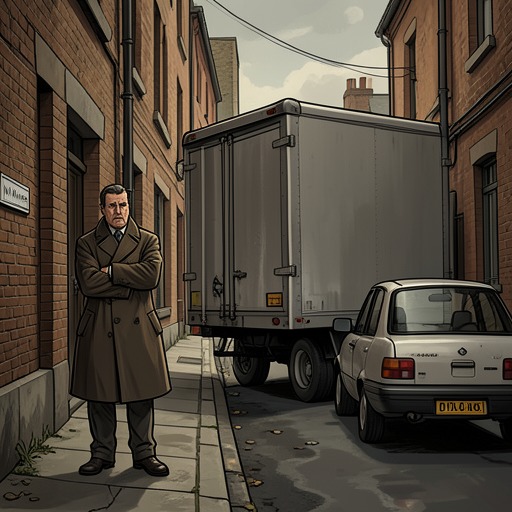
The Residential Area consists of rows of houses joined by small footpaths, a parking area, garages, a bicycle shed, guest parking, and a trash room. A sign at the entrance prohibits motor vehicles from driving inside. Other posted instructions regulate how long visitors may leave cars in the guest parking area and where residents must put their bicycles. These regulations are not incidental scenery: they give the neighborhood a legible order that Ove believes residents must maintain through attention and action.
The place also contains a boundary between older and newer settlement. Ove’s Childhood Home stands on a line between two municipal authorities, at the edge of an old village beside a newer residential development. When Local Council and Administrative Authorities seek to redraw the boundary and acquire the land for demolition, the contrast between the old house and the new construction becomes a conflict over belonging as well as property. Ove refuses to sell, in part because the house is all that remains of his family, and decides instead to repair it. The neighborhood thus joins domestic memory to a changing local landscape.
Ove’s rounds and the maintenance of order
Ove’s inspections give the Residential Area a daily rhythm. He checks the traffic sign by kicking its post, walks along the garages to look for signs of burglary or fire, and tugs three times at his own garage door, where Ove’s Saab is parked. The checks are repeated even though nothing has happened; their point is to ensure that nothing has been overlooked. His method is blunt and physical, but also consistent: the status of things is established by testing them.
The guest parking area extends this routine into the enforcement of shared rules. Ove records every license number in a small pad and compares the day’s list with the previous day’s. If a car has remained beyond the twenty-four-hour limit, he obtains its owner’s details and contacts the person. To him, the rule matters beyond the particular car: ignoring it would mean that everyone could park wherever they pleased. His vigilance is therefore both a practical check and an argument about how common space is to be governed.
He applies the same principle to waste sorting, despite having opposed its introduction. Once the Residents’ Association adopts the requirement, Ove decides that someone must make sure it is followed. In the trash room he checks the bins and separates a jar from its metal lid before putting each in the appropriate recycling container. He locks the room and tugs the door three times. On another round, he finds a bicycle left outside the bicycle shed despite the sign, moves it inside, locks the shed, and tests its handle. He also removes a handwritten notice from the wall, objecting not to the instruction itself but to the use of the wall as an unauthorized notice board.
The inspections are personal as well as procedural. A proposed motion-sensor camera system would have monitored the trash room and parking area, with footage erased after twenty-four hours. Ove casts the sole dissenting vote because he distrusts the Internet and does not want it to watch him disposing of his own rubbish. The cameras are not installed. Ove regards his daily rounds as more effective: they let him see who is doing what and whether the neighborhood is being kept under control. His preference is for direct observation and repeated, tangible checks rather than remote surveillance.
Residents, disputes, and shared history
The houses have accommodated many kinds of residents over nearly four decades. The home between Ove’s and Rune’s has passed through a succession of occupants, including families whose choices about gardens, fences, or house colors became points of neighborhood contention. At the end of the 1980s, an owner rented it to three young men whose parties disrupted nearby homes. Ove went over to intervene; when Sonja later tried to reason with them, they insulted her, and a bottle thrown during the disturbance broke a window at Anita and Rune’s house. The episode shows how a problem in one house could quickly become a matter for the whole block.
Ove and Rune’s relationship is bound to this setting. They had known one another for almost forty years and spent much of that time in conflict, but their neighborhood involvement began in cooperation. Their wives, Sonja and Anita, became close friends after the couples moved into the area at the same time. Ove and Rune helped establish the Residents’ Association, with Ove as chairman and Rune as assistant chairman. They also joined forces when the council proposed cutting down the woods behind their houses to make way for more homes. Through appeals, petitions, legal filings, and letters to newspapers, they opposed the plan until the council abandoned it and built elsewhere. Their victory did not end in simple satisfaction: the two men had found the prolonged campaign itself one of the most enjoyable periods of their lives.
The neighborhood’s rules also become a point of confrontation with public authority. When a man in a white shirt drives into the Residential Area, Ove challenges him over the prohibition on motor vehicles; the man claims he has permission. Later, Ove invokes the posted sign again when challenged over a trailer. His response that there was nothing good on television makes his intervention sound casual, but his insistence is continuous with the inspections: the sign applies whether or not an official claims an exception, and whether or not Ove has anything else to do.
Change, care, and the neighborhood’s later life
The Residential Area is also where Ove’s practical work for other people becomes visible. After Sonja’s accident, he rebuilds the kitchen in Ove and Sonja’s row house, lowering the stove and counter and leaving wheel marks in the floor from the repeated movement of a wheelchair. The altered room records how the house—and the routines within it—had to change. His attention to the built environment is not limited to enforcing its rules; it also takes the form of adapting a home to someone’s needs.
Years later, the same paths where Ove conducts his inspections become a setting for a late-night emergency. After a birthday gathering, he walks with That Stray Cat through the neighborhood on his customary route, checking signposts, garage doors, guest parking, and the trash room. Near a house whose residents are away, he notices figures by a shed and recognizes the sound of someone tapping at a taped window. He calls out and then charges after the intruders. When he collapses in the snow, his last concern is that Parvaneh must promise not to let the ambulance drive between the houses: even in crisis, the traffic prohibition remains part of how he understands his responsibilities to the place.
The routine continues after this episode, but the neighborhood changes around it. Children grow older, Parvaneh’s family celebrates birthdays, and Ove becomes part of their ordinary life: he accompanies a child to school, learns to use a cell phone, and builds a pool for the family’s young son. The block’s continuity is not a matter of keeping every resident or custom unchanged. Instead, shared life accumulates through repeated acts, from practical help to the rounds Ove continues to make.
Almost four years after Parvaneh and Patrick first backed a trailer into Ove’s mailbox, Parvaneh wakes on a snowy November morning and notices that the snow outside Ove’s house has not been cleared by quarter past eight. She enters with the spare key he gave her and finds him dead in bed, with That Stray Cat beside him. The missed snow-clearing is a departure from the pattern that has defined his place in the Residential Area. His absence is first registered not by a formal announcement but by the interruption of a familiar task. In that final contrast, the neighborhood’s routines become a measure of attachment: Ove has been keeping watch over the shared space, and the people who have come to care for him notice when he is no longer there.