Row-House Neighborhood
A Man Called OveThe Row-House Neighborhood begins as a settlement bordered by trees and becomes the stage on which Ove’s private attachments and public routines meet. Its houses and shared ground are never just scenery: they invite regulation, neighborly cooperation, rivalry, and, in time, the recognition of loss. The neighborhood’s history also touches the older place from which Ove came, as development presses against the village at the forest’s edge.
Setting and domestic space
Before the row houses were established, Ove lived in his family’s deteriorating house, a remnant of a small village beside the forest. The house stood on the boundary between two municipal authorities, and the Local Council and Administrative Authorities told him that the land might be taken so the building could be demolished and replaced. New houses and families had arrived nearby, while Ove’s old home seemed out of place. Rather than sell, he decided to repair it. This earlier landscape establishes a recurring tension in the story: development can make a home appear obsolete, but a place may matter precisely because it bears the weight of family and personal history.
The later Row-House Neighborhood is described as newly built and, at first, still surrounded by trees. Ove and Sonja were the first couple to move in; Rune and Anita arrived the same day. Their shared domestic life gives the street its own history, distinct from Ove’s childhood home. The neighborhood is made up not only of separate houses but also of the parking area, gardens, and a narrow lawn behind the houses, places where residents meet and where private disagreements become visible to others.
The interior of Ove and Sonja’s house also records how the home changed to accommodate her after the accident. Ove rebuilt the kitchen himself; its stove and counter were lower than usual, and soft wheel marks crossed the floor, evidence of repeated movement through the room. The Local Council and Administrative Authorities refused to help with the work. Later, the cleared kitchen still held Sonja’s decorative objects, hair clips, and handwritten notes. Its practical alterations and personal traces make the house a record of both the care Ove undertook and the life the couple had shared there.
Rules and shared routines
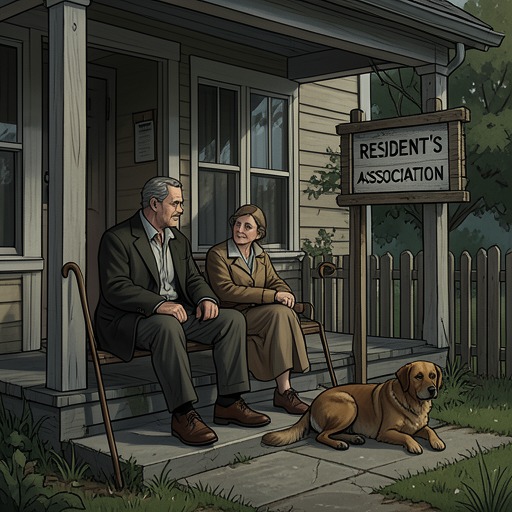
Ove and Rune’s friendship became an organizing force in the neighborhood. After discussing how to manage the arrival of more residents, the two men established rules, put up signs explaining what was allowed, and set up a steering group for the Residents’ Association. Ove became chairman and Rune vice chairman. Their work was practical and sometimes comically officious: they went to the dump together, challenged incorrect parking, negotiated over paint and drainpipes, and watched over a telephone installer despite not knowing exactly how telephone wiring should be done.
The association’s orderliness extended to the lawn behind the houses. About five yards wide, it ran behind Ove’s and Rune’s homes and the house between them. Sonja and Anita called it the neutral zone, though nobody had a clear use for it. Ove, who had always mowed the grass, was designated groundsman while the two men were still friends. When other residents proposed tables and benches to make it a shared gathering place, Ove and Rune rejected the idea, expecting noise and disorder. The episode shows how their version of community depended on cooperation, but also on their power to decide what kind of shared life the neighborhood should permit.
Their routines were not limited to association business. The couples sometimes ate together, while Ove and Rune spent much of the evening standing in the parking area, discussing their cars’ capacity and turning radius. Their friendship had begun as a wary accommodation: Ove lent Rune tools, and a conversation about lawn-mower prices ended with a handshake that felt almost like a business agreement. The detail that Rune drove a Volvo mattered to Ove, but did not prevent the two men from building a durable working companionship.
Conflict and change
The friendship gradually turned into a long rivalry. After Ove and Sonja returned from Spain, Ove laid new paving stones in his garden, Rune built a fence, and Ove raised his own fence higher. Rune then boasted about a small pool for his newborn son, which Ove considered no proper pool at all. The shared lawn remained a point of order: when residents suggested making it a common space, Ove and Rune stopped the proposal. The neighborhood’s small boundaries—fences, lawns, and gardens—gave their arguments concrete form.
Years later, Ove stormed out of a Residents’ Association meeting during another dispute, this time over the collective heating system, and did not return. Their final battle concerned Rune’s robotic lawn mower, ordered from Asia and programmed to make special patterns. Ove noticed that it repeatedly ran outside his and Sonja’s bedroom window at night. One evening Sonja saw him take a screwdriver and go outside; the next morning the mower had ended up in Rune’s pool. The following month Rune entered the hospital for the first time and never bought another mower. Ove understood that their animosity ended there, though the story does not resolve exactly how the machine reached the pool. For Ove, what remained afterward was memory; Rune’s later loss of memory made their shared past increasingly one-sided.
The neighborhood as home and loss
The neighborhood’s ordinary maintenance eventually becomes a measure of whether Ove is still there to perform it. Nearly four years after Parvaneh and Patrick accidentally backed their trailer into Ove’s mailbox, Parvaneh wakes on a cold November morning and notices that the snow outside his house has not been cleared by a quarter past eight. She crosses the road in her dressing gown and slippers, uses the spare key Ove gave her, and finds him lying peacefully in bed with The Cat beside him. The familiar absence of shoveled snow has become the sign that his routine—and his life—has ended.
That final discovery gives the neighborhood’s repeated acts of upkeep a larger meaning. Mowing, clearing snow, maintaining signs, and keeping track of what belongs in shared spaces are practical tasks, but they also make residents legible to one another. Ove’s place in the Row-House Neighborhood is expressed less through declarations than through the work he performs there, the rules he helps establish, the conflicts he cannot leave alone, and the domestic space he adapted for Sonja. By the time Parvaneh notices the untouched snow, the street has become a setting where the absence of one familiar task speaks for an entire life.