Sonja's Grave
A Man Called OveSonja’s Grave is both a place of mourning and the setting for Ove’s continuing conversations with his dead wife. He clears snow from the stone, tends its flowers, and reports the disorder, kindness, and changes of neighborhood life as though Sonja remains his closest confidante. The grave gives his grief a recurring physical form: he comes intending to speak, but the visits repeatedly lead back toward the living people who still need him.
Setting and Ritual
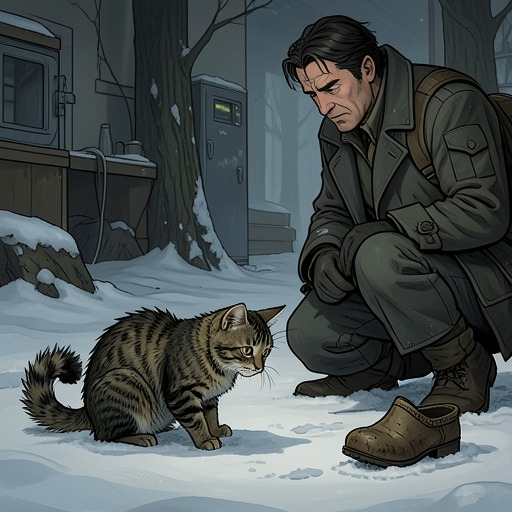
The grave appears in winter scenes as a place Ove reaches by a path from the parking area. Snow gathers over the gravestone and the ground freezes hard enough that tending the flowers requires him to dig. He brushes the stone clean before speaking, making the clearing itself part of the visit: he wants the two of them to see each other properly, even though he knows she cannot answer.
His care is practical and repeated. Ove digs out old flowers, presses new ones into the frozen ground, dusts himself off, and stands before Sonja’s name. On one visit he brings a blue plastic deck chair because he knows the conversation may take time. He carefully brushes away the snow so they can see each other, then explains that he thought he would have more time to do everything. The chair, the flowers, and the deliberate clearing turn an otherwise silent site into a familiar domestic appointment.
The ritual also persists in small gestures that exceed what the task requires. Ove runs his hand over the gravestone again and again, as if trying to rub Sonja back to life; elsewhere, he brushes away snow that has already been cleared. He returns to the same physical acts even when there is nothing left to remove. Repetition gives his love somewhere to go, while making the absence that prompts it impossible to mistake.
A Conversation Across Bereavement
By the fourth year after Sonja’s death, Ove still approaches the grave as someone whose plans must be explained to her. He tells her that he is going to attempt suicide, acknowledges that she would not want it, and steels himself as if she might try to persuade him otherwise. Yet he ends the visit with, “See you tomorrow,” then stamps the snow from his shoes and leaves. The farewell is ordinary in form and consequential in meaning: even while imagining death, he speaks as if another meeting is already arranged.
At other visits, the grave becomes a place to give Sonja news. Ove apologizes for the commotion caused by neighbors who enter his house and interrupt his privacy, presenting the complaint as another update she should hear. He looks toward the stone for agreement, and the narration notes that he knows what her silence would mean. Sonja’s lack of an answer does not end the exchange; their shared history lets Ove imagine the response without words.
The subjects of these conversations include the ongoing effort to protect Rune from being transferred into care. After an official from Social Services arrives and a certified letter confirms the planned transfer, Ove goes to Sonja’s grave and says he is sorry for fighting with people. He tells her that she will have to wait longer for him because he does not have time to die. He then replaces the frozen flowers and folds up his chair. The conversation places private grief beside an urgent obligation to someone still alive: Ove’s intended reunion with Sonja is deferred because Rune needs help.
A Shared Place for the Neighborhood
Although Ove first visits alone, the grave becomes a place where others can bring their own messages to Sonja. Parvaneh brings flowers on behalf of herself, Patrick, and the children, then presents another from Anita and Rune. Their words make visible a circle of affection that Sonja cannot meet in life but remains part of in memory. Ove’s private ritual has not been replaced; it has widened to include the people whose lives are intertwined with his.
Ove also uses visits to share ordinary developments rather than only crises. In the spring, after Parvaneh passes her driving test, he teaches Adrian to change tires and later shows Sonja photographs of Parvaneh’s four-month-old son. He carries paper copies in his wallet, held together with a rubber band, because he does not trust the phone camera Patrick tried to give him. Showing the pictures at the grave extends the couple’s old intimacy into the present: Ove continues to bring Sonja the details he would once have shared at home.
The conversations also let him acknowledge that the present has acquired its own purpose. After helping neighbors repair their houses, he admits at the grave, “Sometimes it can be quite nice having something to get on with in the daytime.” The admission is modest, but it marks a change from the man who repeatedly treats death as an appointment he intends to keep. The grave is where he reports his continued work as well as his sorrow.
Narrative Significance
Sonja’s Grave makes Ove’s bereavement visible through action rather than explanation. The snow must be brushed away, the ground dug, the flowers replaced, and the chair folded up again. These tasks do not resolve the loss; they let Ove continue a relationship that has no possibility of ordinary reply. The contrast between his careful tending and the gravestone’s silence gives the visits their emotional force.
The grave also holds two timelines together. Sonja is absent, yet Ove addresses her about new neighbors, family photographs, driving tests, and the conflict over Rune’s care. At the same time, his repeated promises and postponements of death show how much of his life remains organized around her. His words at the stone do not erase that attachment, but the people and responsibilities he brings into the conversation give it a living continuation.