Chamblee
A Man in FullChamblee is the Atlanta-area town where Conrad Hensley moves from an improvised refuge after his escape from Santa Rita into an unfamiliar life of precarious freedom. To Conrad, it is at once a landscape of immigrant hospitality, roadside commerce, and acute loneliness—and, later, the place where he finds The Stoics, the book that gives his flight a religious and moral purpose.
Setting and Arrival
Conrad reaches Chamblee after being met at the airport by Lum Loc, who recognizes him by his Hi-Gro baseball cap. Lum Loc drives him to Meadow Lark Terrace, a ground-level apartment in a two-story stucco building. The apartment is crowded with Vietnamese residents spanning generations: children play among sleeping adults, men eat from plastic plates with chopsticks, and an elderly woman sits propped against a wall. The close quarters, cooking smells, and press of bodies make this a vivid contrast to the isolation Conrad will soon experience. The residents are not merely a backdrop: they provide a place for him to land, however temporarily, after his escape.
Lum Loc gives the neighborhood its own comic geography. He jokes that Chamblee should be called Chambodia, while the Vietnamese enclave around Meadow Lark Terrace is Saigon West. His wordplay marks the area as a distinct social world within the Atlanta region, one Conrad enters as an outsider and dependent guest. When Lum asks whether Conrad has money, Conrad says he has some; Lum points him toward Buford Highway, explaining the route beneath the MARTA tracks and along New Peachtree Road. He reduces the crossing to a sharp divide: one side is America, the other Chambodia.
A Town of Roads and Small Businesses
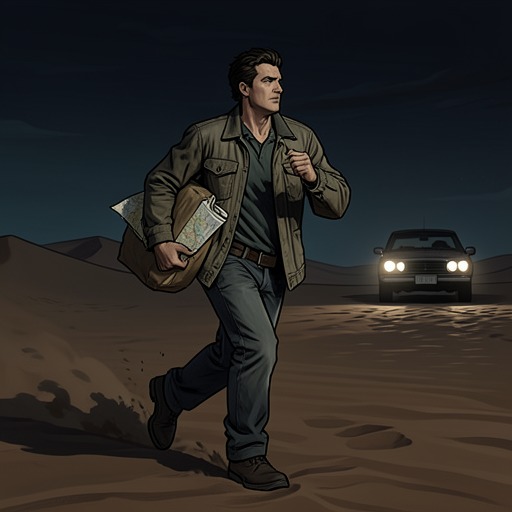
Following Lum Loc’s directions, Conrad walks from Meadow Lark Terrace carrying an overnight bag and the $700 he has left. The journey takes him past apartment buildings, a convenience store, gasoline pumps, and small commercial establishments. He notices men watching the road and pickup trucks stopping to collect workers; their presence makes the route feel like a place where people are waiting for opportunities, even as Conrad remains alert to being watched himself. The roadside businesses include Liza’s Restaurant, a 24-hour play school, and antique shops such as Hello Again.
On Buford Highway, the scale changes. Conrad encounters six lanes of pavement, broad stretches of concrete and hard-baked dirt, low buildings, and signs raised high to catch passing drivers’ eyes. Pawnshops advertise car-title loans and discounted gold and diamonds; an emission-testing tent reflects the everyday demands of Georgia motor-vehicle law. Chinese food, collision services, pawn businesses, and roadside commerce crowd together along a highway built for people moving through at speed. Chamblee is presented through the practical details Conrad sees on foot: a dispersed, commercial landscape that he must read for food, work, and a way to remain unnoticed.
Refuge, Fear, and Loneliness
At Mr. Saigon Noodle Parlor, Conrad remembers Lum Loc’s instruction that he must get a job. He buys The Atlanta Journal-Constitution, pays for his meal before settling in with the classifieds, and orders green tea as he searches for work. The newspaper interrupts that ordinary task with news of the earthquake in California. It reports destruction in downtown Pleasanton, at Camp Parks, and at Santa Rita, with eight deaths and twenty inmates unaccounted for. There are no names and no mention of a manhunt, but the report gives Conrad no assurance that his escape will remain undiscovered. He considers contacting Jill, Kenny, or Mai, then hesitates.
The restaurant becomes the site of a loneliness sharper than what Conrad remembers from Santa Rita. In prison, Five-O and Mutt were people he saw and dealt with every day, however difficult those relationships might be. In Chamblee, Lum Loc may already have moved on to another group of migrants, and Conrad is left among strangers with no dependable companion. His search for employment and his attempt to follow the news cannot fill that absence. Chamblee thus offers a place to hide, but not the settled belonging that would make hiding feel like home.
The Book and a New Purpose
Chamblee later acquires a different significance when Conrad explains to Charlie Croker that he found The Stoics in a secondhand store there. The discovery joins the town to the book’s earlier arrival at Santa Rita: Conrad interprets the text as something that has followed him through prison, escape, and exile. In his understanding, the book introduced him to Zeus and Epictetus and helped him withstand the dangers of jail, estrangement from his family, alienation from the law, and a confrontation with a thug.
Conrad reads the sequence as providential. He believes Zeus opened Santa Rita in the earthquake, made a Jeep available, and led him through Kenny and Mai’s underground airline to Atlanta. Chamblee, a town he had never previously heard of, then supplied the copy of The Stoics that he was meant to carry forward. When he stands beside the crippled Croker, Conrad sees his own layoff from Croker Global Foods not as a reason to punish Croker, but as part of a pattern directing him to recruit a powerful man and his resources into Zeus’s service. He agrees to leave the book with Croker and asks him to look after it, insisting that it is alive. The town’s importance therefore lies not only in its role as a stop in Conrad’s flight, but in the unlikely secondhand-shop discovery through which he turns survival into a mission.