Charlie Croker
A Man in FullCharlie Croker’s identity is built around a commanding body, a commanding business persona, and the assumption that both can keep misfortune at bay. The real-estate developer who once presided over a sprawling corporate empire is ultimately brought close to bankruptcy, forced to face the limits of wealth and reputation, and led toward a new understanding of strength in his own will. His trajectory turns on the collision between an exuberant public self and the private fear that the world has already begun to see through it.
Identity and Self-Image
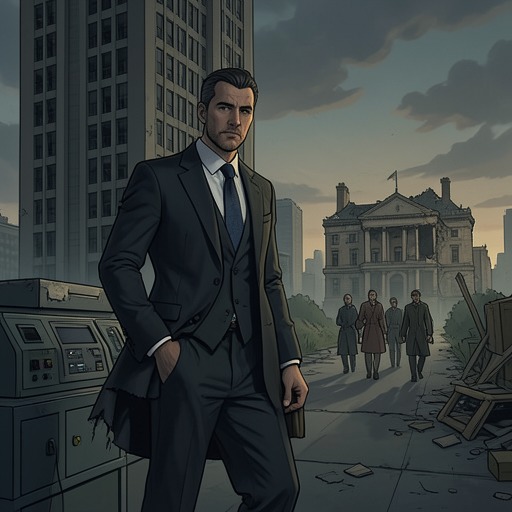
At sixty, with a bald crown and curly gray hair around the sides and back, Charlie remains devoted to the spectacle of his physical power. On horseback at Turpmtine estate, he straightens in the saddle, takes a deep breath, and imagines that the hunting party is noticing his build. He flexes his back for the guests, the six Black retainers, and his twenty-eight-year-old wife, Serena. His pride centers on his broad shoulders, massive neck, powerful forearms, and especially his back: the body is not merely a possession but a performance staged for an audience.
That performance draws on a local legend. Turpmtine’s employees call him Cap'm Charlie, after a Lake Seminole boat captain of the same name, remembered in stories as a daring strongman. Charlie does not know whether the legendary figure ever existed, but he relishes the possibility and the song celebrating a man with a back like a bull. The uncertain legend gives him a ready-made heroic identity: he can imagine himself as the latest incarnation of a larger-than-life Croker, even while the actual foundation of his power is becoming precarious.
His manner matches the physique. At the Croker Global Corporation, Charlie is hearty, charming, blustering, and capable of evasion; his young sidekick Wismer Stroock is presented as his opposite, speaking in the register of business education and technical expertise rather than Southern ease. In a creditor meeting, Charlie fences verbally until he has no route left to avoid the damaging facts, then makes Stroock state them. The contrast exposes a division of labor: Charlie’s charisma can dominate a room, but it cannot make the company’s figures disappear.
Business Power and Financial Decline
The debt crisis is already a mountain in Charlie’s mind, an avalanche he recognizes has begun. Croker Global has borrowed $515 million from PlannersBanc and failed to meet $36 million in scheduled interest payments. These figures give material form to the distance between his self-image as an imposing, successful developer and the company’s actual capacity to meet its obligations.
The threat becomes harder to ignore as new demands and possible seizures accumulate. Charlie wakes abruptly in the dark, sweating, his heart pounding, with the Wiz’s latest numbers already turning over in his mind. The bank’s pressure is compounded by an IRS problem involving phantom gains: he fears that foreclosure could cost him his assets while also leaving him with a large tax bill. The crisis reaches beyond the company into his personal life. He had spent $2.75 million on the Croker house on Blackland Road and allowed Serena to put more than $3.5 million into its interior, sums he now thinks of as money he would rather have available. Another extravagant Buckhead property, on Valley Road, had gone to Martha Croker in their divorce.
Charlie continues to behave as though expense can certify command even after the evidence of insolvency is plain. At a dinner, he buys an entire table for $20,000, using money that belongs to PlannersBanc. Raymond Peepgass regards the purchase as typical of Charlie’s refusal to register how serious the situation has become. Even the seizure of his Gulfstream Five has not, in Peepgass’s view, made the danger fully real to him. The airplane, the costly table, and the grand house belong to the same old grammar of status; each makes his diminishing control more visible.
The business decline also appears in the people left waiting on the Croker Global floor. One angry, sweating visitor has a legitimate complaint: Croker Global has stiffed him. The man becomes a sign of the beginning of the end, not because Charlie has lost the ability to command attention, but because the company’s unpaid obligations are now present in its own waiting room. At the Croker Concourse tower, once the scene of corporate authority, Charlie sits with the Wiz amid a business whose public stature is no longer a reliable measure of its solvency.
Social Performance and Intimacy
Charlie’s gift for staging himself extends from business into hospitality. At a Friday dinner at Turpmtine estate, he presides over a table of burled tupelo maple and tries to draw conversation from Herbert Richman. The weekend has been arranged to win Richman over: as the founder of DefinitionAmerica, a nationwide network of 1,100 fitness centers, he represents a business opportunity Charlie needs. Yet Richman’s mild manner and the social distance Charlie perceives between a Jewish guest and Georgia society make the usual hearty performance a poor instrument. Charlie recognizes that the Turpmtine spell may not work on everyone, even as he keeps trying to cast it.
A verbal gaffe involving Richman follows them onto the flight back to Atlanta. Charlie sits in the forward cabin of the G-5, with Richman, their companions, Serena, and Wally behind him; the mistake remains an uncomfortable presence in the aircraft’s recirculated air. The episode punctures the illusion that lavish arrangements can guarantee social mastery. Charlie can assemble guests and provide the setting, but he cannot dictate what they remember or how they judge him.
His marriage to Serena is also framed through unequal needs and competing performances. On the way to the Mayflies Ball, he drives the Ferrari up the Piedmont Driving Club’s driveway, resenting the tuxedo, the dinner, the expense, and the obligation to appear among people he does not want to see. He has reached a depression in which going out feels like exposing his own inadequacy to the world. At another dinner, he has no wish to project the familiar Croker personality for Serena’s guests; Billy and Doris Bass are the only people at the table he cares about. Serena, meanwhile, is visibly enjoying herself, laughing and moving her bright eyes around the room. Their different responses make the shared social occasion feel less like intimacy than parallel experience.
Charlie’s relations with others also retain the force of an older, generous confidence. When Inman stands to greet someone, Charlie rises despite the pain in his knee, offers to help him at Georgia Tech or anywhere else, and seals the promise with a handshake just short of a blood oath. Later, however, Charlie feels guilt as he drives toward Buck McNutter’s house to meet Fareek Fanon, passing near Inman’s home. His hesitation shows the strain of making a consequential commitment under the scrutiny of neighbors and friends. He is still attentive to loyalty and reputation, but neither tells him what the right choice is.
Humiliation, Depression, and the Loss of Command
As the crisis deepens, Charlie’s body changes meaning. It had been his emblem of force; now he imagines that his broad frame, square jaw, and bald head announce bankruptcy and fraud. At a gathering in the Croker Concourse, he grips a white pipe railing with both hands and looks down at the crowd, whose cackling noise reminds him of turkeys. The scene joins physical dependence to social alienation: he is surrounded by friends, admirers, and rivals, yet experiences the prospect of joining them as an exposure he would rather avoid.
His response at an art exhibition is not quiet resignation. Charlie goes close to the panel titled Arrangement in Red Clay and loudly makes a crude joke about its image. For a moment, he feels a surge of spirit in refusing to stand piously with the other viewers. The outburst is abrasive and does not repair his finances, but it shows that his defiance survives after the authority behind his public persona has weakened. He can still disrupt a room; he can no longer assume that disruption will restore control.
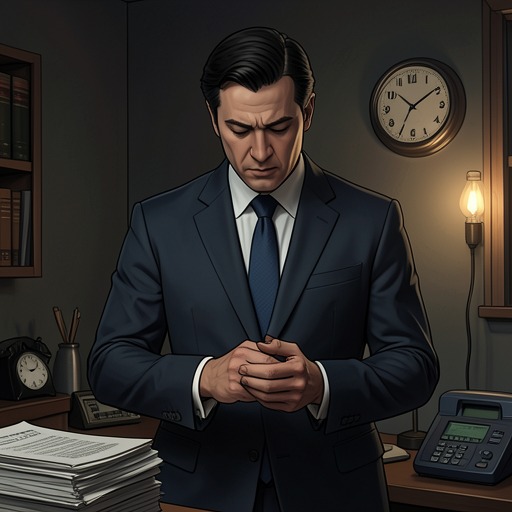
Insomnia makes the decline more inward. In his office, Charlie tells Marguerite to hold calls unless they require immediate attention, then slumps in the cockpit of the Croker Global Corporation with his head dropped, eyes shut, and body folded forward, hoping for hypnagogic hallucinations in place of sleep. He deliberately ignores the view over Atlanta’s northern suburbs. The man whose identity has depended on surveying and possessing the city cannot take comfort from looking at it. His posture registers not a dramatic public defeat but the exhaustion of someone unable to leave the crisis behind even when he closes his eyes.
Change and Ending
Charlie’s movement toward a different idea of strength comes through humiliation rather than renewed business success. After a woman speaks to him harshly in front of Connie, he recognizes why the insult has reached him so deeply: his former strength had rested on money, reputation, and worldly success. He now identifies a truer source in his own will and in the reason that allows him to distinguish what lies within his power from what does not. The shift does not erase his pride or reverse the losses. It changes the standard by which he understands power.
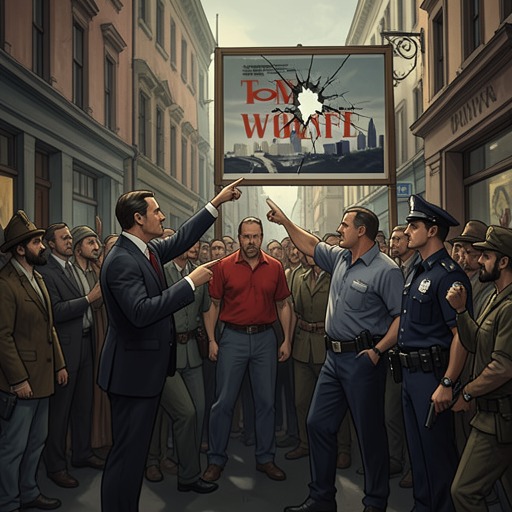
When he tells Connie that he has decided to attend the press conference, Charlie calls the decision a test. His manner is still plainspoken and characteristically familiar, but the test concerns whether he can act according to conviction rather than simply protect the image that once served him. At the press conference, he says that a lawyer representing Fareek Fanon had approached him with a proposition about two weeks earlier. He acknowledges that he could say the expected things, but refuses to do so. For Charlie, the crucial freedom is the ability to assent to what is true and deny what is false, a freedom he says no offer is worth surrendering.
The declaration of principle culminates in a declaration of material surrender. Charlie says he is close to bankruptcy, holding his forefinger and thumb almost together to indicate how little distance remains. He then hands over Croker Global Corporation, its branches, his houses, plantation, horses, and car to his creditors, and says he will not hold them back through Chapter 11 or another part of the bankruptcy code. He calls these assets trifles and places his keys on the table. The gesture reverses the old performance of possession: rather than insist that his holdings prove his greatness, he gives them up and claims tranquility in the act.
Narrative Role and Significance
Charlie’s arc makes financial collapse inseparable from a crisis of self-definition. His lavish estate, aircraft, public dinners, and cultivated physical presence are not incidental decorations; they are the visible forms through which he has understood success and expected others to recognize it. As creditors and unpaid claims expose the weakness beneath those forms, the same body that once seemed to guarantee mastery becomes, in his imagination, a surface marked by fraud and failure.
The ending does not present a restored empire or an uncomplicated victory. Charlie gives up the property through which he had measured worldly strength, while retaining the capacity to choose what he will endorse and what he will refuse. His final claim to wealth is therefore deliberately paradoxical: he is materially surrendering almost everything precisely when he argues that reason and will remain his own. The distance between the man who preened in the saddle and the man who sets his keys before his creditors marks the decisive change—not the disappearance of Charlie’s force, but its relocation from ownership and reputation to judgment.