Freaknic
A Man in FullFreaknic brings Roger Too White into contact with Fareek Fanon against the spectacle of Atlanta’s spring-break street celebration, where stalled traffic gives way to dancing and the city’s racial geography becomes impossible to ignore. The episode connects that encounter to the rape accusation that soon entangles Fareek, Buck McNutter, Georgia Tech, and Roger, while a later recollection links the night to a black-tie gathering at the Piedmont Driving Club.
Traffic Becomes a Street Party
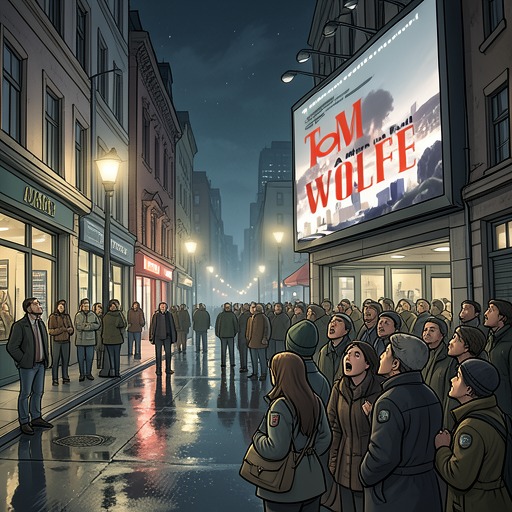
On a Saturday night in April, Freaknic traffic crept up Piedmont Avenue, passed Tenth Street, and reached Fifteenth before stopping altogether. Cars could not move in either direction across the four lanes. With the road reduced to a standstill, young Black men and women began climbing out of convertibles, muscle cars, Jeeps, vans, pickup trucks, and ordinary sedans. The trapped roadway became the event’s public space: people emerged directly into the dusk rather than waiting for traffic to clear.
Roger Too White watched from his Lexus as a young woman rolled out of a red Camaro through its passenger-side window, without opening the door. She landed in the street in a movement Roger compared to a high jumper clearing a bar. The scene caught his attention first as a display of youthful physical confidence, but it also exposed the limits of his own position as observer. He read her clothes, jewelry, hair, and apparent social background as signs of a prosperous Black professional family and a college life beyond Atlanta. His gaze turns the traffic jam into a portrait of the assumptions he carries even while he is watching a crowd that has taken over the street.
Atlanta’s Competing Claims
The young people had come from colleges around the country for a spring-break gathering held in Atlanta each April. Their celebration extended through Midtown, Downtown, and Buckhead, reaching parks, malls, commercial strips, and the highways. Roger understands their presence as more than a party: the students have come to the streets of a city that they regard as their own. The event makes public space itself a source of conflict, as the movement and noise of the crowd unsettle White Atlanta’s expectation that it can control the northern part of the city.
The contrast is sharpened by the city’s political structure. Atlanta is described as 70 percent Black; its mayor, Wesley Dobbs Jordan, is Black, as are twelve of the nineteen city council members, the police chief, the fire chief, and much of the civil service. Roger and the mayor are also fraternity brothers from Morehouse College. Against that civic reality, white complaints about Freaknic portray the revelers as rude, rowdy, drunken, and destructive, accusing them of littering, urinating on lawns, blocking roads and malls, and costing white merchants millions. Complaints even extend to the alleged disturbance of the rhinoceroses’ mating habits at the Grant Park zoo.
Roger recognizes a disparity beneath this catalogue of grievances: Black students are doing, in Atlanta, what white students have long done during spring break in places such as Fort Lauderdale, Daytona, and Cancun. The difference is that these visitors have chosen the city’s streets rather than a beach. His account presents white outrage as a reaction not simply to disorder, but to Black young people occupying spaces where they are visible and free to act. The traffic jam therefore holds two meanings at once: a practical deadlock and an image of a city whose racial power relations cannot be smoothed over by its official political representation.
Roger’s Encounter with Fareek
Freaknic is also the setting for Roger’s first encounter with Fareek Fanon. Later, while driving with Wesley Dobbs Jordan, Roger recognizes the intersection of Piedmont and Tenth as only a few blocks from where he had been trapped in the festival traffic on the Saturday night Fareek entered his life. The recollection locates the meeting within the same urban landscape as the street party, rather than presenting Fareek’s arrival as separate from the city’s broader racial tensions.
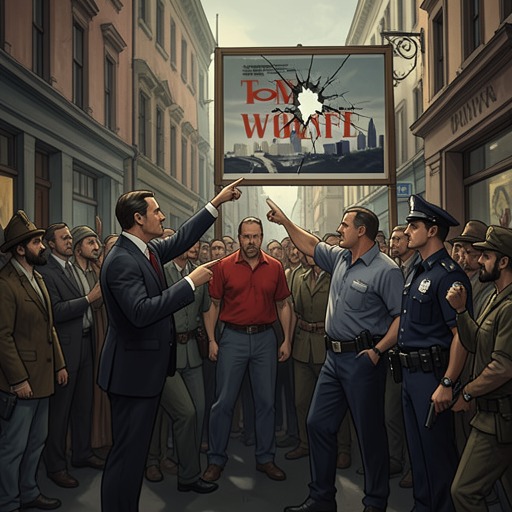
Roger recounts the incident to the mayor, emphasizing the mooning of a black-tie gathering of white people on the terrace of the Piedmont Driving Club by a young man described as a future chairman of a Kentucky board. The anecdote joins the night’s encounter to an episode of deliberate provocation directed at an exclusive white social setting. The later scene does not present the event as a neutral memory: Roger offers the story in conversation with a mayor who has just been discussing Atlanta’s elevation and the unequal social heights of its residents. The club, the street, and the stalled traffic supply distinct settings for the same underlying question of who belongs where and who may claim the city’s spaces.
The Accusation and Its Consequences
The next major turn associated with Freaknic comes when Buck McNutter summons Roger because Fareek has a serious problem. McNutter explains that an accusation of rape arose from a party the previous night, describing it as a possible date-rape case. Fareek denies doing anything improper, while McNutter stresses that the predicament affects not only Fareek but also himself and Georgia Tech. The account establishes the allegation as a disputed claim, not a confirmed finding, and makes clear how quickly a party becomes a crisis with institutional and personal stakes.
Fareek responds to Roger’s attempt to establish rapport with silence and a dismissive look. McNutter, frustrated by what he takes to be Fareek’s cool indifference, presses him to identify the young woman. In this aftermath, the party’s social setting gives way to accusation, scrutiny, and the demand for a name. Freaknic thus connects a mass celebration of Black presence in Atlanta to the intimate and consequential dispute that draws Roger into Fareek’s case. Its significance lies in that collision: a public event already treated by many white residents as a threat becomes the backdrop to an allegation whose consequences reach beyond the people at the party, while the truth of what happened remains contested.