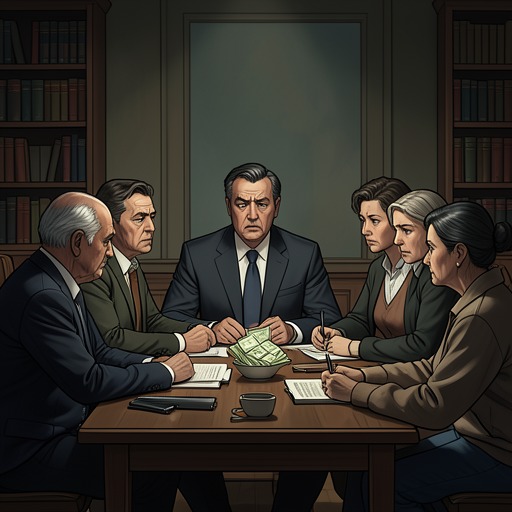
Georgia Tech board
A Man in FullThe Georgia Tech board is portrayed as a governing body whose reported pursuit of football success competes with Inman Armholster’s attempt to secure a response to his daughter Elizabeth’s rape allegation against Fareek Fanon. Its priorities emerge not through a direct board meeting but through accounts relayed to Charlie Croker: the board wants to rebuild the football program, while Inman discovers that his appeal to its new chairman does not produce the decisive intervention he expected.
Identity and Institutional Priorities
The board is identified as Georgia Tech’s governing board, and its new chairman is Holland Jasper, described as a close friend of Inman Armholster. Billy Bass says that there have been many changes on the board and that its members are coming out strongly in favor of football. The account does not specify the board’s membership, formal procedures, or the full extent of those changes; its character is established instead through the priorities attributed to it and the consequences those priorities have for Inman’s appeal.
The football emphasis is presented as more than a sporting preference. According to Billy, the board believes that Georgia Tech has lost ground over the previous decade and that a struggling team brings down other measures of institutional strength. He relays a linked sequence: when football declines, the legislature provides less money, alumni contributions fall, and the SAT scores of applicants drop. Charlie is surprised that admissions scores would be part of the same calculation, but Billy says Inman had heard this reasoning from Jasper. The board’s priorities thus join athletic performance to public funding, donor support, and the university’s ability to attract applicants.
Football as a Public Investment
The board’s ambition is made concrete in the investment and publicity surrounding the team. Billy reports that it has hired Buck McNutter away from Alabama for an annual salary of $875,000 and provided him with a large house in Buckhead. He also points to Fareek Fanon, an All-American running back whose image appears in magazines, capital-contributors brochures, and Admissions Office flyers. In those materials, Fareek is shown shaking off tacklers and running into open country.
That repeated image connects the board’s football agenda to the university’s public presentation of itself. Fareek is not only a player in Billy’s account; his athletic success supplies a recognizable image for promotional materials aimed at readers, contributors, and applicants. The juxtaposition becomes consequential when Inman approaches the chairman about his daughter’s allegation against the same player. The evidence does not establish that the board formally weighed Fareek’s athletic value against Elizabeth’s allegation, or that it made a collective decision to protect him. It does show why Inman encounters an institution already focused on a program in which Fareek has been made conspicuous.
Inman Armholster’s Appeal
Inman wants Elizabeth’s name kept out of public circulation. Billy tells Charlie that Elizabeth is traumatized and does not want to speak to the police, Georgia Tech, or anyone else. Inman is therefore trying to act while protecting her privacy, and his choice to approach Jasper and the board places him in a difficult position: he wants institutional action but is reluctant to expose his daughter to further attention.
Inman expects Jasper to respond forcefully when he explains what happened. Instead, as Billy recounts the conversation, Jasper invokes the need to take everything into consideration and refers to the student government’s mechanism for handling sexual harassment. Inman objects that he is not describing sexual harassment but rape. The distinction matters within the scene: Jasper’s procedural framing does not answer the accusation as Inman presents it, and Inman’s anger makes clear that he regards the classification as a failure to confront its seriousness.
Billy says Inman leaves the conversation stumped and furious, then tries to line up people at Georgia Tech against Jasper. The account indicates an effort to build opposition to the chairman, not a completed board vote, formal investigation, or institutional finding. It also preserves the limited chain of information: Charlie hears the episode from Billy, who says Inman told him what happened and made him promise not to repeat it. The board’s response is therefore presented through secondhand reporting, rather than through a direct view of its deliberations.
Narrative Significance
The Georgia Tech board’s role is defined by the contrast between two institutional concerns: restoring a football program regarded as central to the university’s fortunes and responding to a grave allegation involving the athlete whose image helps represent that program. Its stated rationale for football ranges beyond the field to money, alumni support, and admissions, while Jasper’s reported answer to Inman turns toward procedure and the student government’s harassment process. Those concerns are not shown to be formally connected in a board decision, but their proximity gives the episode its tension.
The scene also places Inman’s private effort to protect Elizabeth’s identity against the public visibility of Fareek’s athletic persona. The promotional images circulate across admissions and donor materials; Elizabeth, by contrast, does not want to speak to the institution or police. The board’s importance lies in this imbalance of attention and institutional purpose: it is the authority Inman hopes will act, yet the account of its chairman’s response leaves him seeking allies against the very leadership he had approached.