Piedmont Avenue
A Man in FullPiedmont Avenue is the setting for a traffic jam that becomes one of the novel’s sharply observed encounters with Atlanta’s racial and social divisions. During Freaknik, cars stop across all four lanes, their occupants spill onto the pavement, and a party takes shape beside the Piedmont Driving Club. From behind the wheel of his Lexus, Roger Too White watches the revelry with a mix of alarm, attraction, and recognition; the avenue turns a routine drive into a confrontation with the city’s boundaries and with his own carefully managed sense of propriety.
Setting and Street Geography
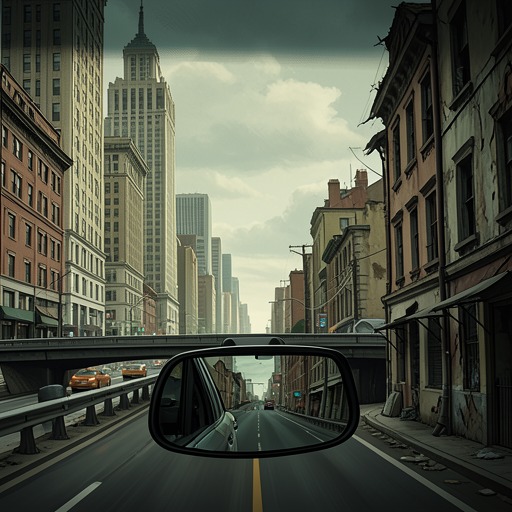
The scene follows the Freaknik traffic as it inches up Piedmont Avenue, reaching Tenth Street and then climbing toward Fifteenth Street before coming to a complete stop in both directions. The repeated crawl ends in a glue-trap halt: cars cannot move forward or back, and the congestion stretches across all four lanes. The avenue is not merely a backdrop for the gathering. Its stalled traffic creates the conditions for it, converting the roadway from a channel for cars into a shared public space. As the vehicles stop, young Black men and women emerge from convertibles, muscle cars, Jeeps, sport-utility vehicles, vans, pickup trucks, campers, hatchbacks, and ordinary sedans. One young woman climbs out of a red Camaro through its passenger-side window rather than opening the door, rolling onto the pavement and beginning to dance as soon as her feet touch the ground. Others move between the cars, call to one another, discard beer cans, and dance to rap music blaring from car stereos. The scene’s movement is therefore twofold: the traffic has ceased, but the street itself is suddenly in motion.
A Party Beside the Enclave
From the avenue, Roger sees revelers dancing near the entrance to Ansley Park and facing a white enclave. Their gathering also places them directly below the terrace of the Piedmont Driving Club, where formally dressed guests look down at the street. The men wear tuxedos; the women’s formal dresses leave their shoulders bare. They do not smile. The club’s elevated terrace and the roadway below establish a visible division between two social worlds, while the Freaknik crowd’s presence makes that division impossible to ignore. Roger recognizes the building as the Piedmont Driving Club, the citadel of Atlanta’s white establishment. He understands that its guests had likely planned their Saturday-night party without anticipating that it would coincide with Freaknik. Now the formal gathering and the street celebration occupy adjoining spaces: white guests watch from above, while Black revelers dance at the club’s entrance. The avenue makes the contrast immediate and public, without requiring either group to leave its place.
Roger’s Predicament
Roger has a practical reason to get through the jam. At 7:05, he remembers that he must reach an address on Habersham Road in Buckhead by 7:30. The appointment is with Buck McNutter, the Georgia Tech football coach, who has summoned him urgently without explaining the matter over the telephone. Roger had allowed extra time because he knew Freaknik would make traffic difficult, but he is now trapped in a block party that shows no sign of ending. His anxiety is bound up with an older humiliation. During negotiations for the MoTech Corporation’s Atlanta Pythons stadium, Roger heard two white executives make a mocking imitation of Black speech while joking that Russell Tubbs, a Black lawyer representing the city, operated on Colored People’s Time. Roger had used the same familiar joke among Black colleagues, but hearing it from the executives filled him with anger. He swallowed that anger and privately resolved never to be late to an appointment, especially with a prominent white person. The current jam threatens that self-imposed rule, turning the celebration around him into a test of the discipline he built in response to racial condescension. Roger’s view of the street is not simple disapproval. He feels panicky about missing the appointment, yet the crowd’s freedom and abandon exhilarate him. The spectacle of young people dancing near the Driving Club unsettles his expectations even as he is drawn to it. His response gives the location a double charge: Piedmont Avenue is where he is stuck, but also where the scene exposes a desire that his professional caution and sense of respectability have kept in check.
Escape and Narrative Significance
Desperate to escape the jam, Roger considers driving over the curb and along the sidewalk toward Tenth Street. He can see the embankment beside the roadway, with its fence and rustic stone pillars, and the high ground between the avenue and Piedmont Park. Above the wall, the Driving Club terrace supplies a view of the party from the other side of the street’s social divide. Roger’s imagined route is an improvised response to physical confinement, but the location’s layout also keeps the competing scenes in view: the revelers below, the formally dressed guests above, and a blocked avenue between them. The traffic eventually begins moving again. The young people climb back into their cars, including the woman who returns to the Camaro, and the party disperses as quickly as it formed. Roger’s heart is still pounding from fear about what might have happened and from the sexual excitement the scene stirred in him, but he keeps his wits and leaves Piedmont Avenue at Morningside Drive. He takes Lenox Road and makes a wide loop around the congested Lenox Square area before heading toward Habersham Road; driving too fast, he reaches his destination eleven minutes late. Piedmont Avenue thus serves both as a physical bottleneck and as a meeting point for sharply contrasting forms of Atlanta life. The episode begins with cars immobilized on the way to their destinations and ends with Roger moving again, but not before the street has made him witness a public collision between youthful revelry and establishment formality—and feel its effects within himself.