Pocahontas
A Man in FullPocahontas is a vulnerable young prisoner whose apparent assault by Rotto becomes a decisive test of Conrad’s Stoic beliefs. First presented as a frightened figure whom the other inmates avoid, he is later found collapsed and bleeding after emerging from the shower room. His predicament draws Conrad out of anxious observation and into action, even as the surrounding prisoners remain still.
Identity and Presence
Pocahontas is described as a skinny, gangling youth with an auburn Mohawk, shaved eyebrows, pallid skin, and a body that Conrad sees as nearly devoid of muscle. His appearance is conspicuous, but the story offers no independent account of how he came to adopt it or how he understands himself. The name by which the other prisoners and the narrative identify him is not explained. His characterization instead arrives through what Conrad can see: his posture, his face, and the fear with which he responds to other men.
The details of his appearance register both self-presentation and exposure. Conrad notices the Mohawk, the shaved eyebrows, and puncture marks in Pocahontas’s earlobes, signs of a look designed to command attention. Yet that striking exterior does not protect him in the pod. His long, pale arms hang from his yellow felony pajamas; his shoulders hunch, and his head droops forward. The contrast between a body styled to be seen and a person whom everyone later refuses to look at gives his presence an uneasy force.
Rotto’s Approach
Rotto first crosses the pod toward Pocahontas while the other inmates watch. Pocahontas raises his face only far enough to see him, then remains rigid, his eyes fixed in fear and his breathing so hard that his Mohawk bobs. Rotto smiles, leans toward him, and speaks too quietly for Conrad to hear. Pocahontas’s mouth shifts between an attempted polite smile and an incoherent mumble. After several minutes, Rotto claps him on the shoulder and returns to his associates. The exchange is outwardly framed as a conversation, but Pocahontas’s frozen posture and terror make it appear profoundly unequal.
The inmates’ silence leaves the encounter unresolved for Conrad, who can only guess what has happened. Pocahontas straightens briefly, gives a helpless sigh, and folds himself over the table again. The others avoid looking at him, as though even witnessing his distress might expose them to danger. Conrad is shaken by the scene and imagines himself in Pocahontas’s position. The fear is therefore not merely an observation of another prisoner’s suffering: it makes the threat to Pocahontas register as a possible threat to Conrad as well.
Five-O later tells Conrad that Rotto has been disrespected by Vastly and now wants to prove himself tough. He characterizes Pocahontas as an especially easy target and predicts that Rotto’s attention will bring him serious harm. During evening pod time, Pocahontas walks around the edge of the white turf, keeping as far from Rotto as he can without entering the territories of other groups. His bent posture and slow progress make his attempt to stay clear visible to everyone. Five-O and Flaco glance at him; Pops turns away whenever his shuffle brings him near. The pod’s response is collective avoidance, leaving Pocahontas exposed even before the apparent assault.
Conrad’s Hesitation
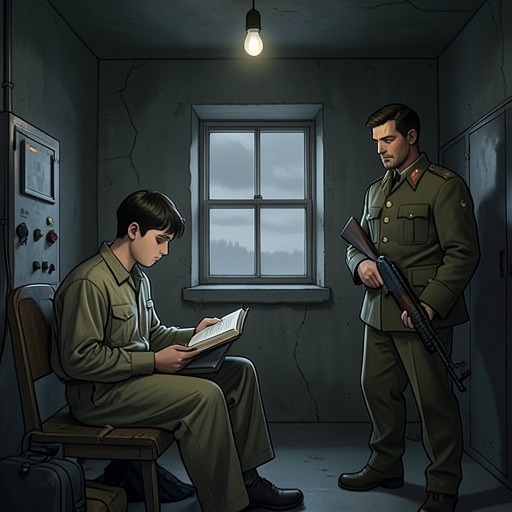
Conrad watches from a table where he has opened The Stoics. He feels the urge to approach Pocahontas, encourage him, or otherwise help, but he cannot decide what help would mean or whether intervention would make matters worse. He turns repeatedly to Epictetus’s teaching about not spending feelings on what lies beyond one’s power and not allowing affection to make a person miserable. The passage offers a possible reason to remain uninvolved, but Conrad also worries that he is using philosophy to excuse himself from a clear duty.
That conflict sharpens the scene’s ethical stakes. Pocahontas is not able to explain his circumstances to Conrad, and the narrative does not give him an extended voice of his own. Instead, Conrad has to judge what the visible fear, isolation, and danger demand of him. His reading cannot settle the question in advance: the same Stoic teaching that might counsel restraint also forces him to examine whether detachment has become a shelter from responsibility. For a time he stays at his table, looking across the pod and arguing with himself while Pocahontas continues to keep away from Rotto.
Collapse and Aftermath
After Rotto has returned to his group, Pocahontas emerges from behind the shower-room wall, still pulling his prison trousers up over his hips. His midsection is bare. His face appears contorted and dazed; he steps into the pod sobbing silently, then looks around at the prisoners. He puts his hands on his hips as if trying to recover his composure, but collapses onto the concrete. The narrative’s sequence strongly implies that he has been sexually assaulted, though it does not provide a full account of what occurred. The surrounding inmates, including men close by, make no move to help. Even Pops turns away.
Conrad rises and crosses between the groups’ territories, acting before he can reason himself out of it. Pocahontas lies face down, his head and neck twisted, his eyes unfocused and his mouth open. Conrad initially fears he is dead, then feels a pulse in his throat. He notices the smell of his body and a red stain, about two inches wide, between the legs of his yellow pajamas. These concrete signs transform an alarming but uncertain encounter into an immediate medical emergency. Conrad kneels beside him, tells him not to move, and promises to get help.
When Five-O does not respond to Conrad’s request, Conrad looks for the surveillance camera near the ceiling and steps into its line of sight. He raises both hands and calls for a deputy, pointing out that Pocahontas is bleeding. The shift from watching to summoning help is the defining change in Conrad’s relation to him: Pocahontas’s suffering can no longer be kept at a safe distance by argument or by the pod’s practiced refusal to look. The episode leaves Pocahontas’s subsequent condition unstated, but it establishes that Conrad, alone among the inmates described, acts to bring the injury to the attention of the authorities.
Narrative Significance
Pocahontas’s role in these scenes is closely tied to the limits of what Conrad can know. He does not hear the first exchange with Rotto, and the assault is not narrated directly; Conrad and the reader encounter its aftermath through posture, silence, avoidance, and the bloodstain. That restricted perspective preserves uncertainty about the exact events while making the harm legible through its physical consequences.
The contrast between the pod’s many witnesses and its single responder gives Pocahontas’s isolation its narrative weight. His body is repeatedly visible, yet the inmates treat looking as something to avoid and action as something too dangerous or burdensome to take. Conrad’s decision does not resolve Pocahontas’s predicament, and the evidence gives no outcome for his injury. It does, however, mark a break in Conrad’s attempt to treat Stoicism as a reason to remain untouched by other people’s misfortune. Pocahontas’s collapse turns a philosophical question into a practical demand for help.