Santa Rita Rehabilitation Center
A Man in FullSanta Rita Rehabilitation Center is an Alameda County jail housed in former military buildings north of Pleasanton, California. For Conrad Hensley, its crowded cells and barriers to ordinary human contact turn confinement into a daily physical and emotional trial. The institution also places his insistence on innocence and principle under pressure: a visit from Jill Hensley brings their disagreement over his rejected plea into the same sealed space where he must learn to endure life among other prisoners.
Setting and history
Route 580 separates Pleasanton from the sprawling jail, which occupies two square miles of dusty rangeland. The freeway serves as more than a route past the facility: it helps keep the town and the institution apart. Residents rarely think about Santa Rita except when a released prisoner walks through Pleasanton with personal belongings exposed in a clear plastic bag, heading toward the BART station for a train back to Oakland. The narrative notes that the jail does not provide these people with a ride to the bus, while townspeople mostly accept their passage as a way of sending them out of town. Release therefore does not immediately erase the visible boundary between confinement and ordinary life.
The property has undergone successive changes of use. The freeway cuts through land that had been part of the once-rich Rancho Santa Rita, whose southern farmland was suitable for grapes, plums, apricots, and avocados. The northern hills were used to graze horses and cattle before the U.S. Army acquired that portion during the Second World War for Camp Parks, a training ground for soldiers bound for the Pacific. The Army put up clapboard buildings for its troops; more than half a century later, the same cluster of large, gray-brown wooden structures serves as the Alameda County jail. Seen from the freeway on a bright Sunday in May, the buildings could be mistaken for decaying barracks. Their present purpose is not apparent from their weathered exterior.
Buildings and conditions of confinement
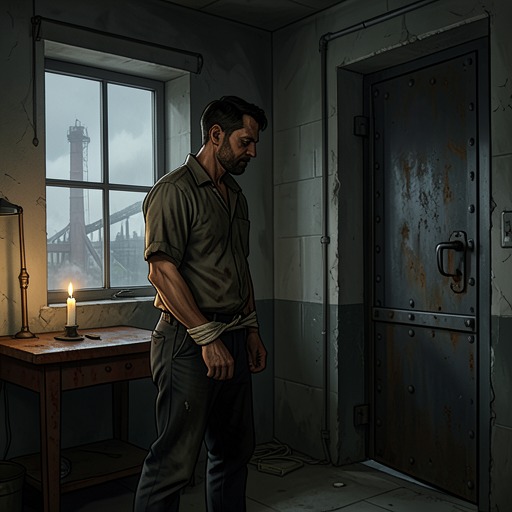
Inside, the old barracks are arranged in tall, dark wooden bays. Conrad’s cell is not a barred room of the kind he might have imagined, but a cramped enclosure compared to a stall or sty. At roughly five by nine feet, it barely accommodates a double-decker metal bunk and a unit-welded metal toilet and basin. The cell has no windows; its solid black wooden door has a slot for food, while a heavy wire screen takes the place of a ceiling. Above it runs a catwalk where deputies patrol and look down. Clerestory windows provide some light and air, but ancient belt-driven attic fans grind and screech overhead, and the heat presses on even at night.
The larger jail’s routines and fittings reinforce the sense of bodies held in place. On Sunday, visiting day, prisoners in the West Greystone building sit on metal stools bolted to the floor. Their short-sleeved, yellow, pajama-style uniforms are made of coarse cotton twill; the color indicates a felony conviction. Rubber flip-flops offer little protection or support. Across the concrete wall, visitors sit behind Lexan, a thick, layered barrier described as difficult to break. Prisoners and visitors can see and hear one another through the windows, but cannot touch; they speak by telephone, whose poor acoustics muffle high and low tones. From Conrad’s perspective, the arrangement resembles a tomb with a small opening onto the living world.
Visits, family, and the rejected plea
Conrad waits hunched close to the Lexan for Jill to arrive, afraid that missing even a moment of the visit will make another week in Santa Rita unbearable. Their conversation quickly turns to his decision to reject probation. Jill points out that the offer was for a misdemeanor, while Conrad insists he could not plead guilty to an assault he says he did not commit. In his account, the others attacked him and he only prevented them from hurting him and damaging their property. Their conflict is not simply about the length of a sentence: Jill sees a chance to avoid the worst consequences, while Conrad regards accepting the plea as a false admission.
At the end of the visit, Jill tells him that she loves him and hangs up. She remains seated with her lips tightly compressed as Conrad gestures a kiss and tries to show that he would embrace her if the barrier allowed it. Her departure leaves him afraid that she may not return the following Sunday, or any Sunday. The visiting booth makes the separation concrete: the couple can see and hear each other, yet the jail permits neither touch nor an unmediated conversation. For Conrad, the uncertainty about Jill and the children intensifies the fear that prison will narrow his world until even the possibility of family life disappears.
Overcrowding, violence, and Conrad’s response
Santa Rita’s chronic overcrowding puts three men in a cell barely large enough for two. Conrad, the newest arrival, sleeps on a mattress on the floor between the bunk and the door; at night he must fold it against a wall and sleep with his legs bent. During the day it is pushed under the bottom bunk, leaving him no place to sit except the floor. His cellmates, Mutt and Five-O, resent both the mattress and the additional occupant it represents. The cramped arrangement makes overcrowding an intimate, recurring condition rather than a statistic: it governs where Conrad can sleep, sit, and even move without imposing on men who already wish he would disappear.
The jail’s pod also exposes him to coercion among prisoners. After Rotto approaches Pocahontas, Conrad sees the younger man remain rigid with fear and later collapse onto the table. The encounter lasts only a few minutes, but its aftermath unsettles the pod; prisoners avoid looking at Pocahontas, while Conrad is shaken by the thought that he might have been in the same position. At first he cannot concentrate on Epictetus. Eventually, as the pod returns to a precarious equilibrium, he finds the passage he was seeking in Book III and considers what duty he might have toward Pocahontas if the danger returns. The episode connects the institution’s physical crowding to its social vulnerability: prisoners are confined together, but that proximity does not ensure solidarity or safety.
Narrative significance
The setting tests Conrad’s principles through concrete limits: the cell dictates his posture, the visiting barrier prevents an embrace, and the jail’s population creates dangers he cannot control. His refusal to plead guilty remains a moral conviction, but Santa Rita makes its cost visible in isolation, anxiety about his family, and exposure to other prisoners’ power. His return to Epictetus after witnessing Pocahontas’s distress marks a shift from abstract argument toward a question of conduct within confinement: what responsibility remains when another person’s suffering cannot simply be removed? Santa Rita is thus not only the place where Conrad is held. Its architecture and daily conditions repeatedly force the novel’s questions about guilt, agency, endurance, and human obligation into physical form.