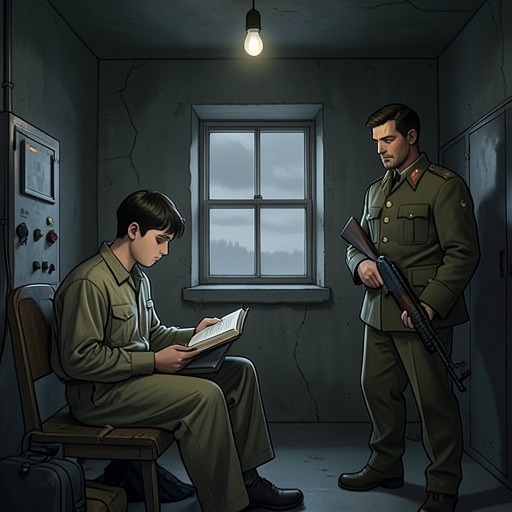
The Prison Anti-Snitching Code
A Man in FullThe Prison Anti-Snitching Code is an informal rule of inmate life at Santa Rita: seeking help from deputies can mark a prisoner as a snitch, even when someone has been hurt. Its force comes not from any stated written regulation but from the social risks attached to being seen as an informant. Through Conrad Hensley’s response to Pocahontas’s injury, the novel tests the code against a more immediate obligation to help a person in danger.
The Rule and Its Costs
The code makes silence consequential. When Rotto assaults Pocahontas, other prisoners do not intervene. Conrad later measures that inaction against the language of courage and manhood: prisoners across the black, Latin, and white turfs, he thinks, had tattoos, crosses, and muscles, yet none helped the isolated young man. The code therefore operates in a setting where failing to report an assault can preserve one’s standing, but also leaves a vulnerable inmate exposed to violence.
Conrad’s decision is not simple. He recognizes that calling the deputies may make him appear to have informed on the attacker. At the same time, Pocahontas is injured and bleeding. The episode brings the rule’s competing pressures into view without presenting the danger of retaliation as imaginary: Five-O warns Conrad that Rotto is a shot caller and that the incident may become a serious conflict.
Conrad Calls for Help
Conrad first asks Five-O to get a deputy, but Five-O responds as though the request is irrational. Conrad then looks around the pod, spots the surveillance camera, and steps directly into its line of sight. Facing the camera, he calls, “Yo! Deputy!” and reports that a man is injured. The camera gives him a way to make the emergency visible to the authorities, but it does not remove the social meaning of his appeal. He has acted in public, in front of the inmates whose judgment he fears.
When the deputies arrive and ask what happened, Conrad says he does not know and describes Pocahontas as having collapsed. He considers telling them the whole story, but does not. That omission matters: he has intervened to get medical attention, yet stops short of identifying the assault to the authorities. The scene does not state why he withholds the full account. It leaves his answer beside the code’s pressure, showing both the limit of his disclosure and the perilous position created by speaking at all.
The deputies carry Pocahontas away, with the bloodstain on his trousers visible. Conrad’s action has secured a response to the injury, but it has not made him safe or restored the victim to the group. His choice answers the immediate need for help while leaving the wider question of accountability unresolved.
Social Consequences in the Pod
Afterward, the inmates’ withdrawal makes the cost of Conrad’s decision legible. Back at his table, he sees no one looking at him; both the Nordic Bund and Nuestra Familia seem to draw away rather than risk contact. He understands himself as a conspicuous, scorned newcomer who has helped an inmate others regard as untouchable and has come close to being a snitch. The code is enforced here not by a formal punishment described in the episode, but by isolation and the prospect of conflict.
Five-O’s response is more complicated. He is privately elated when Conrad later stands up to Rotto, but keeps his celebration to a whisper because sound carries through the pod and he does not want the inmates to know he supports the man who humiliated the shot caller. His caution shows that even sympathy can require concealment. The code shapes not only what a prisoner says to deputies, but also what he dares to let other inmates hear.
Ethical and Narrative Significance
Conrad’s reflection turns the code into a test of what prison conduct calls manhood. He asks himself why he waited until the assault was over to help, and why he had not offered Pocahontas even a word of companionship beforehand. At the same time, his questions acknowledge the victim’s isolation and the difficulty of acting within the pod’s existing loyalties. The scene does not make Conrad’s belated intervention equivalent to sustained solidarity; it distinguishes obtaining help in a crisis from having offered support before one.
The rule’s central contradiction is that silence can protect a prisoner from being labeled an informant while allowing violence to proceed without interruption. Conrad breaks that silence far enough to bring deputies to an injured man, but not far enough to recount the assault. The divided action preserves the scene’s moral tension: compassion requires him to risk the status of a snitch, while the code continues to constrain how much he will say.