“Death to Koreans!”
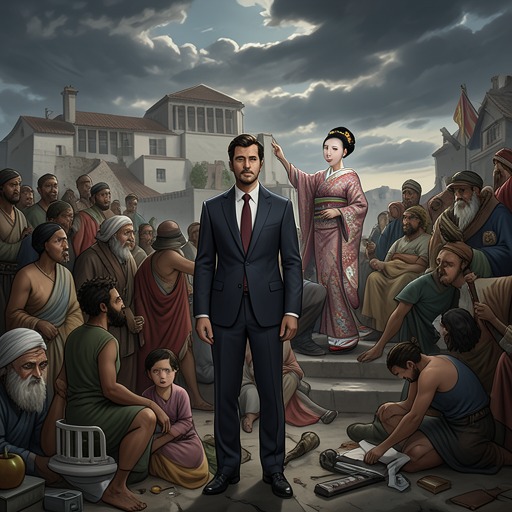
A Man“Death to Koreans!” is a xenophobic slogan whose significance in the novel lies in the violence it can authorize and the history it makes present. For Kido, the words sharpen from a public expression of far-right hostility into a personal and familial threat, connecting contemporary demonstrations to the massacre of Koreans after the 1923 Great Kanto Earthquake. His growing alarm also unsettles his sense of himself: he feels the vulnerability associated with being Zainichi while confronting the historical responsibility attached to his Japanese citizenship.
A threat made personal
For much of his life, Kido had felt little direct connection to discrimination against Koreans. After the Great East Japan Earthquake, however, renewed attention to the massacre in Yokohama and reports of rising nationalism and xenophobic demonstrations made him more conscious of how others might categorize him. The slogan names the possibility that hostility toward a group can become a danger to particular people, not simply an ugly feature of public debate.
That danger becomes intimate when an old university friend alerts Kido to an online post that identifies him as a Zainichi lawyer. The post takes a case he had handled years earlier and turns the suspect’s background into material for racial abuse; it also pairs a childhood photograph of Kido with accusations that he is a spy and a North Korean agent. Because it mentions that he is married and has a child, the attack reaches beyond his public professional identity toward his family. Kido is left shaken by the exposure, though he does not tell Kaori. The slogans shouted in the streets and the abuse directed at him online are distinct incidents, but together they make prejudice harder to dismiss as somebody else’s problem.
History returning to the present
The slogan also carries the weight of the 1923 massacre of Koreans after the Great Kanto Earthquake. In Kido’s reflections, the anniversary brings the past into a future that is already shadowed by the prospect of another major earthquake, whether in the Nankai Trough or near Tokyo. He imagines that disaster and social panic could again create conditions in which people take the cry seriously and turn against Korean residents. The concern is not that a future massacre is certain, but that the history of violence makes the possibility impossible for him to treat as unthinkable.
Kido’s unease is grounded in records as well as anticipation. He recalls that documented prosecutions alone included fifty-three cases involving the murders of Koreans, and that the Ministry of Justice at the time reported 233 deaths. The total was thought to be several times higher, though estimates differed, and Chinese people were also among those killed. Against that record, the slogan is not merely an abstract insult: it recalls a public climate in which rumor and hostility could expose people to lethal danger.
Citizenship, vulnerability, and responsibility
Kido’s anxiety is complicated by his position. He grew up largely as a Japanese person and had not experienced himself as either a direct victim or a perpetrator of the conflicts surrounding Korean communities. Yet the contemporary slogan forces him to consider how little his professional standing or private virtues would matter to someone acting on racial hatred. Being a lawyer, a father, a music lover, or a good person could not guarantee his safety; in the eyes of a hostile crowd, such qualities might make no difference at all.
At the same time, Kido does not understand himself only as a potential target. As a Japanese citizen, he feels implicated in the historical responsibility of the society in which the massacre took place. His reflection moves between identification with the victims and recognition of his own connection to the country responsible for their persecution. This unsettled position explains why the slogan produces more than fear: it confronts him with the difficulty of belonging to a society in which he may be endangered and whose history he cannot simply disown.
Public speech and political unease
The slogan’s force also depends on the environment in which it circulates. Kido worries that lies and fabricated news can stir people within ordinary life, while the courts and the legal order that protect him and his family may not be enough to restrain those ready to act on hatred. His anxiety is not confined to far-right demonstrations. He and his colleagues are dismayed that respected publishers are filling bookstores with titles such as Hating China and Hating Korea, a sign that hostility can travel through institutions beyond the street protest.
A later television discussion makes the public dimension explicit: commentators denounce xenophobia and mention the massacre, an unusual intervention in the broadcast climate Kido has been observing. He also reconsiders his earlier criticism of Misuzu for joining counter-demonstrations. He comes to understand that she did not participate because she held an idealized view of Zainichi people, but because their existence was under threat. His own argument—that Japanese people should regard the danger as a problem of their country and oppose those giving bigots free rein—returns to him as an obligation he has not fulfilled.
Narrative significance
The phrase gathers the novel’s concerns with identity, historical memory, and the fragility of ordinary protections into a few words. Its recurrence links a past massacre, present-day rallies, hateful online exposure, and Kido’s imagined future after another disaster. That pattern does not make these situations identical; it shows how historical knowledge changes what Kido can dismiss or regard as safely over.
Kido’s response remains conflicted rather than triumphant. He questions whether his concern for society is sincere or partly a performance of virtue, and he is weary of his own heightened sensitivity to prejudice. Even so, he can no longer return entirely to the earlier comfort of treating intolerance as a mistake. The slogan matters because it turns that retreat into a moral and personal question: what does it mean to belong to a society where such words can be shouted, and what responsibility follows from hearing them?