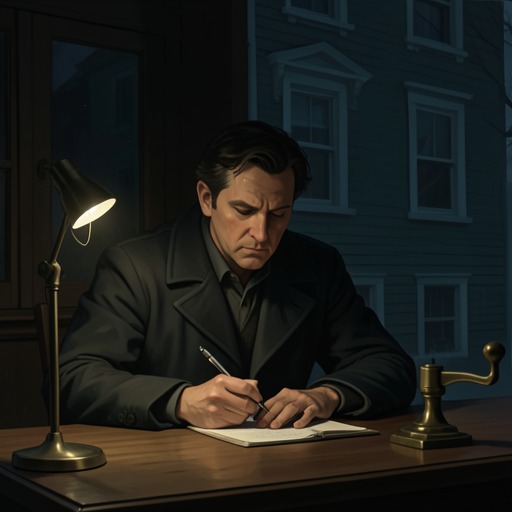
Akira Kido and Makoto Hara’s investigative connection
A ManAkira Kido and Makoto Hara’s investigative connection is built around a life Kido reconstructs after Hara’s death: first a case to explain, then a story that alters how Kido understands both Hara and himself. Kido never meets Hara alive. Instead, he follows the trail of the family-register exchange, searches for the missing Daisuké Taniguchi, and ultimately visits Hara’s former logging grounds, where imagining Hara’s daily life brings the investigation to its most personal point.
The investigation and Hara’s history
Kido’s interest in Hara is rooted in the unresolved circumstances surrounding his identity and death. To understand the man who had lived as Daisuké Taniguchi, Kido pieces together a history that begins with Hara’s father, Kenkichi Kobayashi, and the murders he committed. He then follows Hara through childhood bullying, abandonment by his mother, and time in a boxing club. Hara’s ambition to become a boxer ended after an accident following his professional debut. The sequence matters to Kido not simply as background: it shows the accumulation of losses and reversals preceding Hara’s decision to begin again under another identity.
The family-register exchange gives Kido’s inquiry its central practical problem. He needs to find the real Daisuké Taniguchi, confirm that he is safe, and, if possible, learn what passed between him and Hara when their identities were exchanged. The search stalls. Kyoichi Taniguchi, whose help Kido had once hoped to enlist, refuses to get involved after learning about Kobayashi’s crimes. He condemns Daisuké for willingly entering what he calls an “other world,” and Kido comes to accept that Kyoichi will not assist him.
Kido’s work on Hara therefore remains incomplete even as other professional responsibilities reach their conclusions. After speaking with Kaori about Hara, Kido feels newly compelled to bring the investigation to some kind of resolution, but Daisuké is still missing. His persistence reflects more than a desire to close a file: the longer Hara remains a figure assembled from testimony and implication, the more Kido wants to understand what his choices meant to him.
From indirect contact to resolution
A breakthrough comes through Kido’s renewed contact with Misuzu. An email about seeing her on television prompts a reply that supplies news relevant to finding Daisuké. Kido gets in touch with the person using the name Yoichi Furusawa, who responds after 2:00 a.m. with a series of questions challenging Kido’s identity and demanding to know who the initials Y. S. refer to and how Kido is connected to the account. The guarded message confirms Kido’s suspicion that the person on the other end is Daisuké, living under the name Sonézaki. It also makes Daisuké’s effort to conceal himself look less convincing to Kido, who begins to feel sympathy for him rather than simply treating him as an obstacle in the case.
Kido proposes a Skype call so the two men can verify each other’s identities. He is willing to speak first with Yoichi Furusawa and, if possible, directly with Y. S. That exchange ultimately leads to Kido meeting Daisuké and interviewing him about the register swap with Hara. The meeting supplies an answer to a question that had sustained Kido’s search, though not every detail he would have liked to know about Hara.
After a year and three months of investigation, Kido completes his report for Rié and decides that, for the time being, it is important to put the inquiry to rest. The decision marks a practical endpoint, not full knowledge: Kido acknowledges that more remains unknown, but no longer treats the investigation as something that must continue indefinitely before he can move forward.
The forest as an imagined meeting
Kido’s return to Miyazaki makes clear that closure is not merely a matter of delivering the report. He wants to discuss it with Rié in person, but recognizes that this does not fully explain his desire to come back. He also wants to visit the place where Hara worked. Through Rié’s introduction, Kido arranges to meet Ito, president of Ito Lumber, and see the company’s logging grounds. He tells Ito that he is interested in forestry rather than offering an elaborate pretext, and Ito agrees to show him the mountains where the company operates.
At the worksite, Kido is left alone for a time among rain-soaked cryptomeria. Thinking about Hara at work with a chainsaw, he recalls that a cryptomeria takes fifty years to mature and considers the long span of time carried by the trees: planted by people of earlier generations, cut in Hara’s time, and followed by trees that would be felled by people yet to come. Against that scale, Kido imagines the ordinary measure of Hara’s days. Hara may have wanted to finish work, return to Rié and the children, and lie down beside them after putting them to bed. Kido imagines that the family’s brief happiness felt immediate and powerful precisely because of everything Hara had endured before reaching it.
The scene shifts from reconstruction to reverie. Kido loses his sense of time while standing in the rain; when he opens his eyes, he momentarily mistakes a logger for Hara. He imagines what he might say if Hara were really there and thinks of Hara beginning life anew after his second suicide attempt because he wanted to remain alive. In Kido’s imagined exchange, he wants to tell Hara that he understands. The encounter does not happen outside Kido’s mind, but it brings the emotional pursuit of Hara into focus: Kido has followed the traces of a man he never knew until he can picture, however briefly, standing before him.
What Hara’s story changes for Kido
Kido’s response to Hara’s history is not detached from his own relationships and struggles. Talking about Hara with Kaori helps make the investigation newly urgent, while Kido’s conversation with Misuzu gives him language for change within love: he agrees that love can persist precisely because it changes. That idea resonates with his attempt to understand Hara’s life without reducing it to the false identity under which Hara lived. The register exchange altered Hara’s name and circumstances; it did not, in Kido’s developing account, erase the person whose hopes, losses, and family life lay behind them.
The forest visit also distinguishes understanding from recovery. Kido can imagine Hara’s fatigue, the wish to return to his family, and the happiness he may have found, but these remain imaginings rather than memories or testimony. He does not claim that this reconstruction answers every question. Its force comes instead from Kido’s recognition of a connection that evidence alone could not establish: he wishes he and Hara could have met.
That wish completes the emotional movement of the investigation without undoing its limits. Kido has located and interviewed Daisuké, prepared Rié’s report, and stopped pursuing the case after fifteen months. Yet Hara remains present to him—not as a mystery fully solved, but as a person whose attempt to live again has become legible to Kido through the traces of his past and the worksite he left behind.