Akira Kido and Sota’s father-son relationship
A ManAkira Kido and Sota’s father-son relationship is at once part of the family’s everyday routine and a measure of Kido’s deepest anxieties: in the dark beside his son, the simple fact of being Sota’s father becomes a source of ecstasy, while the prospect of leaving Sota behind makes death newly personal.
Family Life and Everyday Intimacy
Kido and his wife, Kaori, bought a ninth-floor condominium near Yokohama’s Chinatown with thirty-five-year mortgages. Their home had been arranged for two children, but the second child they had hoped for had not arrived, and they had recently stopped discussing the possibility. Their four-year-old son Sota was therefore at the center of a family life whose familiar routines Kido had not expected to affect him so intensely.
After picking up fried chicken and savory steamed buns in Chinatown, Kido returned home to eat with Kaori and Sota, repeatedly reminding the child to stay in his chair. It was an ordinary dinner, much like many others, yet it stirred Kido’s emotions more than usual. The significance did not come from a special occasion but from the familiar closeness of caring for a small child.
At bath time, Sota asked about Narcissus after hearing a picture-book version of the Greek myth at day care. He haltingly explained the story and wanted to know why Narcissus had turned into a flower. Kido tried to answer by imagining how people might have looked at a beautiful flower and invented a story to explain its drooping neck. Sota seemed unconvinced; the question became Kido’s homework.
After the bath, father and son sat together in Sota’s room with an illustrated guide to the Ultraman series. Kido then understood why his son had been drawn to transformation: Ultraman, too, changes from a human into a giant alien. The moment joins Sota’s mythological question to the things he enjoys, while showing Kido trying to follow the links in his child’s thinking rather than merely dismissing the question.
Kido’s Recognition of Fatherhood
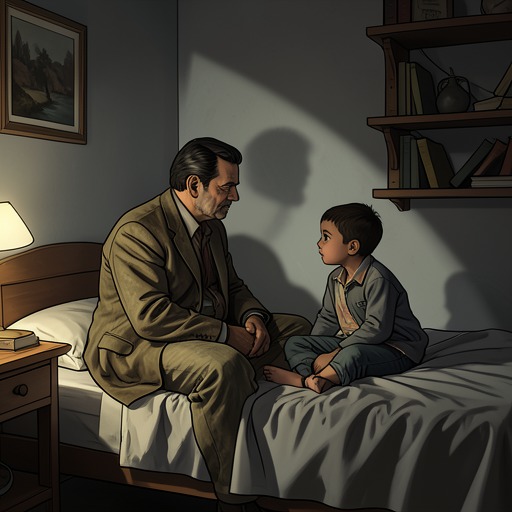
Kido eventually turned off the light and fell asleep beside Sota as he put him to bed. The child’s hand in the dark prompted a sudden, intense happiness. Alone later, Kido recalled that feeling and understood it through the relationship itself: he was Sota’s father, and even the words connecting father and child seemed charged with extraordinary meaning.
The revelation was not uncomplicated. Kido sensed that the specialness of this banal moment was also the reverse side of his anxiety. The more precious Sota became to him, the more sharply Kido could feel what he stood to lose. He wondered whether he might remember that night as the happiest of his life, an anticipation that lends the domestic scene a weight beyond its outward quiet.
The family’s closeness existed alongside a changed household arrangement. Kido had converted the room intended for a second child into a study and put a bed there for naps; he and Kaori had begun sleeping separately, since both rested better that way. After falling asleep beside Sota, Kido woke in the night to find the master-bedroom light out and its door shut. The tenderness of his bond with his son is therefore set within a marriage whose daily communication had dwindled: apart from telling Kaori about the day-care Christmas party over dinner, Kido had not spoken with her that day.
Mortality and the Father’s Future Absence
A friend’s early death makes Kido imagine Sota receiving the news that his own father has died. In this imagined exchange, Sota asks whether Daddy is dead, but Kido recognizes that he would be unable to answer or explain death from beyond his own absence. The thought transforms his previously nebulous mood into what he identifies as existential anxiety. His fear is not only of dying; it is of ceasing to exist while Sota continues in a world from which he has vanished.
Kido’s concern turns toward the memory he might leave. He wonders what kind of person Sota will remember when the boy reaches thirty-eight, Kido’s age at the time: that would be thirty-three years later, when Kido would be seventy-one, if he were still alive. Old age is only one possible limit. Kido also considers the possibility of a Nankai Trough earthquake, a danger repeatedly discussed since the earlier earthquake, striking suddenly and killing him before he could prepare Sota for his absence.
The father-son relationship thus makes Kido’s questions about identity temporal as well as emotional. He had once wondered who he was in order to decide how to live; now he asks whether he made the right choices and what sort of person he will have been. The name Akira Kido links the successive stages of his life, but Sota’s future recollection gives that continuity a human stake: Kido is anxious not only about the end of his own consciousness, but about the version of himself that may persist in his son’s memory.
Care Across Generations
Sota’s understanding of fatherhood later helps him interpret the kindness he received from his own deceased father. He tells his mother, Rié, that he now understands why his dad was so nice to him: he thinks his father did for him what he had wanted his own father to do for him. Rié affirms that this is true, but adds that his father was also kind because he cared about Sota.
The exchange describes care as something that can be carried forward without reducing it to a simple repetition of an earlier hurt. Sota recognizes an inherited longing within his father’s tenderness; Rié preserves the distinct, immediate truth of the father’s love for his son. In the novel’s wider concern with family histories and incomplete losses, this distinction matters: understanding where a parent’s care came from does not make the child merely a substitute for someone else. Sota was loved in his own right, and the memory of that love gives their relationship meaning beyond the father’s absence.