Burial Hill Park
A ManBurial Mound Park is a family landscape where flowers, trees, and repeated visits hold memories that Rié has not yet been able to explain. A place first associated with seasonal outings becomes the setting for Yuto’s insistence that his father be remembered with a grave—and for Rié’s admission that she has been keeping something from him.
Setting and Seasonal Landscape
On the last Sunday of October, Rié drove to the park with her mother, Yuto, and Hana to see its cosmos, expected to reach full bloom slightly earlier than usual. The park’s tumuli lay in an ellipse half the width of a soccer field, among fields of flowers that extended to the horizon. Some three million red, pink, and purple cosmos surrounded yellow centers, while 319 burial mounds, counting the smaller ones, punctuated the grounds. The mounds had once stood in a barren landscape; a city initiative introduced color, and the park’s seasonal pattern now included cherry and mustard blossoms in spring and sunflowers in summer.
The family’s visit took place on a clear, mild day, but they were not alone in seeking the display. Cars from across Miyazaki Prefecture and beyond filled the parking lot, families crowded the paths, and amateur photographers lined the flower fields with tripods and heavy cameras. The breadth and cultivated order of the park make it both a public attraction and a familiar family setting: its flowers return with the seasons, while the people who come to see them change.
A Place Made Personal
Going to see the flowers had been a tradition since Rié’s childhood. Her late husband loved the scenery so much that he named their daughter Hana, meaning “flower”; Hana, in turn, called the park “my park.” When Rié’s mother asked her to stand beside the cosmos, Hana eagerly requested a photograph. Comparing her height with the flowers and looking at pictures from earlier years delighted her. She was still small enough to disappear among the blooms if Rié did not watch closely, but Rié imagined that in another year or two she might grow taller than them.
The scene makes the park’s seasonal return a measure of family time. Hana’s photographs preserve her changing height, while the cosmos sway behind her as Rié tries to frame the picture amid the crowd. The park is not only a floral spectacle: it is a place where a child can recognize herself from year to year and where a parent sees how quickly that recognition will change.
The Family’s Chosen Trees
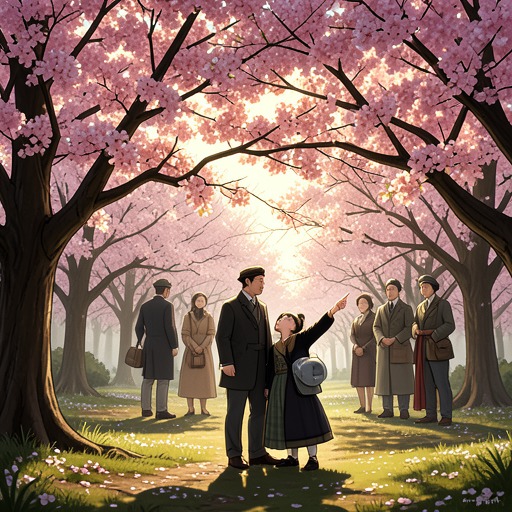
The park’s cherry trees had acquired a more private meaning for the family. After Rié remarried, the family chose individual favorites: Rié selected one tree, Yuto chose a tree two places away from his father’s, and Yuto chose Hana’s tree for her while she was still in the womb. On later visits, the selected trees seemed distinct from all the others because the family had invested them with affection. Each spring, they compared the blossoms to decide whose tree had flowered most impressively. Yuto’s tree lost to his father’s in the year his father died, then won the following year.
Yuto still wanted to stand before his father’s grave and tell him about that victory, but he had been waiting for the chance. Another spring passed without Rié bringing the family to see the trees. When Yuto asked whether she remembered his father’s tree, Rié recalled it by its position and branches. She stopped before the dead man’s bare tree and considered the choice he had made among the park’s roughly two thousand cherry trees: she did not know his past, but she knew he had preferred this one. The tree’s annual blossoms and present bareness hold together the family’s shared ritual and the absence around which it has come to turn.
Bereavement and Disclosure
At the park, Yuto confronted Rié about what she had not done. The anniversary of his father’s death had passed again, he said, and she still had not made a grave for him. He spoke with a composure Rié had not expected from a child, and she understood that a vague answer would not satisfy him. She could not explain herself immediately, but she answered that she had been keeping something from him.
That exchange gives the park’s remembered attachments an immediate consequence. Yuto’s wish to tell his father about the cherry-tree contest has endured beyond the annual visit, and the unmade grave has become impossible for him to overlook. Amid a public field of seasonal flowers and a family ritual dating back to Rié’s childhood, the bare tree marks what remains unresolved. The place where they had once compared blossoms becomes the threshold at which Rié begins to disclose the hidden past.