Buxi Fuzhi
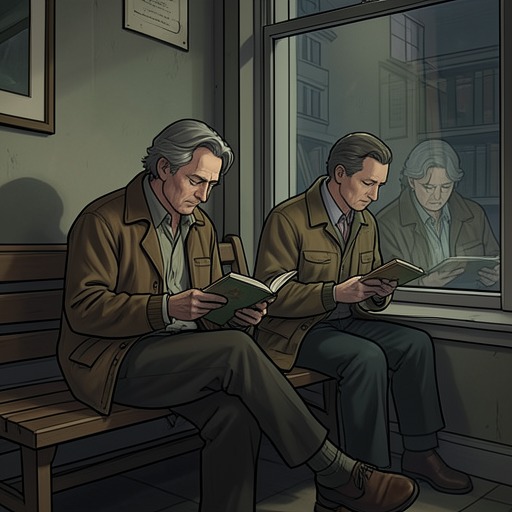
A ManRené Magritte’s painting Not to Be Reproduced is invoked as a visual analogy for the novel’s structure of pursuit and doubling: a man faces a mirror that reflects the back of another version of himself, who in turn looks into the reflection’s depths. The image links Kido’s obsession with another man’s life to the author’s own position watching Kido, making the act of observation part of the pattern it describes.
The Painting and Its Recursive Image
The painting’s described composition withholds the face of the man before the mirror and offers instead another back, repeated within the reflection. Its significance here lies in that recursive arrangement: looking does not reveal a definitive original, but carries the gaze further into another version. The novel is said to resemble the painting in some ways, establishing visual doubling as a frame for its story without claiming that the two works are identical.
Kido as Pursuer and Observed Figure
Kido becomes absorbed in the life of a man, and the author explains that the novel follows Kido from behind as he pursues him. The emphasis falls not only on the man being pursued, but on the pursuer as a figure worth observing. Kido’s investigation thus becomes a mirror-like structure: his attention is fixed on another life, while the narrative makes his own act of pursuit visible.
The Author’s Position in the Reflection
The analogy extends beyond the novel’s characters. The author describes himself as absorbed in watching Kido absorbed in his obsession, placing the act of writing inside the same chain of attention. The author watches Kido; Kido watches the man whose life he seeks to understand. This recursive arrangement makes the observer part of the subject, rather than an invisible point outside it, and presents the novel’s central theme as something the reader may discern in the author’s own stance.
Significance
Not to Be Reproduced gives the novel a compact image for its interest in doubles and the limits of seeing another person. The reflected figure is not presented as a clear, final original; the gaze continues inward. In parallel, Kido’s pursuit and the author’s observation do not collapse into one another, but echo across successive positions. The painting therefore serves both as an interpretive key to the novel’s pattern and as a reminder that every account of another person also reveals the observer who makes it.