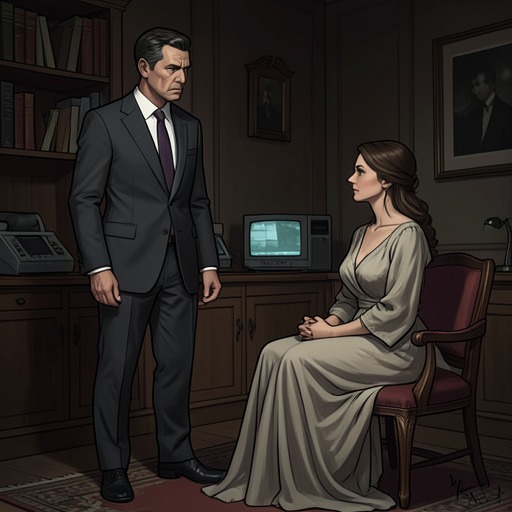
Daisuké Taniguchi and Kyoichi Taniguchi’s brotherly relationship
A ManDaisuké Taniguchi and Kyoichi Taniguchi’s brotherly relationship is marked by the gap between affection and reciprocity: Daisuké continues to love his older brother, but sees their parents’ preference for the firstborn as a source of lasting injustice, while Kyoichi later describes Daisuké as a resentful burden. Their father’s illness brings that imbalance to a crisis. Daisuké consents to donate part of his liver, yet his father dies before the operation, and the family offers him neither comfort nor recognition that his choice had cost him anything. The divergent stories the brothers tell about this history leave Daisuké estranged from the family and make their relationship a defining part of his past.
Family roles and inheritance
The brothers grew up in a family that owned an inn in Ikaho Onsen, a hot-springs town in Gunma Prefecture. Kyoichi, a year older, was the firstborn and presumed heir. Though not bad-hearted, he grew complacent about inheriting the inn, neglected his studies, and became something of a hoodlum in middle school. He later entered a private university in Tokyo, studied in America for two years, and returned to the capital to run a restaurant with friends. Daisuké, the less adventurous younger son, graduated from a public university in the countryside.
Their parents loved Kyoichi dearly and persisted in asking him to return to the inn. When those efforts failed, they reluctantly turned to Daisuké, who joined his father’s company and worked diligently to reassure his disappointed parents that their legacy could be entrusted to him. The arrangement seemed to give the younger son a path toward responsibility, but it did not settle the question of who was truly valued in the family.
That uncertainty sharpened when Kyoichi’s restaurant failed and left him with a large debt. He returned to his father in tears. Their father agreed to pay the debt only on condition that Kyoichi take over the inn; their mother supported the decision. The parents promised that Kyoichi would eventually be managing director and Daisuké vice president. Daisuké understood that, whatever the titles, he would be expected to carry the business in practice. He feared that the arrangement would damage his bond with his brother, while the old question remained: why did being the eldest male command so much of their parents’ love?
The transplant and its aftermath
Several years later, their father was diagnosed with advanced liver cancer at age seventy-one. A transplant offered a poor chance of survival, and there was no time to wait for a liver from a brain-dead donor. Kyoichi was disqualified as a potential donor because he had a fatty liver; Daisuké’s liver was healthy. To Daisuké, the prospect seemed unfair precisely because he had not lived as immoderately as his brother.
The operation carried risks for the donor as well as the recipient, including the possibility of death. Their father, who had never before bowed to Daisuké, gripped his hand and wept as he asked him to fulfill his duty as a son. Kyoichi and their mother did not explicitly demand that Daisuké agree, but neither reassured him that he was free to refuse. They said they wanted their father to live, made no effort to persuade him to reconsider, and held family discussions when Daisuké was absent. He sometimes arrived at the hospital to find them meeting without him. He understood the urgency and wanted his father to live too, but the circumstances left him feeling the pressure of a decision that was supposed to be his.
Daisuké ultimately consented, insisting to himself that he would donate by his own free choice rather than simply capitulate to his family. His father was overjoyed and thanked him—the only time he would ever do so. Kyoichi promised Daisuké the entire inheritance when it came, and their mother appeared happy. But the cancer advanced faster than expected. By the time Daisuké was wavering over the operation, it was too late; their father died before the transplant, wearing an expression Daisuké remembered as irritated and almost hateful. The family mourned together, but neither Kyoichi nor their mother offered kind words about Daisuké’s ultimately fruitless willingness to undergo the procedure.
Two accounts of the same family
Daisuké later told Rié that he had wanted to save his father but had grown frightened as he learned more about the operation. After his father’s death, he felt that something inside him had been broken beyond repair. He cut off contact with his family, left town, and said he had no intention of seeing them again. He called this the last time he would speak of his family. His departure was not presented as a simple rejection of his brother: Daisuké had loved Kyoichi, but believed that love was not fully returned, and the transplant crisis seemed to confirm that his family’s urgent need for him did not translate into care for what the choice cost him.
When Kido asked Kyoichi about the conflict, Kyoichi interrupted, visibly upset, and rejected Daisuké’s account. He insisted that their father would never have twisted Daisuké’s arm, that Daisuké had volunteered freely, and that he later distorted the story to complain. Kyoichi also recast the inheritance dispute: he said that he had handed the business to Daisuké when Daisuké wanted it, and that he himself had never wanted an inn in the countryside. In his version, he returned only because their parents pleaded that Daisuké could not manage the business alone. He described Daisuké’s bitterness as childish envy of the greater importance granted to the eldest son.
Kyoichi’s denial coexists with a more practical fear about the family’s future. He worried that their mother had been distressed by Daisuké’s sudden disappearance and that rumors of a crime involving him could ruin the inn. He had already wondered whether the man who exchanged identities with Daisuké might have killed him, and objected that the wife who received life-insurance money should also be investigated. His concern for the family’s reputation and business did not soften his language about his brother: he called Daisuké an inferiority complex made flesh, said their personalities had never suited one another, and spoke of his death beneath a tree with contempt rather than tenderness. Rié, who had loved Daisuké’s quiet kindness, heard no convincing sadness beneath the insult. She understood why he had resisted contact with Kyoichi and regretted having urged him to reach out.
Estrangement and the meaning of inheritance
The brothers’ conflict is not resolved by a single authoritative account. Daisuké remembers a family that allowed him to choose only within the pressure of duty, then left him alone with the fear and disappointment of that choice. Kyoichi remembers a brother who volunteered, resented his place in the family, and later recast generosity as grievance. Their incompatible recollections make the transplant more than a failed medical intervention: it becomes the point at which the brothers’ different understandings of obligation, parental love, and fairness can no longer be reconciled.
Daisuké’s eventual decision to leave home and sever contact carries the consequence of that unresolved history. The inn’s inheritance, once framed as a division of titles and responsibilities, had already revealed the difference between being named a successor and being emotionally recognized. Kyoichi could promise Daisuké the inheritance, yet neither that promise nor their father’s brief gratitude repaired the underlying fracture. When the operation never took place, the family lost its chance to turn Daisuké’s choice into a shared act of care; after their father’s death, his brother’s denial helped make departure feel like the only way to escape the role the family had assigned him.