Daisuké Taniguchi and Misuzu Goto’s romantic relationship
A ManDaisuké Taniguchi and Misuzu Goto’s romantic relationship began in high school and continued intermittently into adulthood, making Misuzu one of the few people able to recall Daisuké outside the family’s competing expectations of him. Their love was real, but it did not resolve the pressures that shaped his life: his parents’ preference for his elder brother, the burden of responsibility for the family inn, and the decision to donate part of his liver to save his father. After the transplant and his father’s death, Daisuké disappeared from Misuzu’s life without explanation. Her recollections give Kido an intimate account of the missing man and expose how family obligation and a hunger for affection had narrowed his choices.
A relationship remembered through photographs
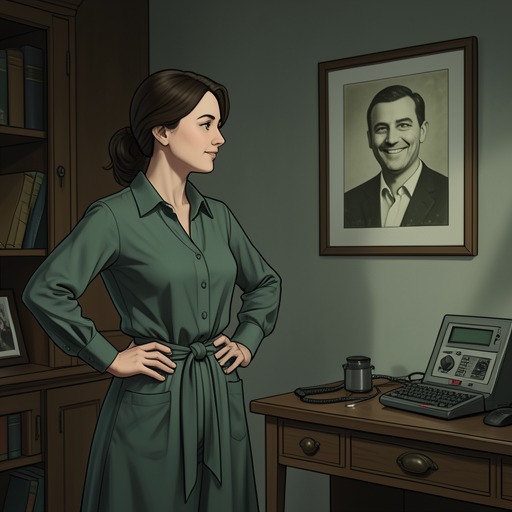
When Kido asks Misuzu about Daisuké, she brings a brown envelope containing three photographs from the period when they were together, more than ten years earlier. They are more recent than the family photographs Kyoichi had supplied, and show Daisuké facing the camera with the stiffness and bashfulness of someone being photographed by a lover. Misuzu offers the pictures for Kido to keep, though she has no recent image or information about Daisuké. The photographs provide a personal trace of a man who, in the family’s account, is mostly defined by his role as the dependable younger son.
Misuzu says she has known Daisuké since high school. They dated, broke up, and were together for a time; she also knew Kyoichi, which is why Kyoichi believed she might know how to find his brother. Her account complicates the family story without turning the brothers into simple antagonists and allies. She remembers Daisuké liking Kyoichi and says the brothers got along at least until high school, despite their contrasting characters. In her view, the lasting strain lay less between the brothers than in their parents’ uncertainty over who would inherit the inn.
Family expectations and the inn
Misuzu explains that Kyoichi had refused to take over the family business, so Daisuké became the fallback choice. Yet their parents continued to behave as though Kyoichi might still change his mind, leaving Daisuké’s future suspended. Daisuké wanted to succeed to the inn, a well-known establishment with a history in Ikaho Onsen. The uncertainty mattered to him not only as a question of work or inheritance: he loved his brother, but did not experience that affection as fully returned, and struggled to understand why being the eldest son seemed to secure Kyoichi’s place in their parents’ hearts.
Daisuké tried to make his parents’ decision easier by applying himself at his father’s company. When Kyoichi’s restaurant failed and he returned with substantial debt, their father agreed to pay it only if Kyoichi took over the inn. The parents promised Kyoichi the title of managing director and Daisuké that of vice president, though Daisuké understood that he would carry the practical burden of running the business. Misuzu’s recollection of the succession struggle adds an intimate dimension to this arrangement: the problem was not simply that Daisuké lacked a place, but that his place could be repeatedly made provisional by the possibility that his brother might come back.
The transplant and Daisuké’s decision
When their father developed advanced liver cancer, a transplant from a relative offered the only timely chance of survival. Kyoichi was ruled out because of fatty liver, while Daisuké’s liver was healthy. Misuzu later rejects the idea that his decision was uncomplicated or effortless. She believes he was frightened by the risks, including the possibility of lasting complications, and tormented himself for fearing a danger that other family donors seemed to accept without question. She recalls that he felt both obligated and uniquely able to save his father.
The family’s conduct helps explain why Misuzu sees his consent as bound up with a need for love. Daisuké’s father took his hand, bowed, and asked him to fulfill his duty as a son. His mother and Kyoichi did not explicitly order him to donate, but neither assured him he was free to refuse; they spoke with their father when Daisuké was absent and made clear that they wanted him to live. Daisuké ultimately chose to donate, telling himself that he would do it freely rather than merely give in to pressure. His father was overjoyed and thanked him—the only time he ever did so. Kyoichi promised him the entire inheritance, and their mother appeared happy. Misuzu’s later interpretation does not erase Daisuké’s agency; it reveals how difficult it was for him to separate a choice he made from his longing to be valued by his family.
Disappearance and the limits of contact
Misuzu and Daisuké were together again after his father’s funeral. By then she had moved to Tokyo, while Daisuké was still living with his family, and they met perhaps twice a week. Then he disappeared suddenly. There was no conversation ending the relationship, and no later call or message; his phone number had been disconnected. The abruptness left Misuzu without even the ordinary explanation of a breakup.
Kyoichi later suggested Misuzu might know how to reach his brother, but she had not been in touch with Daisuké for more than a decade and had no knowledge of his life. Kido learns that her former romance gave her an understanding of Daisuké’s emotional history, not a route to his whereabouts. Her memories therefore sharpen rather than settle the mystery: they make his disappearance legible as an escape from an unbearable family situation, while leaving its precise circumstances unresolved.
What Misuzu’s account reveals
Misuzu remembers Kyoichi calling Daisuké a little shit and failing to appreciate what he did. She believes Kyoichi could not accept that she loved his brother, and that he resented Daisuké’s position as the person able to save their father. When Daisuké hesitated over the transplant, Kyoichi dismissed the risk and criticized him for making a difficult decision seem dramatic. Misuzu’s account places this contempt alongside the family’s dependence on Daisuké: he was asked to assume responsibility, but his fear and uncertainty were not treated with the same seriousness as the family’s need.
She also imagines how Daisuké might have responded to overhearing Kyoichi tell their mother that, if his own liver had been suitable, he would have kept quiet and accepted the operation. For Misuzu, that moment helps explain why Daisuké might run away from a family in which he was needed but not reliably cherished. She worries aloud that, alone, he could be harmed or abducted, though she does not know what became of him. Kido promises to look for him and forms a sympathetic impression of Daisuké partly through Misuzu’s evident affection. Their former relationship thus becomes more than a lost romance: it is a testimony that restores Daisuké’s private fears and attachments to a story otherwise dominated by inheritance, duty, and disappearance.