Daisuké Taniguchi’s disappearance
A ManDaisuké Taniguchi’s disappearance after the 2011 earthquake unsettles both a family’s search for a missing man and the distinction between a person and the records that make him legible. His brother’s inquiries suggest that Daisuké lived under his own name until he encountered X, who took his name and family register; yet Kido’s investigation raises a more troubling possibility—that Daisuké himself may have disappeared from the official record, or that the tsunami erased the evidence by which anyone might identify him. No outcome is confirmed. The absence left behind instead becomes part of how Rié and Yuto understand family, loss, and the name Taniguchi.
The silence after the earthquake
Daisuké’s family had heard nothing from him after the earthquake. Kyoichi treated that silence as suspicious: if his younger brother were alive, he reasoned, he would at least telephone—unless his life had become so bad that he could not face them. Kyoichi voiced suspicions of murder, but the possibility remained conjecture, not a confirmed account of what had happened.
Kyoichi’s outward anger at the police search concealed a more complicated response. He resented the detective in charge, but also felt relief that the search was not becoming a public matter that might draw attention. Once Kido told him that the family register had been updated to show Daisuké alive and unmarried, Kyoichi began to regard the disappearance as something the family would have to handle privately. His mother, however, rebuked him for doing so little to find his brother. In tears, she said she desperately wanted to see her younger son once more before she died.
Tracing Daisuké’s last known identity
A family-register attachment gave Kido an address where Daisuké had lived before moving to Town S: a very cheap, neglected apartment in Osaka City’s Kita district, near the Yodo River. Kido proposed that he, Rié, and Kyoichi visit the building together. Before Rié could answer, Kyoichi went to Osaka himself, saying he had business there, and spoke with the president of the building’s management company.
After hearing Kyoichi’s story and studying a photograph of Daisuké, the president said he was fairly sure Daisuké had lived there. Kyoichi then showed him a photograph of X, but the president did not recognize X. To Kido, this straightforward check established an important sequence: Daisuké had remained Daisuké while living in the Osaka apartment, and only later encountered X, after which his name and family register were taken from him. Kyoichi was newly enraged that the police had not made this basic inquiry.
The president initially cooperated, but became wary when Kyoichi asked for Daisuké’s phone number and forwarding address, which might have been recorded when he moved out. He said evasively that he was unsure whether the files still existed and would look. Kyoichi thought the man feared becoming involved in trouble; he heard nothing further from him. The inquiry therefore clarified the likely point at which Daisuké’s identity changed without producing a current address or a way to contact him.
A search conducted through borrowed names
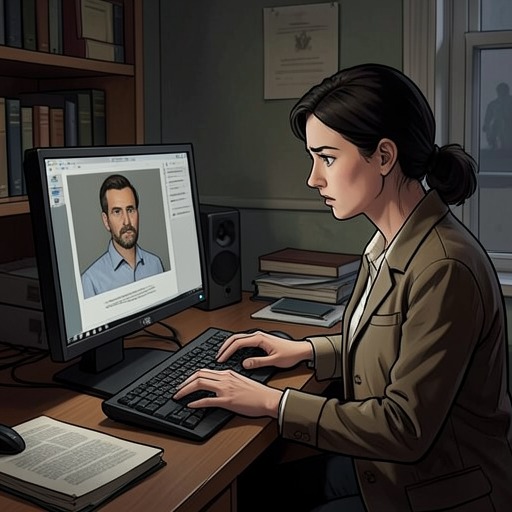
Kido considered it unlikely that a living Daisuké would register on social media under his real name, especially if his dealings with X had involved an exchange of identities. Several people named Daisuké Taniguchi appeared on Facebook, Instagram, and Twitter, but none seemed to be the man they sought. His possible use of another name made a search for his real one inherently unreliable.
Misuzu and Kyoichi also made a Facebook account in Daisuké’s name, posting old photographs, his hometown and schools, and pages for Michael Schenker and his former bands Scorpions and UFO. Misuzu said Daisuké had been a particularly devoted UFO fan. They considered trying to find him through the band’s official page, but abandoned the idea: its roughly 250,000 followers would make it too difficult to identify one person. Kido could imagine that the real Daisuké would be shocked to see the account, particularly its intimate exchanges between the supposed Daisuké and Misuzu, his former lover. But it was unclear whether he would recognize X behind the impersonation, or whether the account would persuade him to make contact. Kido’s observations also led him to suspect that Kyoichi’s interest in Misuzu predated the search and that Kyoichi had loved her before she chose his younger brother; Kido did not ask them directly about that history.
The possibility of being absent from the record
While listening to Nakakita explain the legal status of children born within three hundred days of a divorce, Kido reconsidered what the identity exchange might mean. Some children in that situation had gone unregistered, and thus could be absent from the state’s records despite meeting the conditions for Japanese citizenship. Kido wondered whether X might have been one of those unregistered people. If so, Daisuké might have taken the identity of someone who did not officially exist, while X took Daisuké’s registered identity.
That possibility changed the stakes of the search. If Daisuké had become unregistered and was murdered, the state might not recognize his death: even a recovered body could be treated as unidentified. Friends, acquaintances, DNA, photographs, and personal effects might help establish who he had been, but if the tsunami had swept away the physical evidence, even that difficult process could be made more so. These were possibilities Kido feared, not findings that established Daisuké’s fate.
The uncertainty made Kido increasingly foreboding. He had hoped Daisuké was still alive, and he did not want to believe X had killed him, both for Daisuké’s sake and Rié’s. He worried that confirmation of murder could destroy the fragile hold Rié had on her life after losing the man she had known as her husband. The missing person was therefore not only the object of an investigation: the answer could alter what Rié understood about her marriage and her dead husband.
The name that remains
The unresolved disappearance continues to matter in the household through Yuto’s insistence that he remain Taniguchi. Rié had told him she would return to her maiden name, Takemoto, but he had initially responded with what seemed to be indifference. He later explained that his family had been Yoneda when he was born, Takemoto after the divorce, and Taniguchi when he began elementary school. Now that he was in middle school, friends and students around him knew him as Taniguchi. He did not want to keep correcting them, and the name Takemoto felt to him like his grandparents’ name.
Yuto’s request was about more than convenience or continuity at school. He asked Rié whether, even when she changed back to Takemoto, he could remain Yuto Taniguchi. He said it did not feel right to do this to his father, whose family had turned away from him, and feared that the family might forget him too. Rié recognized that she had mistaken his earlier silence for acceptance. His plea made visible a grief he had not put into words when she first announced the change.
That grief also appeared in ordinary acts of care. Yuto asked to get goldfish after seeing Rié’s mother looking at the aquarium in the shed, and promised to look after them. Rié was moved by the gesture and remembered her late husband’s affectionate description of Yuto as thoughtful. At a flower field, she watched him keep an eye on his younger sister Hana while remaining quiet, and understood that he, too, was trying to bear the losses of his brother, grandfather, and the man he had thought of as his father. He had not spoken openly about his pain; reading, caring for the fish, and looking after Hana were among the ways he kept himself together.
The family’s chosen trees at Burial Mound Park gave that attachment a recurring form. After Rié remarried, each had selected a cherry tree: hers farther ahead, Yuto’s two trees away from his father’s, and Hana’s chosen by Yuto while she was still in the womb. Each spring they compared the blossoms. Yuto’s tree won in the year after his father’s death, and he wanted to tell his father, at his grave, about the victory. But Rié had not taken the family to see the trees that spring, and Yuto reminded her that another anniversary had passed without a grave being made. The tree his father had chosen among the park’s two thousand trees remained a point of connection even as the man’s identity and fate could not be made whole through records or explanation.
Rié’s understanding of Yuto deepened through his reading. After he told her about Ryunosuke Akutagawa’s “Asakusa Park,” she read the story and was struck by its boy, who is separated from his father and mistakes another man for him. Yuto had read it before Rié told him that the man he knew as his father had not been Daisuké Taniguchi. Rié could not know whether that was coincidence or whether Yuto had intuited something, but imagining her son’s response to the story brought her to tears. His indirect way of sharing what mattered to him helped her approach a loneliness he had not plainly described.
Yuto’s poem about a cicada shell on a cherry tree made that private language still more concrete. In the explanation he later gave for the poem, he described imagining the shell hearing the voice of the cicada that had emerged from it after seven years underground, then seeing the crack in the shell as resembling a violin’s soundboard. Rié knew the tree in his account must be the one his father had chosen. Yuto did not mention his brother’s or father’s death, and Rié could not tell whether the scene described an actual solitary visit or an invention. Either way, she understood that literature offered him a way to find solace in loss. The disappearance remains unresolved, but Yuto’s chosen name and his art keep a relationship to his father present without pretending that a name, a memory, or a story can settle what happened.