Death Row Art Exhibition
A ManThe Shibuya death-row inmates’ art exhibition is both a public display of prisoners’ work and the setting for Kido’s breakthrough in identifying the artist behind sketches found among X’s belongings. Drawn there by his growing interest in convict art, Kido recognizes a shared style in landscapes attributed to an executed murderer, Kenkichi Kobayashi, and X. The recognition connects the impersonation of Daisuké Taniguchi to an earlier identity exchange, but it does not by itself settle every question about who the men were or how their records were changed.
Purpose and Setting
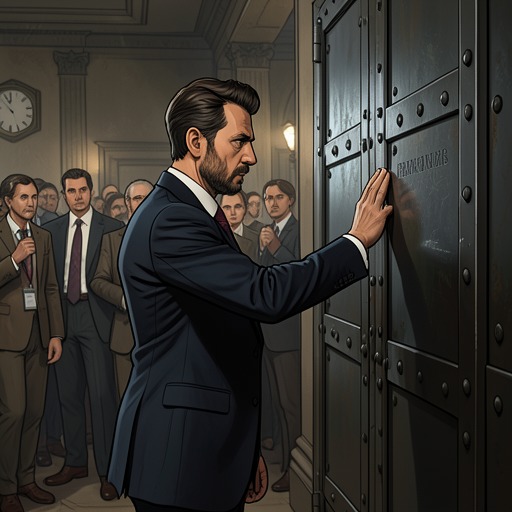
Three days before Christmas, after finishing work at the Tokyo District Court, Kido went to Shibuya for an exhibition curated from art submitted by people on death row. He had learned of it through Sugino, a lawyer friend and an ardent opponent of capital punishment in Japan. Kido opposed the death penalty too, though he had not been directly involved in the abolition movement or defended clients facing capital charges. What brought him to the gallery was a newer curiosity: after encountering Omiura and the unusual postcards Omiura had sent from prison, Kido wanted to see what art made by people awaiting execution might be like.
Snow was falling on the walk from Shibuya Station to the gallery beside the Tokyu Department Store. Inside, the exhibition occupied a large event space on the sixth floor of a building filled with bars and restaurants. The room was crowded, and snow tracked across the white hardwood floor. Kido had worried that the weather might disrupt his train home, so he left his coat at the back and intended to leave early. That intention would matter: the pictures that changed his investigation were among the last he looked at before taking his seat.
The Exhibition and Its Works
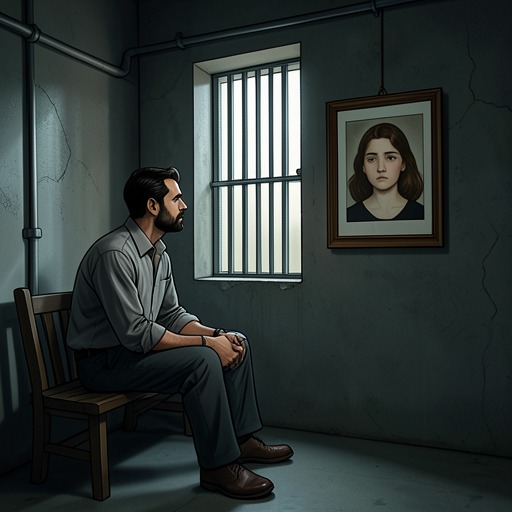
Several dozen artists were represented. The works ranged from pieces reaching toward the ceiling to pictures no larger than a postcard. The materials themselves recorded constraint: papers had been pieced together, and color added wherever it could be managed. Each work carried its title, the creator’s name, and the unofficial name of the case for which its maker had been convicted. With little further information supplied, some visitors consulted their phones as they moved around the gallery.
Near the entrance, a large work joined two paintings made from sheets of B4 paper. Below, a naked woman knelt at the bottom of a deep, dry well, trying to climb its brick walls; above, a narrow view opened onto blue sky and flowering plants in sunlight. Kido read the contrast between the light above and the darkness deepening toward the well’s bottom as a picture of longing and anguish. The artist was the wife in a married couple who ran a pet shop and had killed four customers in succession before destroying the bodies. She had maintained her innocence since her arrest, and the work had been prominently reproduced on the exhibition flyer.
Another group of pictures had a markedly different effect. One showed hills and fields divided by a stream; nearby were small birds among cherry trees in bloom and an old-town street corner with a mailbox, utility poles, and a road enclosed by plank barriers. The landscapes were modestly executed, but Kido felt he had encountered them before. The labels identified their maker as a perpetrator of murder and arson in Yokkaichi in 1985. At first, Kido could explain his reaction only as déjà vu, and he allowed the staff to usher him toward his seat.
Recognition and the Investigation
Kido was not captivated by the exhibition’s talk. The critic discussing the works tried to treat them exclusively as art, an approach Kido found unconvincing; he planned to tell Sugino so afterward. Even as he listened, his attention kept returning to the landscapes. When the speaker turned to the pictures associated with the case called Insurance Fraud Switcheroo Murder, however, the case name sharpened Kido’s attention. The murder involved a switch of identities: someone had killed a homeless man in another person’s place.
That account made Kido connect the case to X’s impersonation of Daisuké Taniguchi. He then recognized where he had seen the landscapes: they resembled X’s pictures. On his phone, he opened photographs he had taken of X’s personal effects at Rié’s home and found several sketches. X’s subjects showed places geographically distant from those in the exhibition, but the style was identical. The difference in depicted locations thus did not undo the visual match; for Kido, the manner of drawing was the clue.
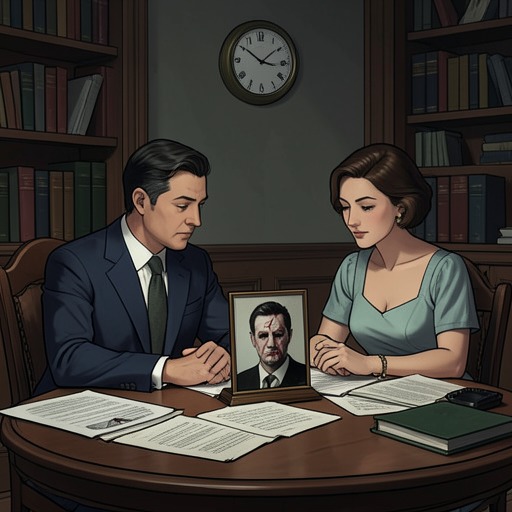
The exhibition’s label supplied the name Kenkichi Kobayashi, a man executed twenty years earlier. Yet X was supposed to be Yoshihiko Sonézaki. The names did not immediately resolve the connection. Kido’s only further clue was the writing on the woman in Omiura’s enigmatic postcard: one breast bore the name Daisuké Taniguchi, the other Yoshihiko Sonézaki. He questioned whether that was sufficient grounds to conclude that the two men had exchanged family registers. The display therefore gives Kido a powerful identification clue, while the postcard and the labels leave the precise relation between the identities to be tested rather than simply asserted.
Consequences and Significance
The discovery renews Kido’s investment in a puzzle he had nearly abandoned. It brings together three strands that had seemed separate: Omiura’s prison postcards, the landscapes among X’s possessions, and the exhibition’s account of an identity-switch murder. The works are not merely illustrations of a criminal past; their recurring style functions as evidence, allowing Kido to connect a living man’s drawings with pictures made under the name of an executed prisoner.
The novel also places that discovery beside the consequences of legal identity. In a related part of the investigation, police ask who has died and prioritize a missing-person report for Daisuké, leaving Rié without an answer about her late husband’s identity. Kido later petitions the Miyazaki Family Court to reverse the record showing “Daisuké Taniguchi” as dead and remove that name from Rié’s register, annulling their marriage on the basis of error. Because the marriage is erased from the register, Hana becomes legally illegitimate; the court also requires Rié to appear and requests DNA evidence that X was not Daisuké. Those proceedings show why the exhibition’s suggestion of another identity switch matters: a name is not only a clue in a private mystery, but a category through which the state records existence, death, and family ties.
A further complication comes from the three-hundred-day rule. Under the Civil Code, a child born within three hundred days of a divorce was legally considered the former husband’s child; in some cases, women who did not submit a birth notification left their children without family registers. The exhibition does not resolve whether X himself was unregistered, nor does its visual evidence alone establish the full history of the exchange. Its importance lies in making a concealed connection newly legible: a style repeated across artworks can point toward an identity history that official names and records obscure, while the limits of that clue keep Kido’s inquiry open.