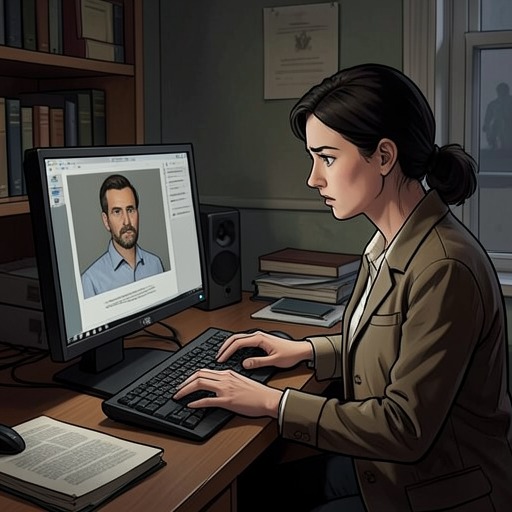
Disappearance of Daisuke Taniguchi
A ManDaisuké Taniguchi’s disappearance is not simply a missing-person mystery but the unresolved hinge between two lives lived under one name. While Akira Kido investigates Makoto Hara’s history and tries to establish what happened after the men met, the real Daisuké remains unreachable. A fake social-media account, a message sent under a name that may conceal his own, and Kido’s eventual recognition of him in Nagoya turn absence into a question of identity: Daisuké has not vanished from the world, but from the ordinary channels through which others might know who he is.
Background and Stakes
After speaking with Kaori, Kido feels a renewed need to bring his investigation into Makoto Hara’s life to some kind of resolution. The immediate task is to locate Daisuké, confirm that he is safe, and, if possible, ask him about his meeting with Hara. Yet the search is at an impasse. Kido’s inquiry is caught between the dead man whose life he is reconstructing and the living man whose testimony might clarify it; until Daisuké can be found, the meeting between them remains an unanswered link in Hara’s story.
Kyoichi Taniguchi, Daisuké’s brother, is not a viable route to that answer. After looking up Kenkichi Kobayashi online, Kyoichi reacts with visceral revulsion to his crimes and wants nothing to do with the affair. He condemns Daisuké for seeking out places where such “monsters” operated despite having been born into privilege, describing that world as one a person would be foolish beyond hope to enter. His denunciation is more vitriolic than before, and he fears being pulled into the same chain of crimes. Kido therefore gives up on Kyoichi’s help: the family connection that might have served as a lead instead sharpens the distance between the brothers.
The False Account and the Hidden Message
A breakthrough arrives indirectly. Kido emails Misuzu about seeing her on television, and her reply brings news that she has left Sunny, as well as an explanation of the trail she found online. Someone had reported the Daisuké Facebook account as fake, temporarily blocking it. Misuzu’s access was restored, but she stopped posting there because she had reservations from the beginning about impersonating Daisuké. Her relationship with Kyoichi had also become, in her description, “unmanageable.”
Misuzu then discovers a separate Message Requests folder in her personal account and realizes that years of messages have gone unchecked. Returning to the fake Daisuké account, she finds the same hidden folder there. Among its messages is a warning from “Yoichi Furusawa,” whose name appears in Roman letters rather than Japanese script. The account has no photos and hardly any posts. Its message claims to come from a legal representative and demands that the fake account be erased, threatening legal measures if it is not. The identity of the supposed client is not given.
The threatened action appears not to have followed: the account remains in place, and the user shows no sign of having taken further legal steps. Misuzu reasonably suspects that the warning caused the temporary account freeze, but she goes further in interpreting its style. She believes the message came from Daisuké himself, recognizing in its awkward attempt to sound intimidating a manner she associates with him. Kido entertains a different possibility: the message may be part of an “aftercare” service supplied by Omiura’s associates to people who exchanged family registers. The competing explanations leave the sender’s identity unresolved, but give Kido a practical lead: he can contact the account that issued the warning.
Contact and Recognition
Kido approaches the unknown user cautiously. If “Yoichi Furusawa” is Daisuké, mentioning Kyoichi could put him off; Kido also takes Nakakita’s advice not to raise Misuzu. He chooses to withhold some details rather than risk alienating a stranger whose identity is uncertain. In particular, he signs with the initials Y. S. instead of spelling out the full name Yoshihiko Sonézaki, which he believes Daisuké may be using.
In his message, Kido identifies himself as Akira Kido, a lawyer acting for Daisuké’s wife at her request, and supplies his professional credentials and a link to his firm. He says that Daisuké died in an accident three years earlier, in September, while withholding the precise details. He explains that his search for a man known as Y. S., said to have known the late Daisuké, led him to the account under Daisuké’s name and the request to delete it. Kido asks whether the recipient is acting as Y. S.’s legal representative and, if so, requests a reply so that he can convey something important. He also leaves room for error, inviting the recipient to disregard the message if his inference is wrong. The careful qualification reflects the risk of approaching someone whose identity—and reasons for remaining hidden—are still uncertain.
The reply leads to an arranged meeting with “Yoshihiko Sonézaki” in Nagoya. Kido and Misuzu have lunch at the station before separating; Kido is to interview the man alone, with Misuzu joining afterward. The meeting is set for one o’clock at a branch of Komeda’s Coffee. Though it should be a ten-minute walk from Nagoya Station, Kido loses his way among the nearby branches and arrives about five minutes late.
Kido knows Daisuké’s face from photographs, but they are at least ten years old, and he is unsure whether he will recognize him. A barista seems to know whom he is seeking and leads him to the smoking area. At a four-seat table, divided from the next by a movable wooden partition, sits a man in a gray knit cap and an embroidered bomber jacket that somehow does not suit him. The man is looking toward Kido. The sight and the memory of hearing his voice on Skype make Kido’s heart pound; despite the years, he recognizes Daisuké without a doubt. The search’s central uncertainty changes in an instant: the man Kido had feared might be dead is alive.
What the Disappearance Leaves Behind
Before reaching Daisuké, the search has already shaped the lives of those who remain with his name. When Rié tells Yuto that she intends to return to her maiden name, he has seemed indifferent, but eventually explains that he does not want to stop being Taniguchi. His name has changed with the family’s circumstances: he was born a Yoneda, became a Takemoto after Rié’s divorce, and took the Taniguchi name on entering elementary school. Now his friends, older students, and younger students all know him as Taniguchi, and having to correct them would make him feel that he was surrendering a familiar part of himself.
Yuto’s objection is also an appeal on behalf of the father he believed to be Daisuké. He asks to remain Yuto Taniguchi even if Rié becomes Takemoto, saying that the family had already turned its back on his father and should not forget him as well. He asks when his father will have a grave, since the ashes have remained in an urn and Rié hardly speaks of him. The request brings together the legal and emotional stakes of the disappearance: changing a surname may be an administrative consequence of the concealed identity, but to Yuto it threatens to erase the person who raised him. His insistence makes the inherited name a form of remembrance, even as the story exposes the deception behind it.
The boy’s grief appears in care as well as protest. Seeing his grandmother look at the aquarium in the shed, Yuto suggests getting goldfish to take her mind off things and promises to look after them. Rié is moved by the thoughtfulness of the gesture, recalling her late husband’s prediction that Yuto would grow into a good, considerate boy. Later, at a field of cosmos flowers, Yuto watches over Hana while remaining silent, his hands tucked into his hoodie. Rié considers the losses he is carrying: his brother, his grandfather, and the man he had thought of as his father. She recognizes that he, like her, has been enduring pain without expressing it, and that tending the fish, caring for his little sister, and reading may help him hold himself together.
Reading gives Yuto a way to approach what direct conversation cannot. Rié tries the Ryunosuke Akutagawa story “Asakusa Park,” which he had mentioned at Burial Mound Park. Its boy loses his father in Tokyo, mistakes a masked stranger for him, and eventually finds himself crying at the base of a stone lantern. Rié does not understand the story as a whole, but she cries when she imagines Yuto responding to it. He had read it before she told him that the man he called his father was not Daisuké Taniguchi; she wonders whether he sensed something, but cannot know. What the story does make possible is a more intimate understanding: Yuto had let her approach his loneliness through the book, and its emotional connection brings mother and son closer than daily proximity alone had done.
At Burial Mound Park, Yuto’s account of a cicada shell becomes another indirect expression of loss. In an explanation accompanying his poem, he describes an abandoned shell stuck to a cherry tree while cicadas sing in the branches. He imagines the shell hearing the voice of the body that had lain underground for seven years, then sees the crack in its back as resembling a violin’s soundboard, the shell transformed in his imagination into a resonating instrument. He does not mention his brother or father. Rié nevertheless connects the cherry tree to the one her husband had chosen for himself and pictures Yuto alone beneath it, listening and looking. Whether the scene happened exactly as described or was partly imagined, she understands that writing has given him a means of coping with ordeals she could not have taught him how to face.
Significance
The disappearance works on two levels at once. As an investigative problem, it withholds the testimony Kido needs and sends him through an uncertain trail of impersonated accounts, anonymous warnings, and borrowed names. As a family rupture, it shows how a person’s absence can persist in apparently ordinary forms: a surname, ashes still kept in an urn, a child’s wish not to be renamed. The eventual recognition in Nagoya resolves one question—Daisuké is alive—but does not make identity simple. The man Kido finds has been approached as “Yoshihiko Sonézaki,” while the account and warning that led there remain bound to an uncertain “Yoichi Furusawa.”
That distinction gives the search its emotional force. Daisuké’s physical survival does not undo the losses experienced by Yuto or settle what his assumed identity means to the family. Conversely, the name Taniguchi, though entangled with impersonation, has become part of Yuto’s lived history and attachment to the father he knew. The story lets these truths coexist: a name can be false as a claim to legal identity and genuine as a child’s bond to a parent. Daisuké’s reappearance answers the investigation’s most urgent question, while the family’s grief and the meanings attached to his name remain more difficult to close.