Green Employment program
A ManThe Green Employment program is a government training subsidy for forestry workers, mentioned in connection with the training and rapid development of the man known locally as Taniguchi. Its significance in the story is practical: it places his work within an industry shaped by public support, demanding skills, and substantial occupational risk.
Purpose and Industry Context
Ito explains that forestry depends on government subsidies and faces competition from imported materials, although the expansion of biomass generators has made timber saleable and left the market in reasonably good shape. Within that economic setting, the Green Employment program provides a route into training for new workers. It appears not as an abstract policy discussion but as part of an account of how workers acquire the skills required for modern forestry.
Training and Taniguchi
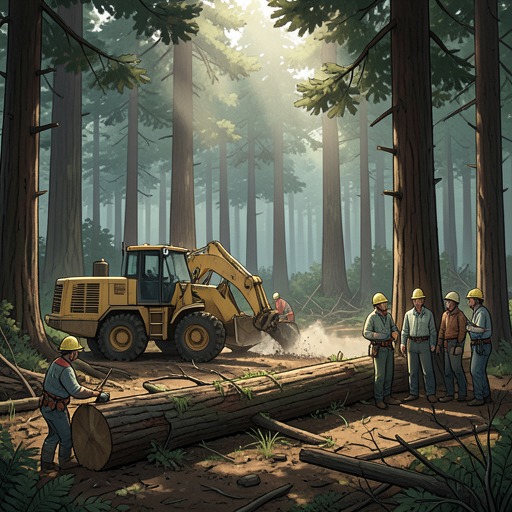
Ito says that a worker ordinarily needs about three years to become fully trained. Taniguchi, however, learned the whole job in about eighteen months, a pace Ito associates with his diligence and decisiveness. He was slight but had surprising stamina, and he operated forestry machinery as well as learning the wider work. The contrast between the usual three-year training period and Taniguchi’s eighteen months makes the program’s context concrete while emphasizing his own commitment and aptitude.
Work, Risk, and Significance
The program belongs to an industry that Ito describes as increasingly mechanized, but not safe or effortless. Forestry workers contend with difficult conditions and hazards, and Ito says accidents are common, including incidents involving machinery. He still feels responsible for Taniguchi’s fatal accident, recalling that it happened at a poorly conditioned site he had accepted for a client he could not refuse. The program therefore marks the institutional path by which Taniguchi learned the trade, while the surrounding account shows that training and mechanization do not remove the risks borne by workers.