Ito
A ManIto, the president of Ito Lumber, is Kido’s guide to the forestry industry and a witness to the working life and death of the man known in Miyazaki as Taniguchi. Through his candid explanations of land disputes, mechanized logging, training, and occupational danger, Ito gives Hara’s death a physical and economic setting: the forest is both a workplace shaped by policy and ownership and a landscape whose trees outlast the people who cut them.
Identity and Introduction
Ito first meets Kido after Kido returns to Miyazaki to discuss his report with Rié and to seek a sense of closure. Curious about the place where Hara had worked, Kido has asked Rié to introduce him to Ito. Rather than invent an elaborate pretext, he tells Ito that he has become interested in forestry. Ito is initially wary about Kido’s motives, but the straightforward explanation seems to reassure him enough to agree to show Kido around the mountains where his company logs.
Ito arranges to collect Kido at the Kiyotake branch of Miyazaki City Hall, since the worksite cannot be reached without four-wheel drive. In the rainy parking lot he calls out to Kido in a resonant voice. Stocky and buzz-cut, wearing pale sunglasses and holding an umbrella, he receives Kido’s business card and a box of sweets from Tokyo. This practical, slightly formal beginning leads into an unusually open conversation once they are on the road.
Forestry, Land, and the Worksite
Ito describes a business operating within both public regulation and difficult market conditions. Ito Lumber purchases rights to log national forests, and its work is booked two years ahead. The industry depends on government subsidies and struggles against imported materials, but biomass generators have made timber saleable, leaving the market in reasonably decent shape. Ito’s account is neither a simple celebration of the trade nor a picture of its decline: the business continues, but its conditions are fragile and shaped by forces beyond any individual crew.
He is especially concerned about unclear ownership of mountain land. As people increasingly decline to keep inherited mountain property, the number of claim holders multiplies, and some parcels have no clear owner. Ito says unscrupulous crews exploit the confusion by buying a small neighboring plot, then cutting and hauling trees from land whose ownership is in question. The problem reaches beyond isolated theft: Ito regards it as a threat to the industry as a whole, and notes that even checking family registers to identify owners of old mountain land can become a tangle of branching claims. In the forest, the paperwork governing a parcel can determine who has the right to remove its trees.
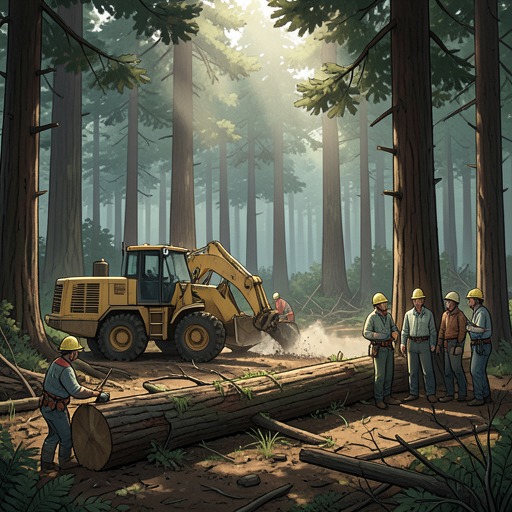
The site Ito shows Kido is not the place where Hara died, but it is similar and relatively close. A clearing large enough for a truck opens onto a working area where a machine with a long orange boom grips logs and strips away their branches. A few workers are visible beyond stacks of wood and a broad field of stumps that ends at a steep slope. Because of the weather, no logging is taking place that day; the crew is doing other tasks. Ito explains that forestry, like other industries, has become mechanized, easing some of the physical burden without making the work easy: heat and cold still take their toll.
Hara’s Work and Death
Ito speaks of Hara as Taniguchi, the name by which he was known at the company. Kido has grown used to thinking of the man as Hara, while understanding that people in this workplace knew him as Daisuké Taniguchi. The difference in names marks the divide between the person Kido is investigating and the identity under which the worker lived and was remembered in Miyazaki.
Ito says that Taniguchi learned the job in about eighteen months, although it normally takes roughly three years to become fully trained. The government’s Green Employment program provides a training subsidy. Ito remembers Taniguchi as diligent and decisive, slight in build but unexpectedly enduring. He had no apparent interest in sports, though he said he had practiced kendo as a child. Ito, who also holds a dan rank in kendo, recalls joking with him about having a match. The recollection makes their connection specific and ordinary: a work relationship that included teasing as well as respect.
The subject of the fatal accident changes the tone of the drive. Ito admits that he still blames himself and prays before the household altar every morning. He had not seen a major accident since taking over the company from his father; Taniguchi’s death happened at the one site with poor conditions, a job for a client Ito says he could not refuse. His regret does not establish that he caused the accident, but it shows how responsibility has settled on him in its aftermath.
Ito was not present when Taniguchi died. He explains that judging the direction of a falling tree remains difficult even for seasoned workers, especially when a tree is bent and liable to fall unpredictably. He says he warned the crew every morning to be careful above all else. Forestry accidents, he tells Kido, are exceptionally common: the hazards include not only logging itself but also machinery slipping from cliffs, snakes, and wasps. His account turns the accident from a bare fact of Hara’s biography into one instance of a broader, persistent exposure to risk.
Trees and Timescales
At the worksite, Ito gives Kido a way to measure a tree’s life beyond the moment of its felling. He estimates that trees are cut at around fifty years old, then used as building materials that may last another fifty years in a house. He therefore asks workers to think of a tree as living for about a hundred years: fifty years on the mountain and fifty years with people. The timber’s life does not end at the stump; it continues in human shelter, carrying the forest into another setting and another generation.
That hundred-year measure contrasts with the speed of the worksite, where machines lift and strip logs and the workers must respond to immediate dangers. Ito’s explanation joins the industry’s practical language—training periods, contracts, subsidies, rights, and equipment—to a longer view of the material being handled. The forest is not scenery around the accident: it is a managed resource, a workplace, and the beginning of a life that may continue in a house long after the workers have left the mountain.
Character and Narrative Significance
Ito is guarded about Kido’s intentions at first, yet becomes talkative and candid once Kido’s plain account of his interest in forestry puts him at ease. His manner holds an important tension: he can discuss questionable logging practices with an almost amused air, but when he turns to Taniguchi’s death, he speaks of daily prayer and remorse. That shift makes him more than an informative guide. He is a company president explaining the economic and administrative conditions of his trade, and a bereaved employer who cannot detach those conditions from the death of a worker he remembers with affection.
His testimony also widens the meaning of Kido’s investigation. Questions of names and family registers are not confined to personal identity or legal records; Ito’s account shows that uncertain claims to land can make ownership itself difficult to establish. At the same time, the company’s dependence on government support and the pressures of work on dangerous terrain reveal the institutional conditions surrounding Hara’s final job. Ito cannot resolve Kido’s questions about the man’s identity, but he supplies something different and essential: a grounded account of the labor, landscape, and grief that formed the last chapter of Hara’s life.