Ito Lumber
A ManIto Lumber is the forestry company where Daisuké Taniguchi begins a new career at thirty-five, and the workplace where he earns unusual respect before dying in a logging accident at thirty-nine. Through the recollections of its president, Ito, and Kido’s later visit to a comparable worksite, the company is presented both as a community of skilled labor and as an industry shaped by subsidy, uncertain land ownership, mechanization, and persistent danger.
Daisuké’s arrival and standing
Daisuké moves to Town S shortly before a documentary about a depopulated mountain village brings new attention to the area. Without prior forestry experience, he seeks work at Ito Lumber at age thirty-five. The choice becomes a consequential break with his earlier life: he enters a demanding occupation and, within a year of arriving, marries local stationery-shop proprietor Rié Takemoto. Because he is so reserved that few coworkers learn about his past, the job is one of the few settings through which the townspeople encounter him.
Ito is pleased by Daisuké’s marriage, which makes it more likely that the new worker will remain in the area. Town officials responsible for urban-to-rural migration also treat the marriage as an exemplary case. The company’s interest in keeping Daisuké therefore coincides with a wider local hope that a capable newcomer might put down roots in a shrinking town.
Daisuké proves his value through steady work rather than self-promotion. Forestry workers generally take about three years to progress from chainsaw felling to operating processors and grapples, but he becomes a reliable hand in a year and a half. He works through summer heat and winter sleet without complaint, while supervisors have to remind him to speak up if he is uncomfortable. Ito repeatedly praises him to others in the industry, credits his university education for part of his ability, and regards him as unmatched in the company’s three-generation history.
Work culture and forest labor
Daisuké’s manner affects the worksite as well as his output. He is introverted rather than hostile: when someone starts a conversation, he responds with unexpected cheerfulness. He is also willing to raise concerns about inefficiency and danger, though he does so gently. In an occupation where accidents are frequent and talk can become gruff, his presence helps reduce conflict. Ito sees in him a rare combination of diligence, judgment, and a calming effect on coworkers.
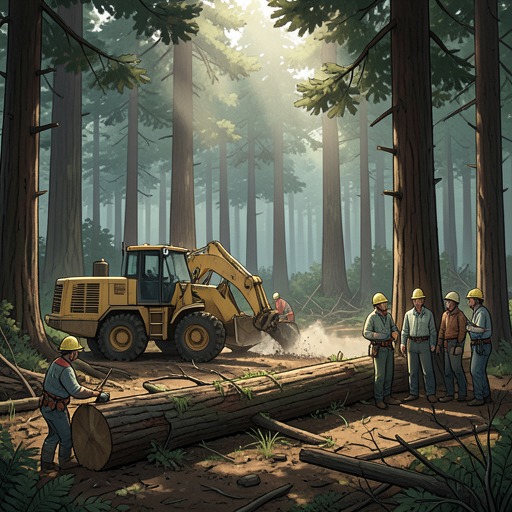
Kido’s later visit gives the company’s work a physical and operational setting. On a rainy day, Ito takes him to a logging site about forty minutes from town. It is not the site where Daisuké died, but Ito says it is similar and nearby. Logging has been suspended because of the weather; the crew is doing other work. A long-necked orange machine grips logs, lifts them, and strips away their branches. Ito explains that machinery has made forestry easier on the body than it once was, without making it easy work: heat and cold still take their toll, and difficult roads and poor conditions remain dangerous.
Ito describes the trees in terms of a human-scale cycle: they are cut at about fifty years old, then used as building material, with another roughly fifty years of life as a house. His account makes the forest more than a backdrop to the company’s activity. Trees move from mountain to human use across a century, while the labor that brings them there must manage immediate risks and decisions about which sites to accept.
The industry around the company
Ito describes Ito Lumber’s core business as logging national forests for which the company purchases rights. It has work booked for two years. The industry depends on government subsidies and faces competition from imported materials, although the construction of biomass generators has made all wood saleable and left the market in reasonable condition. The work is thus governed by both public support and changing demand for timber and other uses of wood.
The company also operates amid increasingly complicated land claims. Ito says that people often do not want inherited mountain land, producing numerous holders and places where ownership is unclear. Some cut-rate crews exploit that uncertainty: they purchase a small adjoining plot and then cut and remove trees from land whose owner cannot be established. Ito regards this as a problem for the industry. Ito Lumber sometimes consults family-register records to identify owners of old mountain land, but branching claims make the records difficult to use. The forest’s practical management consequently depends on legal and administrative identities as well as forestry skill.
The visit also reveals Ito’s standards for the work itself. Seeing a poorly cleared site, he criticizes the stumps and insists that the company would not leave a site that way; in his view, a crew should leave the ground tidy. He avoids especially tricky plots because accidents are a concern and the combination of risk, inefficiency, and low returns makes them unattractive. Rain can also force work to stop or be shortened. These choices set out the tension between earning a living from the forest and controlling the hazards of extracting timber from steep, difficult terrain.
Daisuké’s death and Ito’s remembrance
Daisuké works for Ito Lumber for four years. He is eventually crushed by a cryptomeria tree he has felled, dying at thirty-nine. The accident becomes a lasting burden for Ito, who tells Kido that he still prays before the family altar every morning and blames himself for what happened. He says that he had not seen a major accident since taking over the company from his father, and identifies the fatal job as the one time he accepted a site with poor conditions because the client was someone he felt unable to refuse.
That admission complicates the earlier picture of a careful employer who turns down risky, unprofitable sites. The fatal exception was not simply an unavoidable feature of forestry: Ito connects it to a decision about a particular job and to his own sense of responsibility. His continuing prayers keep the accident present in the ordinary rhythm of his life, even as he tells Kido that occupational accidents are common in the industry.
Kido’s visit is motivated by his work for Rié on the estate and legal aftermath of the man she knew as Daisuké Taniguchi, who was actually Makoto Hara living under Daisuké’s identity. Kido asks Rié to introduce him to Ito because he wants to understand the forestry work Hara had done. Ito initially suspects his motives, but Kido says he has become interested in forestry through his casework and is seeking to learn about the occupation. The visit lets him hear directly from the employer who remembers Hara as a diligent worker, while the distinction between the name known locally and the man’s real identity underscores how much of a life can remain legible through work even when its official identity is false.
Narrative significance
Ito Lumber connects the intimate consequences of Hara’s assumed identity to the material circumstances of his life in Town S. The company gives him a job, a place within a local community, and a demanding trade in which he earns trust; the accident ends that life and leaves the employer with enduring regret. Its surrounding details—the state-supported market, disputed mountain ownership, imperfect family-register records, and century-long passage from tree to house—widen the account beyond one worker without diminishing the particularity of his death.
The company’s history also turns Kido’s investigation into an encounter with labor and landscape. His questions about Hara’s competence lead to a rain-soaked visit, Ito’s account of the accident, and a view of mechanized logging on a different mountain. Forestry emerges as neither a simple backdrop nor a romantic refuge: it is skilled work organized around land, markets, machinery, and decisions about risk, with consequences that persist long after a worker has left the site.