Kido and Kaori's marital estrangement
A ManKido and Kaori’s marital estrangement is a gradual crisis of silence rather than a single rupture: they sleep in separate rooms, barely speak, and find that a suspicion about Kido’s work trip to Miyazaki has chilled a relationship already weakened by distance. Kido’s fear that Kaori may no longer love him gives that quiet domestic drift its decisive force, while the contrast with his tenderness toward Sota shows what he stands to lose.
A Marriage of Quiet Distances
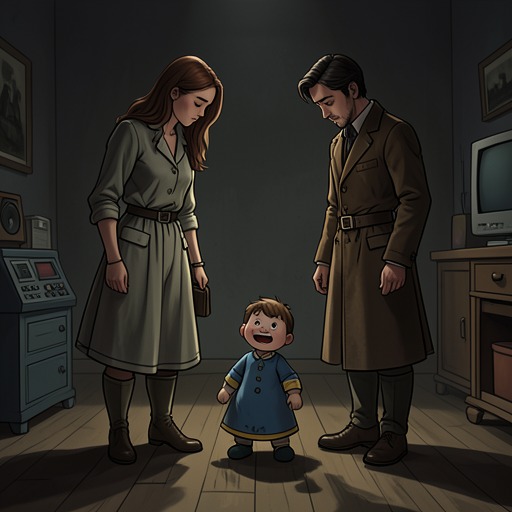
Kido and Kaori’s domestic routine has settled into an outwardly ordinary marriage slump. Kido uses the room intended for their second child as a study, and, after placing a bed there so he can nap, the couple begin sleeping separately. He and Sota spend an evening together after bathing, looking through an illustrated guide to the Ultraman series; Kido turns out the light while putting his son to bed and falls asleep beside him. When he wakes in the middle of the night, the master bedroom is dark and its door shut. The contrast is plain without being openly dramatic: closeness with his child comes naturally, while husband and wife occupy separate rooms and let a day pass with scarcely a word.
In private, Kido experiences the marital silence less as an argument than as a settled, almost transparent condition. He imagines it as water in a glass: either spouse could have ended the awkwardness with a single sip, but the water has stood too long to drink. A sliver of ice drops in, makes only the faintest disturbance, and melts; the silence remains, now chilled by the memory of that small interruption. The image captures the relationship’s problem as he understands it. There is no obvious explosion to settle the matter, only a familiar stillness in which a slight new disturbance can acquire lasting weight.
That stillness also coexists with moments of intense attachment. Holding Sota’s hand in the dark, Kido is suddenly overwhelmed by the fact that he is the boy’s father. The ordinary relation of father and child feels momentarily extraordinary, and Kido recognizes that the joy is bound up with anxiety. His powerful sense of what he has in Sota throws the separate bedroom and the unsaid things between himself and Kaori into sharper relief.
The Story They Tell About Themselves
Kido and Kaori have allowed an invented version of their first meeting to become their accepted account. Officially, they were introduced by an acquaintance; in fact, they first noticed each other at a frivolous party, amid obscene conversation, forced laughter, and the noisy performance of enthusiasm. Neither would have wanted to describe those circumstances in detail as the story of how a serious married couple met. Repeating the more respectable account has made them half believe it themselves.
Kido returns to that memory with rueful irony, wishing they had met under circumstances better suited to the spouses they became. Their story about an acquaintance does not repair their present distance, but it shows how a shared account can smooth over an awkward origin until even its tellers partly accept the substitution. The irony grows sharper because their relationship has been sexless since the Great East Japan Earthquake. A marriage that once quietly edited its beginnings now carries a more immediate absence that neither partner seems able to resolve by looking back.
Their relationship also sits within Kaori’s established family life. She is the daughter of a well-off dentist whose family has lived for generations in Yokohama; her older brother is an internist who has opened a practice in their father’s renovated office. Her conservative but generous family helped Kido and Kaori with the down payment on their condominium. When Kido sought her father’s permission to marry her, he was welcomed despite his Zainichi background. Kaori’s mother made occasional efforts to ask about Korea during the Korean Wave, but stopped when she realized Kido could barely answer and could not read the Korean alphabet. These episodes establish the family’s place in the couple’s history without resolving the estrangement that later takes hold between them.
The Miyazaki Suspicion
The immediate disturbance arises when Kaori becomes suspicious of Kido’s trip to Miyazaki. Their usual arrangement had been simple: Kido rarely discussed work at home because of client confidentiality, and Kaori showed little interest; when either had to stay overnight in another city, saying it was for work had been enough. This time, for reasons Kido cannot identify, the trip seems fishy to her. The established shorthand between them no longer works as reassurance.
Kido initially laughs the suspicion off as paranoia. Later, he wonders whether Kaori is under strain for some other reason, but she denies it, and her manner changes. Her thorny silence, previously directed at him, begins to fall with unusual harshness on Sota. Kido cannot tolerate that shift and loses his temper—not in a full outburst, but in a feeble anger that carries him past the bounds of his usual self-control. He takes the episode as evidence that he is less composed in confronting his wife than he believes himself to be.
Kido sees no factual basis for Kaori to think something happened between him and Rié: even if Kaori had looked at his phone, their messages contained nothing to invite misunderstanding. He therefore reads her concern not as evidence that she has uncovered an affair but as a hunch that something might happen between them. The distinction matters to him, though it cannot settle the suspicion. He tries to defend his professional boundaries by telling her that becoming involved with a client would bring reprimand, while holding back a sharper accusation that she does not respect his work. His light tone conceals how much the incident has unsettled him.
An Inherited Language of Obligation
The crisis belongs to a wider pattern in the book in which family affection and family duty do not fall evenly. Daisuké works diligently in his father’s company, hoping to reassure disappointed parents and earn their trust with the family legacy. Yet when his indebted older brother returns after his restaurant fails, their father agrees to pay the debt only on condition that the brother take over the inn. The parents promise titles that place the brother above Daisuké, although Daisuké knows he will carry the business in practice. He loves his brother, but cannot understand why his parents’ love and expectations have so consistently favored the eldest son; the feeling is not fully returned.
That unequal expectation becomes bodily and dangerous when Daisuké’s father develops advanced liver cancer. The older brother is disqualified as a donor because of a fatty liver, while Daisuké is healthy. His father asks him to fulfill his duty as a son, grips his hand, and cries. Daisuké’s mother and brother do not explicitly demand that he agree, but neither assures him that he is free to refuse; they speak with his father when Daisuké is absent and stress that they want the father to live. A live-donor transplant could leave lasting complications or even kill the donor. Daisuké nevertheless consents, choosing to give his liver without resentment rather than merely yielding to pressure. His father is overjoyed and thanks him—the only time he ever does so—while his brother promises him the entire inheritance. The episode makes visible how love, recognition, and obligation can become entangled across a family, even when a person’s consent is real.
Fear, Philosophy, and the Possible End
After the earthquake, Kido considers whether he should finally speak with Kaori. He wants their home to return to how it once was and recognizes that Kaori, too, must feel disoriented. Yet he has avoided the thought that most troubles him: perhaps the situation is simpler and more final than his explanations make it, and Kaori no longer loves him. He thinks their relationship is already gradually falling apart, and that its dynamic resembles the couples whose divorce negotiations he handles almost every day. His professional familiarity with failing marriages does not give him distance from his own; instead, it supplies a disquieting pattern against which he measures it.
Kido’s hesitation is bound up with questions he has difficulty voicing. In talking about love and philosophy, he reflects that he had never considered their connection when he was young, and cannot tell whether he once overvalued love or undervalued philosophy. He has wanted to add a bitterly candid observation about how long his marriage has been sexless, but finds the words caught in his throat. He feels ashamed of himself and jealous of happier couples, and imagines living out his days with an unsatisfied sexual desire. The thought does not resolve the marriage; it gives the silence an intimate, physical dimension alongside its emotional and intellectual ones.
The novel leaves the estrangement as a condition Kido must confront rather than a conflict already settled by a decisive confrontation. His fear of losing Kaori coexists with his tenderness toward Sota, his awareness of his own temper, and his habit of keeping troubling subjects unspoken. The separation of bedrooms, the false story of the couple’s first meeting, and the suspicion surrounding Miyazaki are different signs of the same distance: a relationship can appear calm while becoming harder to reach, and the hope of restoring it begins with naming the possibility that it may already be coming apart.