Kido and Misuzu’s growing closeness
A ManKido and Misuzu’s growing closeness is an emotionally significant but unresolved relationship: a search for Daisuké Taniguchi draws them together, and their exchanges gradually become intimate, even as Kido recognizes his attraction and chooses not to turn it into a new partnership. Their bond joins Misuzu’s wistful attachment to the man she once loved with Kido’s desire to experience, if only briefly, the life she shared with him.
A connection formed through the search
Kido first reads Misuzu’s exchanges through the impersonated Daisuké account as evidence about the brothers’ history. He observes that Kyoichi appears attracted to Misuzu and suspects the feeling predates their recent messages: Kyoichi may have loved her before she chose his younger brother. Kido also notices signs that Misuzu and Kyoichi communicate privately, though he never asks them directly. The inquiry therefore puts Kido in contact not only with the problem of Daisuké’s identity but with a past attachment that remains emotionally active for Misuzu.
The online Daisuké is not simply a reconstruction of the man Kido is trying to find. Misuzu gives the account the vigorous, cheerful, competitive, yet sensitive character she wishes Daisuké had possessed. In one post, the imagined Daisuké is moved to tears by UFO’s song “Love to Love.” Through this performance, Misuzu revisits her memories and approaches a version of her former lover that she can still imagine. Kido understands the account as an expression of her longing, even as it complicates the search for the real man.
Kido’s attraction and their meeting
Kido’s own feelings shift after he impersonates Daisuké at a bar. While drunk, he tells Misuzu what he knows about the man and lets slip that he once loved her. The admission exposes a wish he had kept secret: to know, even for a few hours, what it was like to be the young man who had loved Misuzu and been loved by her. Later, the thought of seeing her in person leaves Kido flustered and self-conscious, as if he were trying to conceal a crush.
At eleven o’clock on their appointed day, Kido meets Misuzu at Minatomirai Station. He arrives in a necktie beside her casually dressed figure and feels awkward. Their meeting changes the quality of an earlier interaction at the bar: no counter separates them, and the two smile bashfully at one another. The attraction is conveyed less as a declaration than through Kido’s embarrassment and their shared ease.
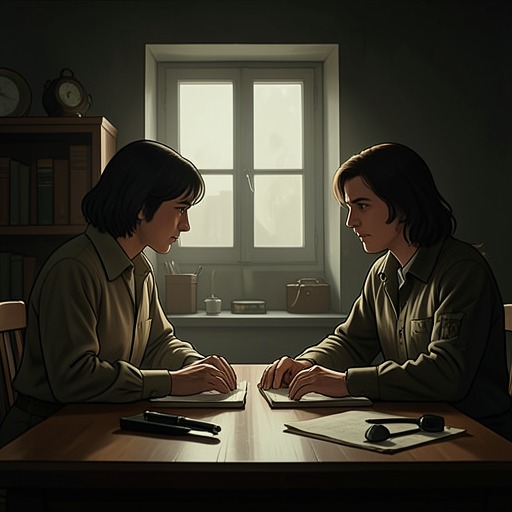
At an exhibition, they climb with difficulty onto chairs placed around an oversized dinner table in an installation called Three Years Old, A Memory. The work recreates the artist’s childhood perspective, making ordinary household objects seem enormous. Facing one another across the table, Kido and Misuzu imagine themselves as childhood friends and begin to wish for desserts they could share, with the sense that someone larger might serve them. The scene gives their meeting a gentle, make-believe intimacy: for a moment, their adult histories recede into a shared imaginative space.
Conversation, recognition, and increasing intimacy
Over lunch at a restaurant near the station, Kido and Misuzu agree that much of the exhibition was mediocre, while returning to the installation they had enjoyed. Their discussion of its lonely-looking mother figure leads Kido to speak openly about his own background. He tells Misuzu he is third-generation Zainichi and became a Japanese citizen through naturalization in high school. He recalls that his childhood home included Korean calligraphy and commemorative photographs of his grandmother and mother wearing jeogori, details that made it different from a stereotypically Japanese home.
The openness marks a change from Kido’s guardedness when he first met Misuzu. He realizes only after speaking that he has disclosed his background without hesitation, and attributes the change partly to the exhibition and partly to having become familiar with Misuzu’s feelings and way of thinking over the previous months. Misuzu does not visibly react with surprise, though Kido reads her eyes as suggesting that she is reconsidering her earlier behavior toward him. Their conversation has therefore become a setting in which Kido can disclose something he had previously protected.
Misuzu later says she wants to go to the counter-demonstration in Kido’s place. He laughs with her, but never learns what she had wanted to consult him about concerning the search for Daisuké. What becomes clear is that their online interactions grow more intimate from that day onward. Their closeness thus advances without a clearly stated relationship or a single decisive confession; it is registered in changing patterns of communication and in the trust that permits more personal conversation.
Desire, restraint, and the life Kido keeps
Kido eventually recognizes his attraction plainly. Their online exchanges make him feel more at ease than he does in other contexts, and Misuzu’s cheerful Facebook picture prompts him to imagine ordinary days with her as his partner. He wonders what life might have been like if he had married Misuzu and she had become Sota’s mother. The imagined future is vivid to him precisely as an alternative: he understands that it belongs to a life that could have existed in another world, not the one he has lived.
Despite these fantasies, Kido does not intend to move their relationship to the next stage. The possibility of getting together seems so unrealistic that he does not treat it as a serious plan. He weighs the temptation to abandon his established life for a middle-aged romantic dream against Misuzu’s philosophy of moving three steps forward and four steps back: a grounded, compromising way of living that had impressed him. His restraint is not evidence that the attraction has disappeared; it is the decision to leave it unacted upon.
Misuzu’s later participation in a counter-demonstration brings the affection between them back into view. Kido remembers that, at lunch, she had said she would go in his place, but he had not taken the promise seriously and had almost forgotten it. Learning that she fulfilled it surprises him. He is glad that he matters in her world and smiles at how characteristic the act seems of her, yet feels both joy and dismay. He cannot approve of her decision without reservation, and his own hesitation makes him aware of how carefully he tries to manage the consequences of caring about her. Their bond remains meaningful but bounded: it opens a possible life in Kido’s imagination without displacing his existing one.