Kido in Miyazaki impersonated X
A ManAkira Kido’s brief impersonation of X in Miyazaki turns another man’s borrowed identity into a live, intimate performance: Kido gives a bartender the history of Daisuké Taniguchi as though it were his own, and discovers how easily an invented past can create a bond in the present. The experience exhilarates him, but after meeting Rié again and seeing her distress, he cannot return to the bar without feeling that his private game has come at her expense.
The borrowed story
On an earlier visit to Miyazaki, Kido had been at a bar, speaking with its manager, a bartender whose family history unexpectedly resembled the one Kido was preparing to tell. The bartender said that his elder brother had taken over the family’s construction business; like Kido’s purported self, he had been the younger son. The similarity loosened the conversation. He admitted that he rarely shared this with first-time customers, while drying a glass and listening with a gentle, understanding look.
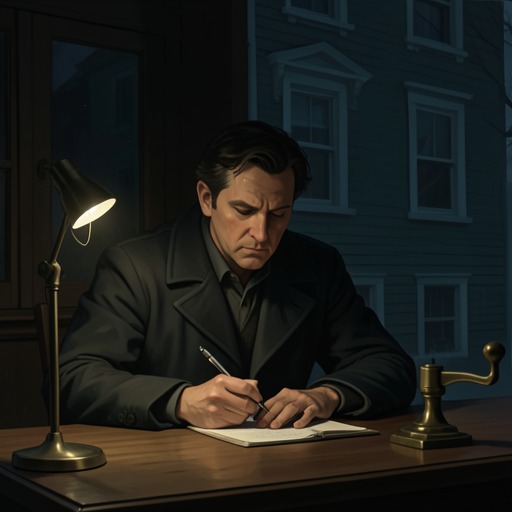
When the bartender passed him a business card, Kido said he had run out of his own and introduced himself as Daisuké Taniguchi. The bartender accepted the name without question. Kido had first made the assumed identity plausible by telling him that he was the second son, that his elder brother inherited the family inn, and that he had left home because he never got along with his family. He wondered whether X, on arriving in the town as Daisuké, had recounted the same past in the same way: testing the ease of a new life as though trying on a garment or taking a car for a test drive.
A life told as one’s own
Over another glass of Stalinskaya, Kido continued the performance. In a detached tone, he related how agreeing to be an organ donor had ultimately caused an irreparable break with his family, occasionally adding a woeful grin. These were Daisuké’s experiences, not Kido’s, yet Kido felt that speaking them brought him closer to unity with the story. The bartender answered with measured sympathy, commiserating without pressing too hard. Kido felt he could have continued until he drank himself under the table in tears.
The encounter made Kido’s public identity more than a name spoken in passing. He imagined that if he crossed paths with the bartender again, the two would recognize one another and exchange a nod: he was no longer a complete stranger in town. That small prospect of recognition gave the assumed self a social foothold. The story Kido borrowed did not only recount a past; it gave a stranger a reason to feel that he knew him.
Excitement, guilt, and retreat
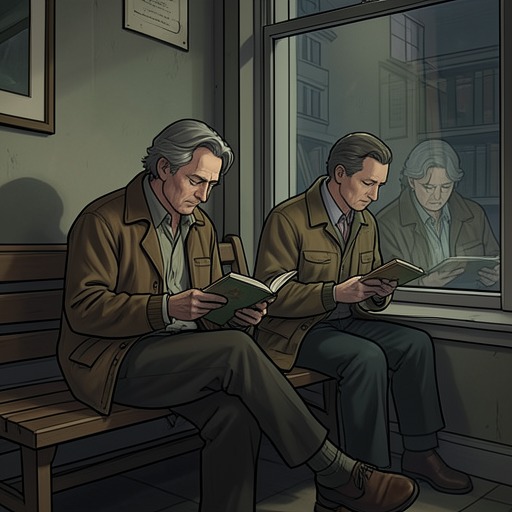
After returning to Yokohama, Kido retained the inexpressible joy of the two hours spent impersonating X. He remembers feeling nervous, excited, and dizzy. Rather than merely consuming tragedies in books or films, he began to imagine a new hobby: synchronizing himself with another person’s life story and vicariously entering that person’s inner world. He recognizes the activity as a shameless game, one that leaves a bitter aftertaste even as it offers him a powerful sensation of proximity.
On his recent return to Miyazaki, Kido quietly wished he could become again the self he had left downtown: the continuation of X’s life while impersonating Daisuké. But after seeing Rié the next day, and witnessing her distress at the truth of X’s identity, he felt guilty about the pleasure he had taken in the masquerade. He could not bring himself to revisit the bar. The experience, he suspected, would no longer thrill him in the same way; moreover, there was almost nothing left that he needed to say as Daisuké.
The life behind the impersonation
The performance leaves Kido thinking beyond the bar. Waiting at a stoplight, he watches cars pass and wonders what it would mean to be fatally struck while living as Daisuké Taniguchi. He also imagines the instant in the secluded mountain forest when a falling cryptomeria ended X’s life, asking himself what might have passed through X’s mind. His own temporary identification with the dead man thus becomes a way of approaching the unanswerable circumstances of X’s death, without giving Kido any certainty about what X thought.
Kido cannot fathom why X was able to throw everything away. He admits to a vague envy: however weary he becomes of his present life, he cannot do the same. Even in the outdoor hot spring at the Sheraton, he thinks of how much his son would enjoy it. That thought gives his life a continuing attachment that Kido cannot imagine X sharing with his former existence. He wonders whether X, like Daisuké, abandoned a past inseparably bound to family, giving up even hatred in order to sever those ties. Kido can only speculate that by taking on Daisuké’s past and carrying it forward, X may have found a kind of redemption.
An intimacy that cannot be kept
The episode’s decisive change is not a lasting transformation of Kido’s identity, but his recognition that borrowed experience can generate real feeling—and that the feeling does not belong to him alone. In the bar, a shared account of family estrangement brings bartender and customer close enough to imagine recognizing each other again. For Kido, the same act opens a route into X’s life; for Rié, the concealed truth behind that life remains painful. Her distress makes his exhilaration ethically difficult to sustain.
Kido’s impersonation therefore repeats, on a smaller and self-conscious scale, the question raised by X’s assumed life: whether taking another person’s past can become a genuine way of inhabiting the present. Kido feels drawn toward the unity he associates with telling Daisuké’s story, but he also knows he is performing and that the story ends in a death and a deception that hurt Rié. He leaves the bar’s imagined future of recognition behind. What remains is not an answer about X’s motives, but Kido’s uneasy awareness that sympathy, self-invention, and appropriation can occupy the same act of narration.