Kido–Kaori marriage
A ManKido–Kaori marriage is a long partnership whose deterioration unfolds less as the result of one decisive rupture than as an accumulation of distance, parenting conflict, and unspoken disagreement. Kido considers divorce, yet continues to search for a way to repair the relationship; his uncertainty is sharpened by concern for Sota and by the recognition that he has avoided confronting the deeper source of Kaori’s discontent.
Identity and Background
Kido and Kaori have been married for ten years and are Sota’s parents. Their life together still includes familiar family routines: they visit Kaori’s family in Yokohama for New Year’s Eve and Kido’s family in Kanazawa on New Year’s Day. They can converse naturally at family meals and discuss practical plans when alone. Such outward ease, however, no longer reflects the state of their private relationship. The contrast between a recognizable family pattern and the growing strain between the spouses makes their crisis a gradual disturbance of ordinary life, not a separation triggered by one clearly defined incident.
The Marriage’s Gradual Estrangement
Kido understands that Kaori is unhappy with him, and he recognizes himself as a cause of her growing discontent. Yet he cannot bring himself to examine what lies beneath her irritation and her suspicion that he is unfaithful. Whenever he approaches that underlying issue, he retreats, finding a temporary distraction in his continuing search for X. The search thus occupies a revealing place in their marriage: it offers Kido somewhere else to direct his attention when confronting the relationship itself feels harder.
The distance has become physical as well as emotional. In recent months the couple have not touched, and they keep their bodies apart as warily as strangers, careful not to brush against one another by accident. Kido cannot identify a single event that caused the marriage to come apart; instead, after ten years together, the relationship is slowly unraveling. That gradualness matters. Both spouses are making efforts to keep conflict from escalating, but restraint has not restored intimacy or enabled them to discuss what is wrong.
Kido finds it difficult to say plainly whether he loves Kaori, yet he cannot deny that he does. He also imagines that she might be better off starting over with a new partner, perhaps recovering the composure that their shared life has cost her; he wonders whether he might recover as well. His thought of divorce therefore combines concern for Kaori with his own exhaustion, but it does not amount to a settled decision. He continues to seek a way to set things right.
Parenting and the Risk to Sota
A conflict over Sota’s schooling exposes how difficult ordinary discussion has become. After Kaori scolds him for failing to do his Kumon math homework, Kido tries to defend their son, arguing that he will learn arithmetic in time without being pressed so hard so young. His effort to suggest that Kaori may be tired from taking Sota to his many lessons only intensifies the disagreement, and Sota receives a severe scolding. Kido sees Kaori’s treatment of their child and, for the first time, seriously considers divorce.
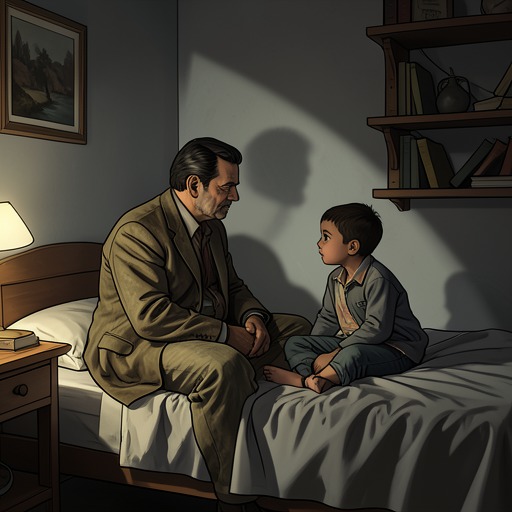
Kido does not regard Sota as a bystander to the marriage’s deterioration. He sees the boy’s rebellion against his mother’s imperious instructions as part of the development of his own sense of self, while the friction between mother and son has become a vicious cycle. Kido tries to raise the problem with Kaori, but his intervention is timid: afraid that the slightest interference could destroy the marriage, he fails to make himself heard. He later comforts Sota in his room and in the bath, hugging him and listening, while recognizing that this private consolation is also an evasion of his responsibility to address the family conflict.
Kido’s hope for Sota is modest but emotionally decisive: he wants his son, looking back as an adult, to feel certain that he was raised with love. He believes this should be a goal shared with Kaori, even though their current pattern makes it difficult to pursue together. The question of whether the marriage can continue is therefore inseparable from Kido’s fear that their conflict will shape what Sota remembers of his childhood.
That fear becomes concrete when Kido loses his temper. Sota has generally been obedient to him, allowing Kido to imagine that they share a special trust, even as he knows his own kindness toward the boy can be dishonest. After Kaori leaves town, Sota’s frustration finds an outlet in resistance to his father. Kido reacts angrily, throws socks at him, and grips his head; he first understands the gesture as a reprimand, then recognizes that it was a slap. He leaves his hand in place in an unconscious effort to conceal what he has done. Sota stops crying, frightened, while Kido looks at his hand and recognizes in his own action the violence he rejects. The moment exposes how the spouses’ unresolved conflict can place their child in its path—and how Kido’s desire to be a loving father does not prevent him from causing harm.
Conflicting Views of Justice
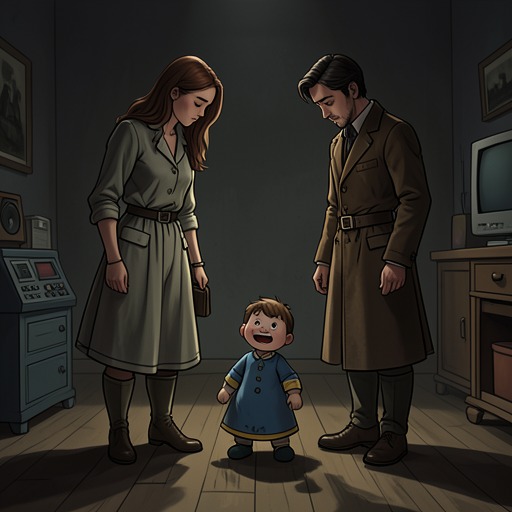
The marriage also contains a fundamental disagreement about what justice demands after a murder. When Sota has just turned one, Kido and Kaori watch the news and discuss what should happen if someone killed their child. Kaori says the murderer should be executed, pressing Kido to answer even after he points out that Japanese law would not impose the death penalty for a single murder. Asked to imagine the murderer killing her and Sota as well, Kido maintains that the state must reject killing even in extreme cases if it is to oppose murder consistently. He argues that offenders should not be forgiven, but that the state should accept responsibility for the social conditions underlying crime and support victims rather than claim innocence while indulging punitive feeling.
Kaori responds with anger and disappointment, looking at Kido as if she doubts his humanity. They end the conversation quickly, sensing that continuing it could bring an irreversible rupture in their relationship. The subject is hypothetical, but the conflict is not: their opposing responses reveal a difference in moral judgment that neither can readily reconcile. Kido’s convictions about state responsibility and punishment thus become part of the intimate distance between them, rather than a position he can comfortably discuss with his wife.
Family Life and an Unsettled Future
During one New Year’s holiday, the family’s routines continue at both sets of grandparents’ homes. Kido and Kaori appear at ease together in company, and after the visits they lie on futons and talk about the next day’s practical arrangements. But Kido cannot sleep, either in Yokohama or in Kanazawa. Being beside Kaori and Sota on the floor makes him acutely aware of how different this is from their established routine, in which one parent puts Sota to bed and then has time alone until morning. The ordinary closeness of the family arrangement unsettles him because the marriage itself has grown so distant.
Kido imagines what divorce would demand: explaining the situation to both families and likely facing a custody dispute. He does not intend simply to give up Sota, but knows he would feel guilty about taking the boy from Kaori. Sota’s grandparents love him deeply, so Kido anticipates guilt toward whichever side lost custody; he also believes that Sota would choose his mother if asked, notwithstanding the boy’s apparent preference for him under the circumstances. These anticipated consequences make separation feel brutal rather than liberating. Staring into the dark beside Kaori, Kido concludes that the marriage has not yet reached the point where such an extreme decision is unavoidable.
The relationship therefore ends this portion of its arc in suspension rather than resolution. Kido has contemplated divorce and understands that the family’s current arrangements are hurting Sota, but he has not decided to leave Kaori. His wish to repair the marriage persists alongside his retreat from difficult conversations, his fear of losing his son, and his awareness that he himself can fail the role of father he wants to inhabit. The marriage’s significance lies in that unresolved tension: care remains, but care alone has not made the spouses able to face their differences or protect their child from them.