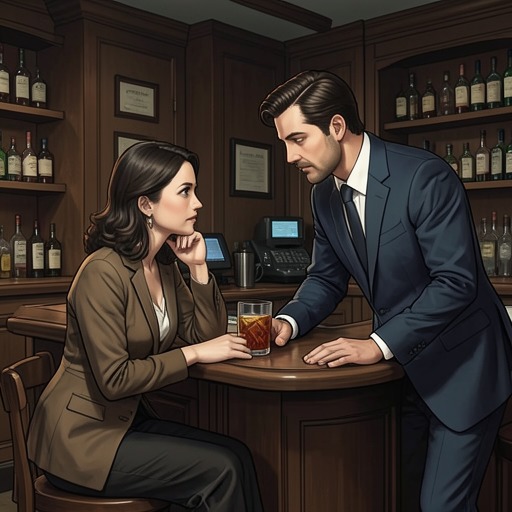
Kyoichi Taniguchi and Misuzu Goto’s strained relationship
A ManKyoichi Taniguchi and Misuzu Goto’s strained relationship is rooted in an old rivalry over Misuzu and sustained in the present by Kyoichi’s unwanted pursuit. Misuzu explains that Kyoichi’s search for his missing brother, Daisuké, has become a pretext for remaining in contact with her; beneath that pursuit, she sees not enduring affection but a wish to undo an old humiliation. Their connection links the brothers’ estrangement to Kyoichi’s continuing efforts to claim Misuzu’s attention.
Past Rivalry and the Brothers’ Estrangement
Misuzu recalls that Kyoichi had a crush on her and could not accept that she began dating Daisuké. In her account, his pride was part of the problem, but so was his habit of belittling his brother: because Kyoichi looked down on Daisuké, Misuzu’s choice of Daisuké was difficult for him to tolerate. Her recollection suggests that the brothers’ falling-out was not separate from their romantic rivalry; her relationship with Daisuké became a point at which Kyoichi’s contempt and jealousy converged.
Misuzu contrasts the brothers’ temperaments. Kyoichi attracts women, she says, but is not her type; Daisuké is awkward and not especially handsome, and he seems to invite jokes at his own expense. Yet, she observes, his apparent good humor can abruptly give way when he has endured too much. What others experience as a sudden outburst has, in her reading, been building all along. The contrast complicates the rivalry: Daisuké’s vulnerability is visible in his self-effacing manner, while the resentment beneath Kyoichi’s pursuit has its own history.
The Search as a Pretext
In the present, Kyoichi has been persistently hitting on Misuzu, and the resulting argument was severe enough that she had to abandon the account concerning Daisuké. Misuzu interprets his continued involvement in the search not as a sincere effort to find his brother but as an excuse to keep in touch with her. The stated purpose of the contact and its personal function therefore diverge: the missing Daisuké provides a reason to approach Misuzu, even as Kyoichi pursues her directly.
This account sits uneasily beside Kyoichi’s forceful insistence that his brother was murdered. Misuzu does not say that he is simply a bad person, but she cannot understand how that conviction fits with his behavior toward her. The contradiction leaves his motives mixed rather than resolved: concern about Daisuké may coexist with a personal agenda, but Misuzu believes the search is being used to preserve access to her.
Desire, Humiliation, and Misuzu’s Judgment
Misuzu describes Kyoichi’s reaction to her sexual relationship with Daisuké as an intense, possessive resentment. Her explanation shifts the matter away from a romantic story of lasting devotion: she believes Kyoichi wants to conquer an old humiliation, not to know or love the person she is now. In her view, he is intent on adding her to his record of conquests, despite the years that have passed and the difference between their youthful history and present lives.
Kido responds by laughing, and Misuzu joins him. The shared laughter briefly gives them a way to speak about Kyoichi’s behavior without treating his pursuit as proof of noble love. Kido then suggests that Kyoichi may be trying to free himself from his past humiliation, a reading that fits Misuzu’s account of unresolved rivalry. The exchange does not establish Kyoichi’s inner motives independently; it records Misuzu’s interpretation and Kido’s response to it.
Relationship and Narrative Significance
Misuzu’s account connects three strands that might otherwise appear separate: Kyoichi’s pursuit of her, his contempt for Daisuké, and the brothers’ estrangement. The search for Daisuké is thus also a channel through which the old rivalry remains active. Kyoichi’s attention to Misuzu reaches back to her choice of his brother, while her refusal to frame that attention as enduring love denies him the romantic meaning he might claim for it.
The relationship is presented through recollection and judgment rather than a reconciliation or settled resolution. Misuzu describes the history as something Kido had not previously heard, including her possible role in the brothers’ falling-out. She can recognize the past’s continuing force without excusing Kyoichi’s present conduct, and she distinguishes his earlier humiliation from any genuine understanding of who she has become. In that distinction, the old triangle remains unresolved: the search continues to bind the brothers’ story to Misuzu, but it does not erase the damage of Kyoichi’s pursuit or restore the relationship between the brothers.