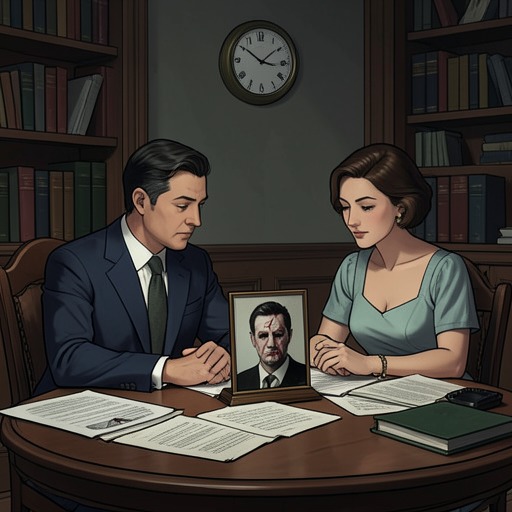
Makoto Hara and Daisuké Taniguchi’s identity exchange
A ManMakoto Hara and Daisuké Taniguchi’s identity exchange is both a change in the family register and an attempt to begin again: Hara takes the identity of a man who wants to escape his past, while Daisuké takes on the identity Hara has left behind. Their arrangement grows from Daisuké’s estrangement from his family and his recognition of Hara’s wish to make something of the life he has left. Yet the exchange does not preserve either man as he was. Daisuké describes a new identity as a different personhood, built by overwriting one past with another; Hara’s choice, by contrast, carries another man’s painful story into a life shaped by family and care.
Background and the first exchange
Daisuké’s wish to leave his family behind had deep roots. As the second son of the owners of an inn in Ikaho Onsen, he watched his parents favor his elder brother, whose status as firstborn seemed to guarantee the inheritance despite his failures. When the brother’s restaurant collapsed under heavy debt, their father agreed to pay it off only if he took over the inn. Daisuké was told that his brother would be managing director and he vice president, though Daisuké understood that he would carry the actual work. He loved his brother, but could not understand why being born first seemed to entitle him to their parents’ greater love.
The family’s expectations became physical when Daisuké’s father developed advanced liver cancer. His brother was ruled out as a potential living donor because of a fatty liver, while Daisuké’s was healthy. The procedure could leave lasting complications for the donor and, in some cases, cause death. His father bowed to him and asked him to fulfill his duty as a son; his mother and brother did not directly demand that he donate, but neither told him he could refuse. They met with his father when Daisuké was absent and spoke of wanting him to live. Daisuké eventually consented by his own choice, deciding to give without resentment.
His father thanked him—the only time he did so—and his brother promised him the entire inheritance. But the cancer had advanced too far: the transplant came too late, and their father died before it could save him. Daisuké recalled feeling relieved as well as frightened by the prospect of the operation. He also felt that something in him had been irreparably broken. He cut contact with his family and left town, determined not to see them again. When he later met Hara, the family register bearing the name Daisuké Taniguchi offered a clean past and a way out of that severed life.
Hara’s need for another life
Hara had already changed his register once, becoming Yoshihiko Sonézaki before exchanging identities with Daisuké. Daisuké explained to Kido that more than one exchange was normal among people involved in that world; a person who had made only one swap, such as Daisuké, was in the minority. Hara’s past was so difficult that Yoshihiko Sonézaki had seemed almost his only possible exchange partner. Hara did not object to Sonézaki’s criminal-family background in itself; the trouble was that he disliked Sonézaki when they met in person.
Daisuké’s register was especially desirable because it carried no criminal record and a clean history. One man kept exchanging for better registers in the hope of acquiring it, a process Daisuké likened to the folktale of the Straw Millionaire. Daisuké was willing to exchange with almost anyone because he cared only about cutting off his family, but he would not accept a criminal record or someone who might scheme to claim the Taniguchi estate. Hara offered a different possibility. After talking with him, Daisuké thought his own identity might help Hara turn over a new leaf.
The exchange was not a casual arrangement between men who remained strangers. They met twice, and Daisuké liked Hara. Hara listened carefully to his account and said that he wanted to make the most of the life Daisuké had left to give. Daisuké saw in him a rare purity and goodness, despite what he had endured, and understood how urgently Hara wanted to leave his old course behind. For Daisuké, giving away his life was acceptable because of the particular person who would receive it. Their exchange thus joined an administrative transaction to a personal judgment: Daisuké chose Hara because he believed Hara might use the borrowed life well.
Becoming a different person
After the swap, Daisuké moved away and cut off his old relationships. He told Kido that a year after changing registers, a person actually becomes someone different. When Kido addressed him as Daisuké Taniguchi, he did not instinctively recognize the name as his own. The shift encompassed more than a label: Daisuké said that pasts had been exchanged along with everything else. He could look at Kyoichi Taniguchi online and see only the owner of a country inn, rather than the brother whose family had been the source of his hurt.
Daisuké distinguished forgetting from replacing. If someone hates the past, he argued, simply trying to forget it does not work; it has to be overwritten with another person’s past until the old one is unrecognizable. That claim does not mean the original history disappears without consequence. Rather, a new identity reorganizes what the person can remember as belonging to himself. Daisuké’s estrangement from his family and change of place helped the memories fade, while the borrowed history supplied a new frame for his life.
His account also complicates the idea that taking another identity means living through that person’s trauma. Kido had assumed that the swap meant inhabiting the experience of someone else’s pain. In conversation, he realized that Daisuké’s account was different: the new identity had made Daisuké feel separate from his former self, not simply like a vessel carrying Hara’s suffering. Kido could recognize the man before him as Kyoichi’s missing brother, but the person he encountered seemed radically unlike the Daisuké that Misuzu had described. Legal continuity and personal continuity had come apart.
The borrowed past in reverse
The exchange’s effects also ran in the other direction. Daisuké said that he had never met the real Sonézaki, so he could not picture the person whose name Hara had once borne. Instead, he built an imagined past for himself from Hara: he began with the question of what Hara might have been like as the son of a yakuza, then constructed his identity from there. In that imagined life, even the period when he had been a boxer came from Hara’s history. The role was not direct memory but an account made plausible by borrowing another man’s experiences.
Hara’s boxing past had included winning the East Japan Rookie King Tournament, and Daisuké was surprised to learn of that achievement. But the exchange carried more than the outline of a biography: it put Hara’s wish to start over beside Daisuké’s wish to sever family ties. Hara had tried to make a new life from the identity of a man who wanted to escape his own. As Daisuké understood it, Hara listened to him and hoped to make good use of what remained of his life; the exchange let each man’s chosen future take shape through the other’s name.
Aftermath and significance
When Kido told Daisuké that Hara had died, Daisuké grieved the loss and admitted that he had wanted Hara to keep living as Daisuké for him. At the same time, he felt relieved to know that the second son of the Taniguchi family was no longer alive somewhere, a presence that had troubled him despite his separation from the family. The relief reveals the limit of the exchange: Hara could take Daisuké’s registered identity, but he could not make the original man’s existence cease to matter.
The legal record made that limit consequential. Hara’s death had been registered as the death of Daisuké Taniguchi, even though the real Daisuké remained alive and missing. Once the deception came to light, the death notification was annulled and Daisuké was officially listed as living. In the same process, the court removed the false marriage from Rié’s family register and restored her maiden name, leaving her daughter Hana legally illegitimate. The exchange had given Hara a life with Rié and her children, but an identity that worked in daily life still left discrepancies for family, government, and law to reckon with.
The relationship between the two men is therefore neither a simple substitution nor a clean escape. Daisuké’s decision to give his register depended on his belief in Hara, while Hara’s life under the borrowed name expressed a wish to become someone capable of caring for others. The exchange offers a concrete version of the story’s question about whether a life can be exchanged: names, records, and remembered histories can be reassigned, and a person can experience a new self as real. But affection and loss remain particular. Hara’s death cannot be undone by restoring Daisuké’s legal existence, just as the register alone cannot account for the person Hara became or the life his family remembers.