Norio Omiura
A ManNorio Omiura is an imprisoned broker of family-register exchanges whose clues help Kido trace the identities of Daisuké Taniguchi and Makoto Hara. Both a source of evidence and a warning about its unreliability, Omiura makes identity exchange sound less like a single bargain than a trade in lives, histories, and the possibility of starting over.
Identity and Introduction
Kido finds Omiura through a court case concerning an exchange arranged in 2007, the same year Daisuké left his Osaka apartment and X appeared in Town S. The case had involved a middleman who charged a fee for arranging family-register exchanges and was later imprisoned for an investment scam. Kido learns that Omiura is serving his sentence at Yokohama Prison and writes to request a meeting. Omiura’s oddly cordial reply encourages the visit without explaining what he knows.
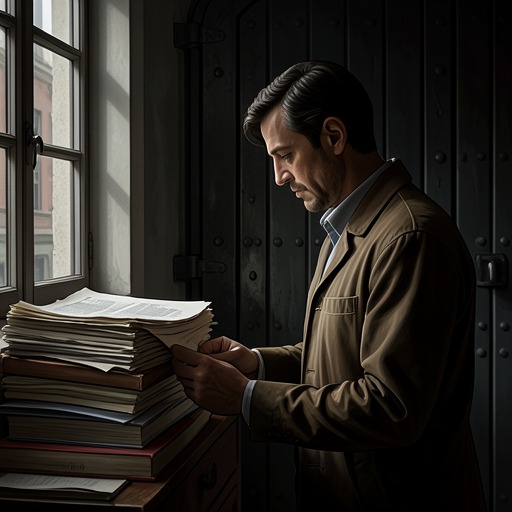
At the prison, Omiura is introduced as a bald, chubby man of fifty-nine, with one eye larger than the other. He greets Kido with extravagant flattery and says he has an inferiority complex about his appearance. The compliments strike Kido as insincere, while Omiura’s admission of insecurity seems genuine. That tension becomes a compact portrait of his manner: an attempt to persuade that is inseparable from concealment, leaving Kido unsure which part of a performance can be trusted.
Broker of Exchanges
When Kido asks who exchanged registers with the man in the court case, Omiura rejects the description of a mutual exchange and names the practice identity laundering. People, he says, want to clean up their pasts and have long tried to improve their position by altering their family trees. The phrase recasts the register not merely as a legal record but as something that can be used to wash away a history and pass a different one to others.
Omiura’s explanation is also a provocation directed at Kido: he suggests that the lawyer may have his own reasons for being interested in such a transformation. Kido does not answer. Omiura asks him to bring small gifts on a future visit, mixing practical self-interest with the suggestion that further contact may produce more information. His method is not the orderly disclosure of a broker explaining a transaction; he draws Kido into a shifting conversation where a useful idea may arrive alongside a taunt.
Postcards and Clues
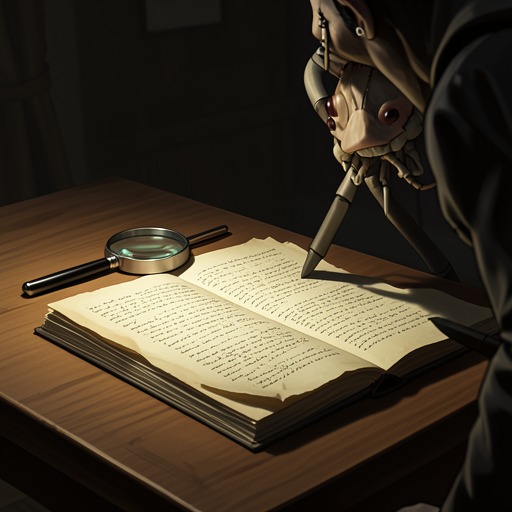
Kido initially puts off contacting Omiura again. He has found the man’s accounts so entangled with fiction that trying to separate lies from facts risks making both harder to understand. Then eight postcards arrive, one after another. They reproduce a nude image from a magazine in ballpoint pen. Kido begins to wonder whether an earlier account Omiura had given him—one he dismissed as far-fetched—was an attempt to communicate an experience of sexual assault and seek either legal advice or human compassion. The postcards do not confirm the story, but they alter Kido’s sense of what Omiura may be trying to convey.
The drawings change subject. Omiura sends an image of the bodhisattva Kannon seated by water and looking at the moon’s reflection. Kido thanks him by letter and applies to meet again. Omiura immediately replies with a letter addressed “Dear Korean!” and a message that calls Kido an empty-eyed “Handsome Lawyer Sensei” and a “C-H-U-M-P!” Kido cannot determine whether the address is friendly or mocking. The words have been traced over repeatedly, making the letter at once a personal message and another deliberately difficult object to interpret.
Omiura then returns to risqué drawings, this time copying an image of a woman from what appears to be a manga. Small writing around the image identifies Daisuké Taniguchi on one side and Yoshihiko Sonézaki on the other. The names turn an apparently crude postcard into a clue about exchanged identities. When Kido shows it to Nakakita without explanation, Nakakita frowns and then laughs in disbelief. Omiura has conveyed information, but in a form that makes the recipient do the work of recognizing its significance.
Omiura’s Own Identity
During a later visit, Omiura challenges Kido’s assumption that the name Norio Omiura belongs to the man sitting before him. He compares the situation to tattoo artists marking themselves as well as other people: with family registers continually being switched, Kido has no reason to imagine that Omiura is an exception. When Kido asks whether he is someone else too, Omiura laughs rather than giving a direct account of his identity. The possibility that the broker has also exchanged registers makes his role harder to reduce to that of an outside arranger. The person who names identity laundering may himself be one of its products.
As their allotted time ends, Omiura tells Kido that the man he is investigating is an ordinary, unremarkable person, not the figure Kido seems to expect. He also warns Kido to leave the matter alone and invokes the danger of a snake hidden in tall grass. His warning is framed around Kido’s family, but the evidence does not establish whether it is sincere concern, manipulation, or both. The uncertainty suits Omiura: even when he offers a potentially important judgment, he leaves its motive unresolved.
Connections and Narrative Role
Omiura’s postcards help connect Kido’s investigation of X to the register of Daisuké Taniguchi and the name Yoshihiko Sonézaki. Later, Daisuké recounts that he met Hara when Hara was living under the name Sonézaki. Daisuké says the two met only twice, but that Hara listened carefully to his story and wanted to make the most of the life that remained to him. This account gives the names on Omiura’s drawing a human context: the register exchange was not simply a broker’s transaction but part of a decision through which one person hoped another might begin again.
Omiura’s character is defined by the friction between information and trust. He may arrange exchanges and identify their logic, yet his own name is called into question; he may send clues, yet puts them in drawings that require interpretation; he may warn Kido, yet speaks in a way that blurs concern with provocation. He therefore advances the investigation without making its evidence feel secure. His presence gives the story’s concern with borrowed identities a sharp personal edge: the broker is not safely outside the system he describes.