Rié's prolonged bereavement
A ManRié's prolonged bereavement is not a single response to one death but an accumulating grief that repeatedly breaks into ordinary life. After losing her young son Ryo, she returns to Town S and tries to keep going for her surviving son, Yuto; later, her father and the husband she knew as Daisuké also die. Memories of Ryo remain sharply embodied, and the discovery that Daisuké lived under another man's identity unsettles even the name of the person she mourns. The losses do not resolve into a settled past: they recur as scenes, questions, and a struggle to remain attached to the living.
Losses and Their Accumulation
Rié first experiences profound sorrow when Ryo, diagnosed with a brain tumor at two, dies six months later. His death is followed by her divorce and return to her hometown, then by the deaths of her father and her young husband. The narrative counts three of the people she loved most, lost one after another. Their deaths are distinct, but together they alter the shape of her life and make grief cumulative rather than episodic.
The losses also unsettle the expectations surrounding Rié. People who had assumed that she was happy are disturbed by the sequence of a child’s death, divorce, and return home. When she loses her second partner after only three years and nine months of marriage, neighbors respond with sympathy for a life that has repeatedly departed from what they imagined for her. Their response registers not only compassion for individual deaths but unease at the possibility that severe misfortune can return more than once.
Ryo in Memory
Ryo’s illness remains present to Rié through a particular memory: perhaps a month before his death, she left his hospital ward to speak with the doctor and returned to find him quietly staring at the ceiling. She wonders what he could think or feel, and the memory turns on the painful gap between the life his capacity for thought should have served and the short future illness allowed him. When this moment comes back to her, grief overwhelms her body; she sits wherever she happens to be and covers her face.
The memory does not remain safely in the past. While caring for the stationery shop, Rié can be overcome by thoughts of Ryo and cry alone. Even the possibility of his death once felt incomprehensible: his mind, which might have guided him through decades, seemed instead to be confronting an end he could not fully understand. Recalling that scene returns her to the helplessness of watching a child die, not to a consoling distance from it.
Her bereavement also holds an imagined refuge. Rié has no particular religious faith, and her family belongs to the Jodo sect chiefly for funeral services, yet she pictures her father watching over Ryo in heaven. Her mother gives that image a more definite family meaning, imagining that the father went ahead to keep the boy company. Rié finds a measure of relief in the thought, even though it cannot undo either death.
Grief in the Present
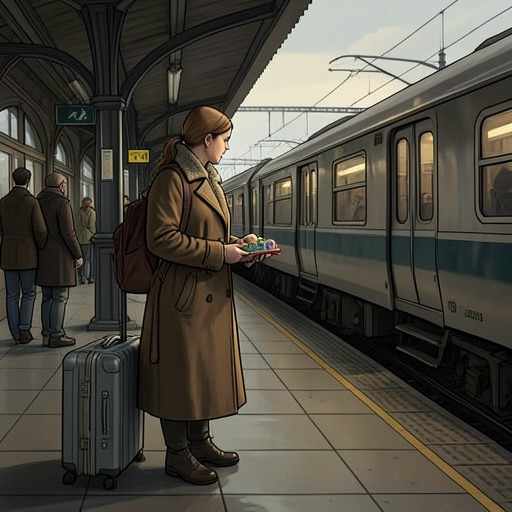
Returning to Town S brings Rié the comfort of familiar surroundings, but it does not restore a secure feeling of belonging to life. At her desk in the shop, she sometimes feels so empty that her connection to the world seems to come loose and time passes without her noticing. In those spells she wonders whether death might not be frightening: if Ryo could undergo it, perhaps she could too, and perhaps her father is waiting with him. The thought does not settle into a wish or belief. When she recognizes where her mind has gone, dread fills her body with a cold, luminous force.
Her surviving son, Yuto, gives her a reason to continue. He is too young to be troubled by his brother’s death and grows into an unexpectedly energetic boy after their return. Rié reminds herself to carry on as cheerfully as she can when her thoughts turn to him. Her effort is not proof that grief has passed; it is a way of remaining present for the child still in her care even as memories pull her toward the dead.
The Body of Bereavement
The news that Ryo would not recover makes the suffering Rié and her husband had allowed him to endure feel pointless. In retrospect, she imagines spending his remaining days on his favorite foods, trips to the zoo, indulgence, and the joy of living, rather than harsh treatment. When she understands that recovery will not come, she cannot breathe. Heat and then glacial cold overtake her, and she rubs her arms and legs together erratically as she cries. Rié later understands the bodily frenzy as an effort to reach a state in which feeling would cease.
That response carries into the question she cannot answer: she could not die in Ryo’s place. Her desire to do so had been genuine and painfully intense, but only Ryo could die his own death; Rié’s own death would still await her. The difference between wishing to take a loved one’s suffering and actually being able to exchange places with that person gives her grief a stark limit. Love can intensify the wish for substitution, but it cannot make one person’s death another’s.
Memory, Identity, and Mourning
The later discovery that her husband had not been the man whose name he used makes Rié’s bereavement newly unstable. According to the family-register records, the dead man was Daisuké Taniguchi, but Rié understands that this name should have had a death belonging to its rightful bearer alone. She is left asking who died and whose death her husband had died. The question does not cancel her memories of the man she loved; it makes the relation between those memories, his assumed identity, and the official record impossible to take for granted.
The narrative gives this grief a form of return rather than a clean chronology of recovery. Rié’s remembered hospital scene, bodily responses, and recurring reflections on death show losses continuing to act in the present. Their force is especially clear in the contrast between the ordinary demands of the shop and the sudden collapse of time into recollection. Her bereavement is therefore both intimate and bound up with identity: she must mourn the people she lost while confronting uncertainty about the name and person attached to one of those losses.