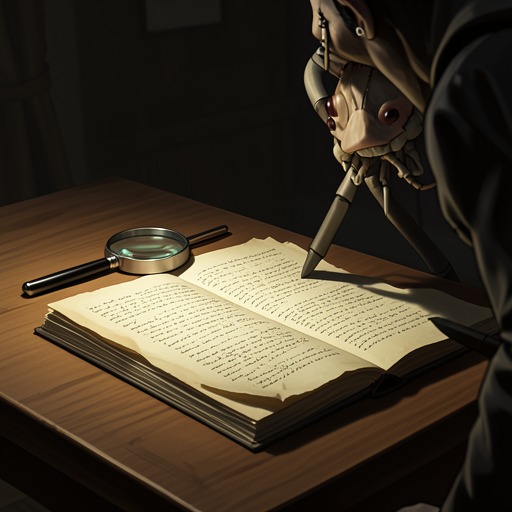
Rie reports to the police about the suspicious aspect of her husband's identity
A ManRié’s report to the police is an attempt to turn the revelation that her dead husband was not Daisuké Taniguchi into an answerable public matter. Instead, the station treats the case as an administrative problem, prioritizes locating the real Daisuké, and leaves Rié without a way to learn who the man she loved had been. That failure sends her back to Akira Kido and begins a more intimate reckoning with the names, memories, and family bonds the deception has unsettled.
The revelation and the decision to report
Kyoichi Taniguchi’s examination of the family photographs gives Rié’s suspicions a devastating shape. The album, assembled by Daisuké from digital photographs, shows the man who had lived as Daisuké alongside Rié, Yuto, and Hana. On its last page, however, Kyoichi recognizes an old photograph of himself with their parents. The real Daisuké is absent because he had taken the picture. Kyoichi tells Rié that the man she knew was an impostor, but he cannot identify him; he has only just seen the photograph himself. His suggestion that they go to the police offers a course of action, not an explanation.
When Kyoichi visits her home, Rié accompanies him to the police station despite distrusting him. The revelation has left her in shock, but she considers reporting it necessary. She has never been inside the station, though it stands directly in front of the bus terminal she used when commuting to high school. As she and Kyoichi give the detective their scattered account, she worries that a formal investigation will draw Yuto and Hana into the affair, spread rumors through their small town, or attract newspaper attention. Those fears make the report feel not only like a search for the truth but also like the beginning of a public exposure she cannot control.
The police response and its limits
The detective’s reaction frustrates any expectation that the station will take up the question of the dead man’s identity. Already in a bad mood, he listens with evident confusion and asks who, exactly, was the person who died. He does not consult anyone else at the station. His only concrete action is to have Kyoichi file a missing-person report for the real Daisuké, turning the case away from identifying Rié’s husband and toward finding the man whose name he had used.
Rié directly asks how she can discover who her late husband really was, but the detective gives no answer, saying that the search for Daisuké must come first. The distinction leaves her with a bureaucratic contradiction: the man she buried and mourns is the central fact of her life, yet the authorities will not investigate him until they have pursued the identity he borrowed. Two weeks later, after hearing nothing, she calls the station herself. She is told brusquely that no one matching Daisuké Taniguchi has been found on the missing-persons list, and that there is “no way to investigate at the present time.” The inquiry has produced neither a recovered person nor an account of the dead one.
Turning to Kido
With no useful help from the police, Rié decides to consult Kido. Her choice rests on more than his professional role as a lawyer. The seven years since she returned home have suddenly lost their sense of reality; against that disorientation, her years in Yokohama after Ryo’s death have become the most distinct period in her memory. Kido had been her lone bedrock then. The earlier bond of trust gives her somewhere to turn when the name and identity around which her recent life was organized prove false.
When Rié tells Kido how little confidence she has in the police response, he answers in the calm voice she remembers. He doubts the police will do anything, observing that they already handle thousands of missing-person cases each year and are likely to avoid additional complications over her late husband’s identity. He describes them as bureaucrats. His explanation does not solve the mystery, but it clarifies why Rié cannot rely on the report to restore a coherent account of her husband. The failed encounter redirects the search from official procedure to personal investigation and remembered relationships.
The family consequences of the false name
The identity problem is not confined to the police file. When Rié later tells Yuto that she will return to her maiden name, he asks to remain Yuto Taniguchi. He traces the successive surnames of his childhood: Yoneda at birth, Takemoto after his mother’s divorce, and Taniguchi when he started elementary school. Now in middle school, he is known by Taniguchi by his friends and the older and younger students around him. For Rié, changing back to Takemoto may feel like a return; for Yuto, another change would mean repeatedly correcting people and taking on a name that feels like his grandparents’ rather than his own.
Yuto links his request to the fate of the father he believed he had. He asks when Rié will make a grave for him, pointing out that the ashes have remained in the urn and that she hardly talks about him. If she returns to Takemoto, Yuto asks, can he still be allowed to stay Yuto Taniguchi? His concern is that the man’s family turned their backs on him, and that the children might forget him too. The request gives the name a meaning beyond legal accuracy: retaining it is one way for Yuto to remain connected to a father whose biography has become uncertain.
Rié had not understood what lay behind Yuto’s earlier silence when she announced the proposed name change. His protest makes visible a grief he has not expressed in the way she expected. She recognizes that he has lost his brother, grandfather, and the man he thought of as his father, while remaining a boy who is still trying to hold himself together. Rié has her own sense of being emptied by loss, but she now sees that Yuto’s quietness does not mean the losses have passed over him. The police report can question a husband’s identity; it cannot decide what the father’s name means to a child.
After the report: grief, reading, and expression
Yuto’s care for others gives Rié small, concrete evidence of the feelings he rarely explains. Seeing his grandmother look at the aquarium in the shed, he proposes goldfish and promises to look after them. Rié is deeply moved, recalling her late husband’s description of Yuto as a thoughtful boy. His attention to the aquarium is both practical care for his grandmother and a sign of the tenderness that continues within the family after the loss.
At a field of cosmos, Rié watches Yuto keep an eye on Hana while standing apart, his hands buried in his gray hoodie. She reflects that he is coping not only with his father’s death but also with the earlier deaths of his brother and grandfather. He tends the goldfish, watches his little sister, and reads, while carrying a pain that he does not put into words. Rié understands that his attachment to the man he called Dad was especially strong because he was old enough to form that bond, and she wishes the dead man were still there to advise him. Her grief gradually loses its sharpness, bringing relief, but a different loneliness sometimes remains. When people suggest that she remarry, she smiles and says she has had enough.
Reading eventually offers Rié a way to approach what Yuto has not told her directly. She tries Ryunosuke Akutagawa’s “Asakusa Park,” which he had mentioned at Burial Mound Park. Its surreal images confuse her, but its story of a boy separated from his father, distressed as he searches, and initially mistaking a masked stranger for his father moves her to tears. What affects her is not simply pity for the fictional boy: she imagines Yuto responding to the story and recognizes in his reading a possible expression of loneliness. He had read it before she told him that the man he called his father was not Daisuké Taniguchi. Rié wonders whether this timing was coincidence or whether he had sensed something, but cannot know what he understood.
The book nonetheless gives her a way to hear what direct conversation has not yet revealed. Yuto had mentioned the uncanny exchange between the boy and a tiger lily, not the story’s separation from a father. Rié sees that his choice to share even that partial detail may have been an indirect effort to communicate his emotional connection to the work. Although she does not consider herself a reader and cannot settle the story’s meaning, following Yuto’s response to it brings her closer to his interior life. Literature becomes a path to understanding that ordinary daily proximity had not provided.
Yuto’s poem carries that indirect communication into his own writing. Its image begins with an abandoned cicada shell stuck to a cherry tree at Burial Mound Park and the living cicadas singing in the branches. He imagines the sound of the body that emerged from the shell after seven years underground, as heard by the shell it left behind. The crack along the shell’s back then reminds him of a violin’s soundboard; seeing the whole shell as a resonating instrument gives rise to the poem. Rié knows that the cherry tree must be the one her husband had chosen, though she does not know whether Yuto actually visited the park alone or invented the experience.
The poem does not mention the deaths of Yuto’s brother or father, but its abandoned shell and the voice of the transformed body give Rié a way to recognize how he is living with loss. She cannot judge the poem’s merit for herself; its judges criticize its ostentation while praising its precocious talent. What matters most to her is that Yuto has found, without her guidance, a means of coping with life’s ordeals. The false identity revealed by the police report remains unresolved in the available account, but its consequences are no longer only a matter of paperwork: they continue through a child’s chosen name, his attachment to a lost father, and the forms of reading and writing through which he makes grief perceptible.