Shozo Tashiro
A ManShozo Tashiro is the homeless man whose testimony disentangles one strand of the novel’s identity exchange: he traded his family register with Makoto Hara, while the man who lived and died as Hara was, in Kido’s reconstruction, the real Hara and the son of Kenkichi Kobayashi. Tashiro’s account makes the exchange more than a puzzle of names. It locates it in a life shaped by insecure work, homelessness, and the immediate need for food and money.
Identity and the Exchange
Tashiro enters the investigation through Kido’s effort to determine who the dead man really was. Learning that Makoto Hara had been imprisoned alongside Omiura at Yokohama Prison, Kido sees a possible link: they were likely fellow inmates, making it plausible that Omiura arranged an exchange between Hara and another prisoner. This connection sharpens Kido’s conjecture that X was not merely someone impersonating Hara, but the real Makoto Hara, and that the man once imprisoned for compulsive shoplifting had exchanged family registers with him through Omiura.
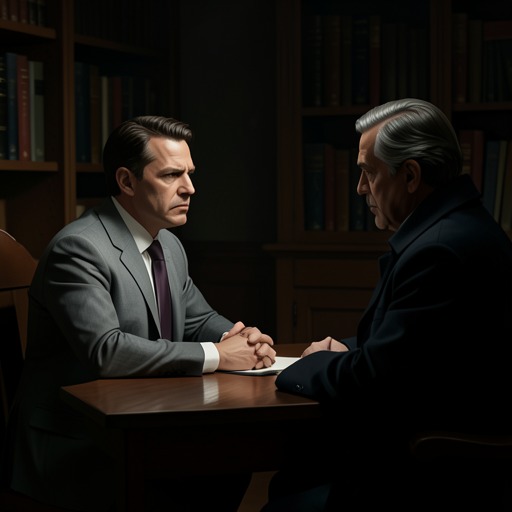
Kido and Kadosaki approach Tashiro while investigating the identity of Rié’s dead husband. Kadosaki briefly explains the case, and Kido asks whether the deceased could have been Makoto Hara. He tells Tashiro that the wife is anguished by the mystery and that he wants to help her; he has heard that Tashiro’s real name may be Yoshihiko Sonézaki. The encounter is uncomfortable: Tashiro appears upset and plainly dislikes Kido, while Kadosaki tries to reassure him. When Kido asks whether Omiura arranged the family-register exchange, Tashiro looks to Kadosaki before deciding whether to speak.
The decisive answer comes only after Kadosaki asks whether his name is actually Makoto Hara and Kido promises not to repeat what he says. Tashiro first worries that telling the truth might send him back to jail. He then gives his birth name: Shozo Tashiro. Asked whether he traded it with Makoto Hara, he confirms that the exchange covered his entire family register. The name Kido had heard, Yoshihiko Sonézaki, is not the name Tashiro ultimately gives as his own; his explicit answer is Shozo Tashiro.
Homelessness and the Price of a Register
Tashiro says the exchange was made for money, but also because homelessness made ordinary tasks difficult. Finding work and borrowing money were hard when he had no home, so the transaction offered both immediate cash and access to a different legal identity. His explanation grounds the exchange in practical desperation rather than an elaborate personal ambition.
After the disclosure, the three share cake while Kido asks about Tashiro’s life. He had moved from job to job after high school, unable to stay long because people called him insults such as “moron” and “waste of space.” He had been homeless for ten years by the time of the meeting. The money left to him after Omiura took his cut was barely enough for a month’s food. Tashiro does not know how much Makoto Hara received, so the financial terms on Hara’s side remain unresolved.
The exchange thus has sharply unequal consequences in the evidence available: Tashiro identifies a brief payment that could cover little more than food, while the adoption of another family register offered a way around the obstacles he associated with homelessness. The transaction’s intermediary, Omiura, took a share, but Tashiro does not describe the arrangement’s full terms or say how long he expected the new identity to serve him.
The Kobayashi Connection and Its Limits
Kido’s suspicion about the dead man’s parentage gives Tashiro’s testimony a second significance. Kido reasons that if X was Kenkichi Kobayashi’s son, descent from a man who committed a terrible crime might help explain why X felt compelled to take on a new past. In that reconstruction, the man who died as Hara was the real Makoto Hara, while Tashiro had taken Hara’s family register. This remains Kido’s explanation of X’s motive, not a motive Tashiro claims for himself.
Asked whether he had worried that becoming the child of Kenkichi Kobayashi could make life harder, Tashiro says that he had. But he kept the concern to himself, and, as he explains it, people did not link Hara to Kobayashi because the two had different family names. His answer reveals a distinction between the identity imposed by the register exchange and what other people could infer from names. The possibility of a damaging ancestry troubled him, but the difference in family names seemed to keep the association from becoming visible to others.
Tashiro also firmly denies knowing the man shown to him as the Makoto Hara with whom he had exchanged registers: “I don’t know this guy!” The denial is emphatic, as though his self-respect depended on it. It separates the man whose register he received from the person in the image, while reinforcing the investigation’s central uncertainty about which life and name belonged to the dead man.
Narrative Significance
The meeting lasts about an hour and a half. Its revelations arrive through pauses and small acts of hesitation: Tashiro watches Kadosaki before answering, worries about returning to jail, pours large amounts of milk and sugar into his coffee, and circles his eyes while saying nothing. These details do not resolve every mystery, but they make the disclosure feel less like a clean exchange of labels than a difficult confession by someone with little security to bargain from.
Tashiro’s story also places the mechanics of borrowed identity beside the material conditions that can make it seem useful. A family register can be exchanged, and names can obscure a connection to a notorious parent, but neither fact erases the pressures that brought Tashiro to the deal: repeated job loss, homelessness, and a payment that barely fed him for a month. His testimony gives Kido evidence for reconstructing Hara’s identity while preserving a limit: Tashiro can confirm his own name, the register trade, and his reasons, but he cannot supply the amount Hara received or settle every question about the life lived under Hara’s name.