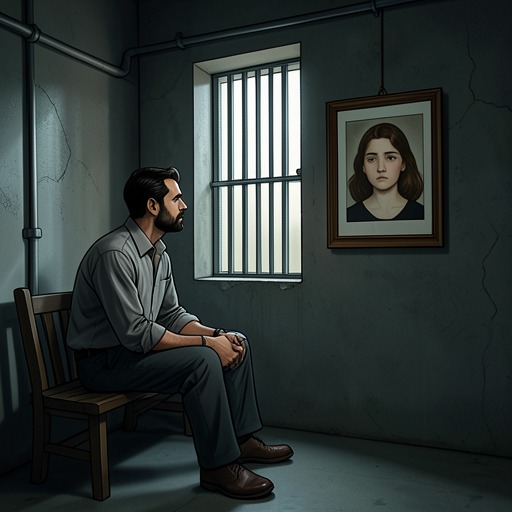
Sugino
A ManSugino is a lawyer, a friend of Kido, and a committed supporter of abolishing capital punishment in Japan. He organizes Kido’s visit to an exhibition of art made by death-row convicts; there, his restrained account of punishment and his connection to the displayed work help set in motion Kido’s recognition of a likeness between Kenkichi Kobayashi and X.
Legal career and abolitionist commitment
Sugino had once been expected to pursue a judge-track career. His prospects were strong from his legal internship onward, and he received numerous invitations to follow that path, but he instead became a lawyer. The narrative identifies him as an ardent supporter of the movement to abolish capital punishment in Japan.
His commitment did not make him Kido’s guide to a movement in which Kido was already deeply involved: Kido opposed capital punishment but had never participated directly in abolition work or defended a client facing a death sentence. Sugino’s invitation instead brought Kido into a setting where the ethical and legal arguments around punishment met the evidence of individual lives.
The prison-art exhibition
Three days before Christmas, after completing work at the Tokyo District Court, Kido went to an exhibition in Shibuya featuring art submitted by death-row convicts. Sugino was one of its organizers and was due to moderate a later discussion. Kido attended partly because his recent encounter with Omiura and the postcards Omiura had sent from prison had awakened his interest in prisoners’ art; he wanted to see what artists living with past crimes and the prospect of execution made in the present.
The exhibition displayed several dozen artists’ works, from large pieces to postcard-sized images. Some had been assembled from scraps and colored with limited materials. Each work was accompanied by its title, the creator’s name, and the unofficial name of the case behind the conviction, but no further details. Visitors sometimes searched on their phones for context. Kido had planned to leave early because snow threatened to disrupt his journey home, yet he stayed through the discussion and later lingered before the landscape paintings.
Argument about punishment and victims
During the event, a participant named Kawamura delivered an angry challenge. Sugino, apparently familiar with him, answered without visible agitation. He distinguished legally guaranteed rights from emotional responses and explained that Japan’s approach was proportional retributivism, not absolute retributivism. In his account, the principle often expressed as an eye for an eye is a limit on retaliation: punishment should not reproduce bodily injury but restrict a perpetrator’s freedom in proportion to the crime. The death penalty, he argued, falls outside that limiting principle. He also acknowledged that he could understand the emotional force behind Kawamura’s position, while challenging the implication that a death-row prisoner should be denied all capacity to think or feel.
Sugino’s composed legal argument did not erase the disagreement. Kawamura shook his head repeatedly and remained visibly tense, though he did not continue arguing. Kido, who had already noticed that no one had raised the victims’ perspectives, felt that this absence deserved a question from the audience. The omission was part of why he remained uncomfortable with becoming actively involved in the abolition movement. Sugino’s answer thus clarifies one legal and ethical position, while the scene leaves Kido’s concern about the victims unresolved.
The Kobayashi connection
After the talk, Sugino spoke with the guest art critics while Kido waited beside the landscape paintings. The exhibition information identified their maker as Kenkichi Kobayashi, a man convicted of murdering a married couple who owned a local construction company and their sixth-grade son. Kido struggled to reconcile the landscapes before him with the crimes described. When Sugino eventually returned, Kido had begun searching Kobayashi’s name on his phone.
The search produced a photograph that resembled X. Kido realized the person pictured was not X, but someone astonishingly similar; he was startled and began to form a guess without yet taking in its implications. Sugino supplied the crucial family detail: Kobayashi had a son named Makoto, who took his mother’s maiden name after his parents divorced and became known as Makoto Hara. Sugino’s information connected the exhibition’s painter to the resemblance Kido had noticed and helped turn an art visit into a decisive investigative lead.
Sugino also explained the history behind the artist’s conviction. In 1985, in Yokkaichi, Mie Prefecture, Kobayashi, a gambling addict in serious debt, demanded money from an acquaintance who ran a construction company. After being refused, he later returned to the house, killed the acquaintance and his family, including their only child, and set a fire in an attempt to destroy evidence. The facts gave Kido’s discovery a personal dimension: Makoto Hara had been born in 1975, the same year as Kido. Kido recalled his own childhood and recognized that another boy of his age had grown up in the aftermath of his father’s crimes.
Narrative role
Sugino links three parts of the episode: the public debate over state punishment, the art made by prisoners, and the private history that Kido is trying to uncover. His legal explanation is deliberate and controlled, but the exhibition’s landscapes resist easy separation between an artist’s work and the violence in his past. By providing Kobayashi’s family history, Sugino gives Kido the clue that redirects his investigation toward Makoto Hara and the resemblance to X. The scene does not make Sugino responsible for Kido’s eventual conclusion; it establishes the information and setting through which Kido begins to reach it.