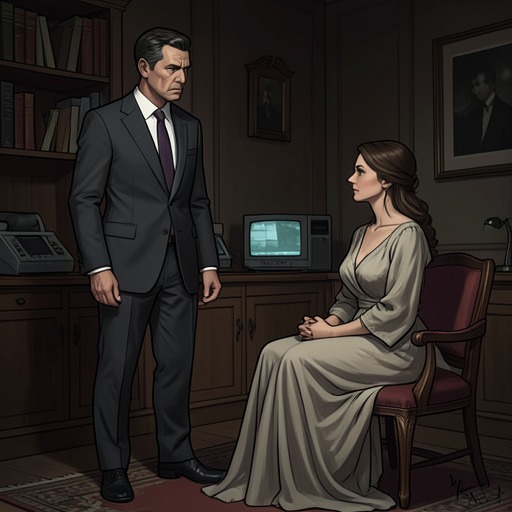
Takeda family liver transplant donor crisis
A ManThe liver-transplant crisis in the Taniguchi family turns Daisuké’s filial devotion into a choice with no good outcome. His father’s advanced cancer makes a living-donor transplant his only chance, and Daisuké is the one relative whose liver is healthy enough to be used. He consents because he wants his father to live, but the operation never takes place: his father dies while Daisuké is still wavering. The failed rescue leaves him estranged from his family and becomes the private wound he eventually entrusts to Rié.
Family and Inheritance
Daisuké’s position in the family had long been shaped by birth order. He was the younger son of the owners of an inn in Ikaho Onsen, while his older brother, though often irresponsible, was expected to inherit because he was the eldest. When the brother’s restaurant failed and left him heavily in debt, their father agreed to repay what he owed on the condition that he take over the inn. The parents then promised the brothers that the older one would become managing director and Daisuké vice president.
The titles did not change who was expected to do the work. Daisuké understood that he would have to carry the business in practice, despite having applied himself diligently after joining his father’s company and gradually winning his disappointed parents’ confidence. He had long struggled to understand why his parents loved his brother so much simply because he was the eldest son. He loved his brother, but did not believe that affection was returned in equal measure. The transplant crisis therefore arrives inside an already unequal family arrangement: Daisuké is valued as the reliable son, yet that reliability also makes him the person expected to bear the greatest cost.
The Donor Decision
Several years later, their father was diagnosed with liver cancer at the age of seventy-one. The cancer was advanced, and although transplantation offered a chance of survival, his prognosis remained poor. There was no time to wait for a liver from a brain-dead donor, so the family’s only possibility was a living donation from a relative. Medical tests ruled out the older brother, whose liver was fatty; Daisuké’s was healthy. The very restraint that had distinguished him from his brother now made him the available donor.
A living liver transplant could leave the donor with serious complications and, in some cases, could be fatal. The request was not presented to Daisuké as a decision free of family pressure. His father, who had never before bowed to him, gripped his hand, cried, and asked him to fulfill his duty as a son. His mother and brother did not explicitly tell him to agree, but neither reassured him that he could refuse. They told him they wanted his father to live, held discussions when Daisuké was absent, and made no effort to ask their father to reconsider. When Daisuké arrived at the hospital during one of those meetings, the urgency of the situation was plain; he wanted his father to live as much as the others did.
Daisuké ultimately consented, but the decision mattered to him as an act of choice rather than simple capitulation. He intended to offer part of his liver without resentment. His father was overjoyed, thanked him—the only time he ever did so—and Daisuké’s brother promised him the entire inheritance when the time came. Their mother appeared happy. For a moment, the family’s familiar imbalance seemed to give way to gratitude and an assurance of recognition.
Death Before the Operation
That brief reprieve did not last. While Daisuké wavered over consenting, his father’s cancer advanced faster than expected, and by the time the family was ready, it was too late for the transplant. His father died with an expression Daisuké remembered as horribly irritated, almost hateful. The family mourned together, but neither his mother nor his brother offered kind words about the resolve that had come to nothing.
The crisis thus ends not with a risky operation or a recovery, but with an irreversible failure of timing. Daisuké had been afraid of the procedure and wanted his father saved; those feelings coexist rather than cancel each other out. Later, he admitted that he had been relieved: as he learned more about the operation, his fear had grown, and his father died before he had to face it. That relief did not make his love false. Instead, the inability to separate fear, duty, love, and regret left him convinced that something inside him had broken beyond repair.
Estrangement and the Story’s Afterlife
After his father’s death, Daisuké cut off contact with his family and left town, determined to get as far away as possible. He described the family episode to Rié as the last time he would speak of them. His departure makes the transplant crisis more than a failed medical intervention: it is also the point at which he abandons the family role that had made him the dependable younger son, and the inheritance promise that briefly seemed to acknowledge his sacrifice.
The brother’s account, recalled by Misuzu, sharpens the conflict. Kyoichi had called Daisuké a “little shit,” failed to appreciate what he did, and resented the possibility that his supposedly unsuccessful younger brother might save their father. When Daisuké hesitated, Kyoichi dismissed the danger as trivial, called him a drama queen, and said that if his own liver had been healthy, he would have kept quiet and gone through with it. Daisuké overheard this when Kyoichi said it to their mother. The comment recasts the family’s silence around consent: what was left unspoken to Daisuké directly was said plainly elsewhere, reducing his fear to an inconvenience and his sacrifice to an obligation.
When Daisuké finally tells Rié what happened, she listens without interrupting. She understands that his later arrival in a remote town, his strenuous and hazardous forestry work, his solitary drawing on days off, and his eventual request for friendship followed a rupture he had never been able to discuss. His account also prompts Rié to reveal her own losses: the death of her young son, the medical disagreement that led to her divorce, and her father’s death. In this exchange, the transplant crisis changes from a sealed family secret into a story shared between people who recognize one another’s grief.
Its consequences continue through the next generation. Yuto, who had thought of Daisuké as his father, asks to keep the Taniguchi name after Rié plans to return to her maiden name. He worries that the family’s rejection of his father, followed by a change of surname, might amount to forgetting him. Rié later understands that Daisuké’s tenderness toward Yuto may have reflected what he had wished his own father would do for him, but also that he cared for the boy himself. The old crisis is therefore carried forward not as a demand that Yuto inherit Daisuké’s pain, but as a question of whether love and memory can survive the family’s abandonment of the man at their center.