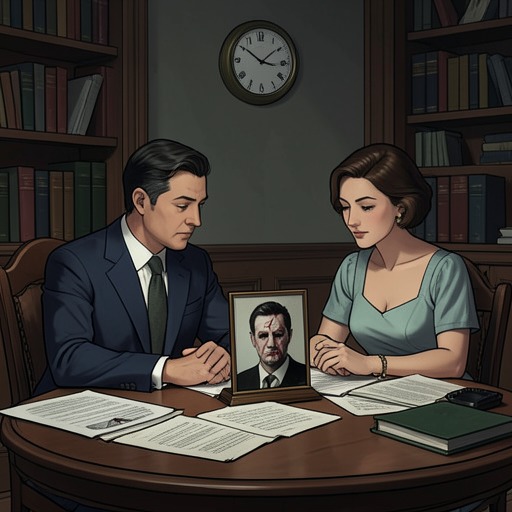
Tashiro Shozo's household registration exchange
A ManThe family-register exchange involving Shozo Tashiro is a crucial false lead in Kido’s effort to reconstruct Makoto Hara’s identity and find the real Daisuké Taniguchi. Tashiro confirms that he exchanged registers with someone presented to him as Hara, but denies that the man in Kido’s photograph was that person. His testimony unsettles the apparent chain of swaps: rather than establishing that Hara traded directly with Tashiro, it suggests that someone else may have passed an unwanted identity to him, leaving Hara’s own earlier exchange—and the real Daisuké’s whereabouts—uncertain.
The Search and Its Initial Theory
Kido’s investigation had reached a point where the history of family-register trading offered a possible explanation for the mismatches among official records, appearance, and personal accounts. He inferred that Hara had first become Yoshihiko Sonézaki, then exchanged registers with Daisuké Taniguchi, and that the real Daisuké might consequently be living as Sonézaki. Under this theory, the mentally handicapped man Kido was about to meet, who used the name Makoto Hara, might have been the person whose identity had been traded away in the earlier transaction.
That reconstruction mattered because the records could make a person appear to be someone else in official dealings as well as in ordinary life. The man Kido was investigating had been able to live under Hara’s name, while the legal history behind that name remained difficult to distinguish from the person carrying it. Kido was not merely looking for a false name: he was trying to identify the sequence of exchanges that had made several people’s biographies and public identities appear to overlap.
Tashiro Identifies Himself
At a café beside Higashi-Nakano Station, Kido met the man with Kadosaki and asked directly whether he was Yoshihiko Sonézaki and whether Omiura had arranged an exchange of his family register. The man initially said that he knew Omiura, but did not answer Kido’s question about the exchange. Kido began to suspect that the man was not Hara after all, while also considering whether Omiura might be intimidating him into silence.
The man asked whether speaking would send him back to jail. After Kido promised not to repeat what he said, he identified himself as Shozo Tashiro. He said that he had traded his family register, and everything associated with it, with Makoto Hara. Asked whether he had done so for money, he agreed, then explained that being homeless made it hard to find work or borrow money. His answer presents the exchange as a transaction shaped by material insecurity, not as a route to a secure or prosperous life.
The Photograph Breaks the Hypothesis
Kido asked Tashiro whether a photograph of X showed the Makoto Hara with whom he had exchanged registers. Tashiro said no, emphatically insisting that he did not know the man in the picture. Kido had the sense that Tashiro was not lying. The denial contradicted the assumption that the man Kido had found was Hara and that Tashiro had directly acquired Hara’s register from him.
Tashiro’s account of his life adds context to what the exchange offered—and failed to offer. After high school he moved from job to job, saying that others insulted him, and he had been homeless for ten years. After Omiura took his share, the money he received for the register was barely enough for a month’s food. Tashiro did not know how much Makoto Hara had paid. He also acknowledged worrying that the identity could connect him to Kenkichi Kobayashi, but said he did not tell people about that concern and that they did not associate Hara with Kobayashi because their surnames were different.
A Revised Chain of Exchanges
Tashiro’s testimony forced Kido to revise his initial reconstruction. If Tashiro had never met the real Hara, then Hara’s first register exchange could not have been the one Kido had attributed to them. Kido instead supposed that a different man had first acquired Hara’s unwanted identity and later passed it to Tashiro. He considered Yoshihiko Sonézaki, the name on Omiura’s postcard, a likely identity for that intermediary, but this remained an inference rather than a confirmed fact.
In Kido’s revised account, Hara may have learned about Omiura and first taken on the identity of Sonézaki; dissatisfied with it for some reason, he may then have exchanged registers with Daisuké and gone to Town S, where he met Rié. If so, the real Daisuké may have become Sonézaki, unless he exchanged identities again. Even that possibility depended on the unresolved question of whether Daisuké was still alive. Tashiro’s denial therefore did not solve the mystery. It removed a seemingly straightforward link and revealed how little could safely be concluded from a name alone.
Significance and Uncertainty
The exchange demonstrates how a family register could be treated as something transferable, while its consequences extended beyond the person who handed it over. For Tashiro, the transaction promised money and the possibility of greater access to work and borrowing, but yielded only a short-lived amount and left him entangled in identities he could not fully explain. For Kido, his testimony changed the investigation from a direct swap between Hara and Tashiro into a conjectural sequence involving an unidentified intermediary.
The distinction between the person in a photograph and the name attached to a register is the episode’s decisive turn. Tashiro can confirm his own identity and the exchange he made, yet cannot validate the apparent identification that had driven Kido’s theory. The result is not a recovered biography but a more complicated map of borrowed identities, in which each proposed link must be tested against the person who actually lived it.