Town S
A ManTown S is a small community in Miyazaki Prefecture whose declining shopping street and close local memory frame the story of Rié and the man she knew as Daisuké Taniguchi. Here, a forestry accident turns a private household into a local mystery: the respected shopkeeper’s husband dies, and the identity he lived under becomes inseparable from the town where he made a family. The place’s unassuming streets hold the novel’s contrast between public history and intimate loss, and between a life’s official name and the relationships formed under it.
Setting and Local Character
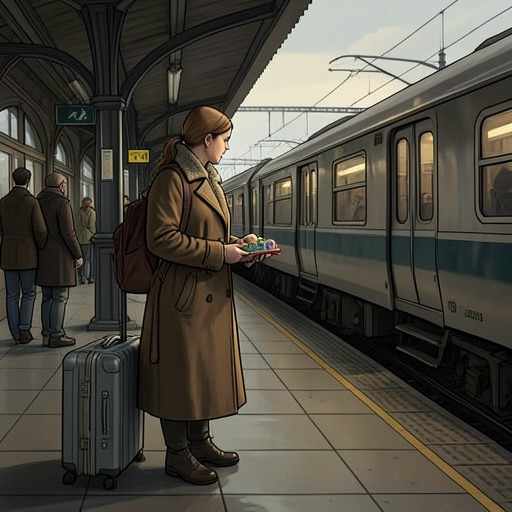
Town S lies in the center of Miyazaki Prefecture, in the mountains of Kyushu. Mera Road, an old thoroughfare, cuts through town on its course across the mountains toward Kumamoto; the settlement is about a forty-minute drive southeast of Miyazaki City. Its modest appearance conceals several claims to distinction: burial mounds draw the interest of ancient-history enthusiasts, a professional baseball team holds its spring camp there, and the town boasts Kyushu’s largest dam.
These attractions do not define Rié’s own connection to the town. As a local, she takes little interest in its notable sites, though she later develops a sentimental attachment to a cherry tree in the park with the burial mounds. The distinction matters: Town S is presented both as a place outsiders interpret through its attractions and as home, whose meaning accumulates through personal attachment.
Decline and the “Showa Burial Mound”
The center of Town S flourished after redevelopment during the Shōwa-era economic bubble. A low birth rate and an aging population later left many businesses along the main shopping stretch on Mera Road permanently shuttered. Residents ruefully called the declining district the “Showa Burial Mound,” turning the town’s association with ancient burial mounds into a name for its contemporary commercial decay.
A family business endured amid the closures: Seibundo Stationery, known throughout town and operated by Rié’s family since her grandfather’s generation. Its survival gives the shop a place in local life beyond its commercial function. Rié is recognized as the proprietors’ only daughter, and her decision to marry a newcomer astonishes the community precisely because people know her as sensible and trustworthy.
Town S also attracts outsiders for reasons shaped by decline. After a 2007 documentary about a remote mountain village abandoned en masse in the 1980s following severe depopulation, tourists began visiting the area with a condescending fascination for ghost towns. Their gaze turns a lived community into a spectacle of disappearance. Against that tendency, the novel attends to the people who remain, the shops still open, and the losses they remember.
Daisuké’s Arrival and Death
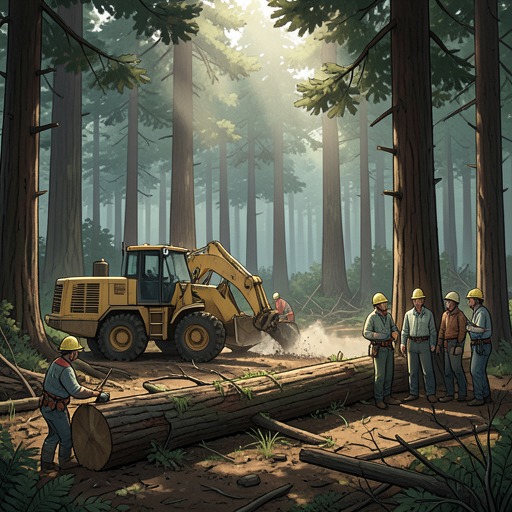
Daisuké Taniguchi moved to Town S shortly before the documentary began drawing attention. At thirty-five, without experience in forestry, he sought work in the industry and was hired by Ito Lumber. He worked there for four years, diligently enough to earn the company president’s admiration. At thirty-nine, he was killed when a cryptomeria tree he had felled crushed him.
The death became locally memorable in mid-September 2011, when news spread that the husband of the woman from the stationery shop had died. The year is nationally associated with the Great East Japan Earthquake, but the novel distinguishes national remembrance from local experience: for some in Town S, including Rié’s mother, Daisuké’s death occupied the more prominent place. The comparison does not diminish the disaster; it shows how the scale of public history and the scale of personal grief can coexist without coinciding.
Daisuké had been reticent and had few notable friends. Because he spoke little with coworkers, Rié and her family were the only townspeople who knew the details of his past. Newcomers to depopulating areas might have reasons to keep parts of their lives private, but Daisuké’s marriage to a local within a year of arriving made him unusual. The community’s confidence in Rié’s judgment temporarily quieted curiosity: people assumed she had thoroughly assessed him and concluded he posed no danger.
The Town as the Ground of a Borrowed Life
The investigation later makes Town S the endpoint of a chain of identity exchanges. Kido finds that the real Daisuké’s family-register attachment gave an address for a cheap, blighted apartment beside the Yodo River in Osaka City’s Kita district. When Kyoichi goes to the building-management office, the president recognizes the photograph of Daisuké as the former resident but does not recognize X. Kido and Kyoichi infer that the real Daisuké still used his own identity in Osaka, before an encounter with X led to the loss of his name and family register.
Kido’s subsequent reconstruction proposes that Makoto Hara first exchanged registers with Yoshihiko Sonézaki, then became Daisuké Taniguchi and eventually arrived in Town S. On that account, the real Daisuké lived under the name Yoshihiko Sonézaki. The reconstructed sequence makes the town’s familiar household a meeting point for lives obscured elsewhere: Hara does not merely assume an identity and pass through, but establishes the life that Town S remembers as Daisuké’s.
That life had real consequences for those who knew him. Rié and Hara fell in love and had Hana; Hara also acted as a father to Rié’s son Yuto. The truth of his name does not erase those relationships, just as the account of his past cannot be reduced to the false story he told. Kido suggests that Hara may have empathized with the real Daisuké, projecting himself into another person’s trauma as a reader might inhabit a novel. In this interpretation, Town S is where an assumed life becomes more than concealment: it becomes a shared domestic past, though one built on a lie.
Narrative Significance
Town S joins the novel’s themes of disappearance, memory, and identity through contrasts built into its setting. Its commercial center is nicknamed for burial mounds while living businesses vanish; tourists treat depopulation as an attraction, while residents attach their memories to a death largely outside national attention. A cherry tree, a family stationery shop, and the recollection of a forestry accident give the town significance through specific ties rather than grand landmarks alone.
The revelation about Hara sharpens that tension. In Town S, the identity under which he lived was false, but the grief, love, and family life formed around it were not thereby made unreal. The town preserves both versions at once: the local memory of Daisuké, a diligent forestry worker and husband killed at thirty-nine, and the later knowledge that the man in that life was Makoto Hara. Its importance lies in holding the human consequences of a borrowed name without making the name itself the whole of a person.