Yuto–Makoto Hara stepfather–stepson relationship
A ManYuto and Makoto Hara’s stepfather–stepson relationship is a genuine bond formed inside a false identity. Yuto knows Hara as his father, remembers the home and family history Hara described, and remains deeply attached to him after his death. When the truth emerges—that Hara was not really Daisuké Taniguchi—the deception shakes Yuto’s understanding of the past, but the care he received remains real. His later insight is that Hara gave him the tenderness he had wanted from his own father, and did so because he cared for Yuto himself.
Identity and Family Life
Hara enters Yuto’s life as Rié’s husband and the man Yuto calls Dad, living with the family under the name Daisuké Taniguchi. The family identity is already layered: Yuto was born a Yoneda, became a Takemoto after Rié’s first divorce, and then became a Taniguchi. That sequence makes a surname more than a label in his eyes. It records the households he has belonged to, while the relationship with Hara supplies the emotional reality behind the latest name.
Yuto’s attachment is not merely a consequence of Hara’s place in the household. He is deeply attached to his second father, even more so than Hara’s biological daughter, Hana, because Yuto was old enough to know and remember him during his life. The distinction matters after Hara dies: Yuto’s grief has a history and a personal object, even when he does not readily put that grief into words.
Care and Inheritance
The relationship is presented through sustained, practical care rather than through a catalogue of declarations. One small family incident becomes emblematic: Yuto and his grandmother found an old aquarium, and Yuto cleaned it, researched the gravel and air pump, helped buy what was needed, and installed it. After Hara’s death, tending the goldfish remained the one passion Yuto did not abandon or leave to others. The aquarium thus carries a living routine forward after the father who belonged to the household is gone.
Yuto also tries to preserve Hara’s place in the family through his name. When Rié tells him she intends to return to her maiden name, he asks whether he can remain Yuto Taniguchi. His objection is partly practical—everyone at school knows him by that surname, and correcting them would be uncomfortable—but it is also an appeal on Hara’s behalf. Hara’s family had turned away from him, Yuto says, and he does not want their own family to forget him too. In this request, the name that once signified a concealed identity becomes, for Yuto, a means of keeping faith with the father he knew.
The Secret and Its Consequences
Rié eventually tells Yuto that Dad’s name was not really Daisuké Taniguchi. Yuto recalls the account Hara had given him of Ikaho Onsen, a quarrel with his family, and his arrival after running away. Rié explains that this was not Hara’s past but the real Daisuké Taniguchi’s. Yuto reacts with shock and anger, asking whether Hara deceived all of them and what he had done. Rié cannot supply an explanation; she had waited for the facts to become clearer and admits that she still does not know.
The revelation separates two things Yuto had been allowed to treat as one: the biographical story attached to his father’s name, and the father–son life they actually shared. The account of Ikaho belongs to another man, so Yuto can no longer rely on Hara’s story as a straightforward record of his past. Yet the disclosure does not make Hara’s affection fictitious. The relationship’s force lies precisely in that distinction: the identity was borrowed, but the care was given to Yuto in their shared life.
Grief and Recognition
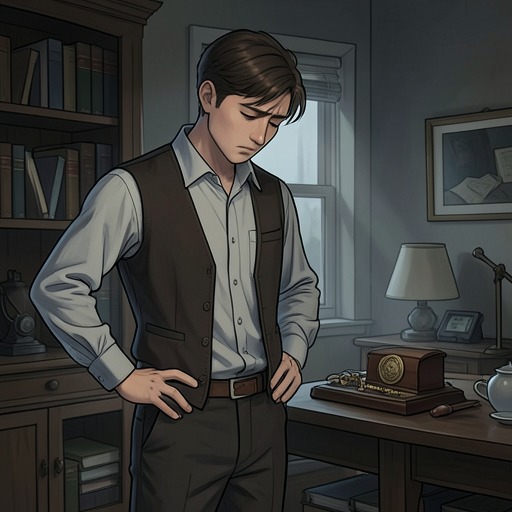
Yuto’s grief is quiet and difficult for Rié to read. At Burial Mound Park he watches over Hana among the flowers, keeping his hands in the pocket of his gray hoodie, while Rié realizes that he, like her, has been enduring loss without openly expressing it. He has lost his younger brother Ryo, his grandfather, and the man he thought of as his father. The goldfish, his reading, and his attention to his little sister become visible parts of how he continues to hold himself together, not evidence that the losses have passed.
Later, when Rié asks what sort of person Hara was, Yuto understands the kindness he received in terms of Hara’s own unmet longing: Hara did for him what he had wanted his father to do for him. Rié confirms that this was not the only reason; Hara also cared about Yuto. That answer preserves both inheritance and particular affection. Hara’s tenderness may have grown partly from his own childhood deprivation, but it was not simply displaced longing: it was also love directed toward this son.
The bond therefore survives neither as an intact family biography nor as an uncomplicated memory. Hara’s assumed name and invented personal history remain a rupture Yuto must face, while his lasting attachment, his insistence on retaining Taniguchi, and his final understanding of Hara’s kindness preserve what was true between them. Their relationship shows how a family tie can be formed through lived care even when the story that first framed it proves false.