Île Saint-Louis
A Moveable FeastÎle Saint-Louis occupies a central place in the narrator’s map of the Seine: it is at once a striking sight across the water, a marker along the quays, and part of a river district where fishing and modest meals give urban life a practical, intimate scale. The island’s significance emerges through movement around it, as the narrator walks, watches, reads, and eats beside the river.
Setting and River Routes
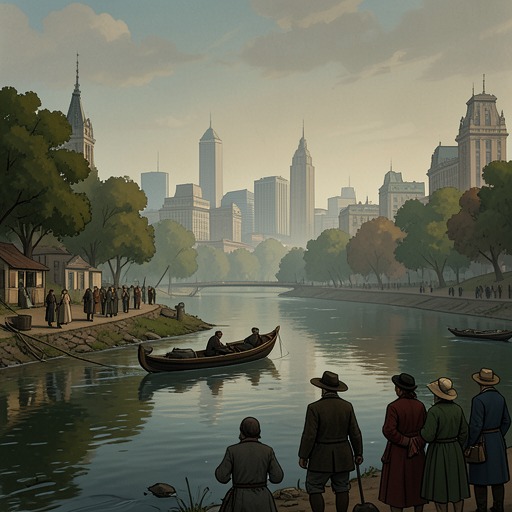
From the upper part of the neighborhood, one route descends steeply to the Seine and emerges by the bleak Halle aux Vins, a tax warehouse likened to a military depot or prison camp. Across a branch of the river lies Île Saint-Louis, with narrow streets and old, tall houses. From there, a walker can cross to the island or follow the quays beside its length, with Notre-Dame and Île de la Cité visible opposite. The geography offers a contrast between the island’s beauty and the cheerless working riverfront, while making the water and its banks part of an ordinary walking route.
Walking is also a way of thinking. After work, or when trying to solve a problem, the narrator finds it easier to think while moving and watching people do something they understand. The river walks offer that kind of attention: a route through the city that is neither simply a commute nor a sightseeing excursion, but a succession of places and activities to observe.
Fishing and the Working River
The waters around the islands support serious, changing fishing. At the point of Île de la Cité below Pont Neuf, a small riverside park beneath spreading chestnut trees gives access to currents and backwaters where the fishing is good. The best spots shift with the river’s height. Fishermen use long jointed cane poles, fine leaders, light tackle, quill floats, and carefully chosen bait; they regularly catch fish, including the dace-like Goujon.
The narrator also knows men who fish the productive stretch between Île Saint-Louis and Place du Verte Galente. Travel writers dismiss Seine fishermen as eccentrics who catch nothing, but the observed fishing is neither a joke nor futile: it is skilled, consistent work. Many of the men have small pensions or fish on days and half-days off from their jobs. Their catches provide food for their families, and the narrator takes pleasure in the fact that sound, productive fishing persists within Paris itself.
He does not join them. He lacks the tackle and prefers to save his money for fishing in Spain; his work also makes it difficult to know when he will be free, and he does not want to become entangled in an activity with busy and slack periods. Instead, he follows the fishermen closely. The choice marks a limit on his urban wandering: time, money, and the demands of writing shape what he can do, even as observation lets him share in the river’s pleasures.
Food, Books, and the Quays
The fish connect the river’s labor to inexpensive eating. At La Pêche Miraculeuse, an open-air restaurant built over the water at Bas Meudon, the narrator eats Goujon when he and his wife can afford a trip beyond their neighborhood. The place recalls a Maupassant story, with a view like a Sisley painting and a white wine resembling Muscadet. A longer trip is not necessary for the same kind of meal: a good friture is also available on Île Saint-Louis. The island thus belongs to a modest geography of pleasure, where a river catch can become a meal without requiring an expensive outing.
The quays supply other forms of exchange. Their bookstalls sometimes offer newly published American books at very low prices. One stallholder buys English-language books left behind by residents of rooms above Tour D’Argent, paying little for them and selling them quickly for a small profit because she has little confidence in books written in English. The river walk therefore passes through a small literary economy as well as a fishing one: books move from rented rooms to the stalls, while the narrator’s walks bring reading and watching into the same routine.
Narrative Significance
Île Saint-Louis is not treated as an isolated monument. Its meaning comes from its position within a lived landscape of opposite banks, neighboring islands, changing currents, fishermen, bookstalls, and places to eat. The narrator’s attention resists the easy picturesque view: the river is beautiful, but it is also worked; its fishermen are not idle figures, and their catches are genuinely useful. By following the quays and learning how the fishing works, he turns casual urban wandering into knowledge of the city’s practical life.