Alpine Club
A Moveable FeastThe Alpine Club enters the memoir chiefly through the huts bearing its name. These shelters offered climbers places to sleep and provisions for heating in the high mountains; for the narrator and Hadley Richardson, they also marked stages on routes whose pleasures depended on climbing, carrying supplies, and learning to travel through changing snow. The account presents the organization through these facilities and their use, not through its administration or membership.
Huts and Practical Use
The huts stood high in the mountain valleys, where summer climbers could sleep and leave payment for any firewood they used. In some cases, visitors had to carry their own wood; for longer journeys into the high mountains and glaciers, they could hire someone to carry wood and other supplies and establish a base. The narrator names the Lindauer-Hütte, the Madlener-Haus, and the Wiesbadener-Hütte as prominent examples.
This system of shelter and supplies belonged to a landscape without ski lifts or funiculars. From Schruns, logging and cattle trails led up the valleys toward the high country. Skiers climbed on seal skins attached to the bottoms of their skis, and every descent had to be earned by an ascent. The huts made longer journeys between high points conceivable, but getting to them remained a physical undertaking rather than a ride to a resort.
Alpine Routes and Skiing
The Alpine Club huts feature in a way of moving through the mountains that values distance from crowds and travel across high passes and glaciers. Walther Lent, whose Alpine skiing school the narrator and Hadley Richardson joined, urged pupils to leave practice slopes for trips into the mountains. His ideal was to cross from one hut to another through untracked snow and high Alpine terrain.
That ambition carried practical risks. Lent insisted that a ski binding should release in a fall, before the ski could break a skier’s leg. The narrator describes unroped glacier skiing as a particular goal, postponed until spring, when the crevasses were sufficiently covered. The huts thus appear not as destinations in isolation but as part of a demanding itinerary, with shelter and supplies supporting journeys whose timing and safety depended on conditions in the mountains.
The Approach to the Madlener-Haus
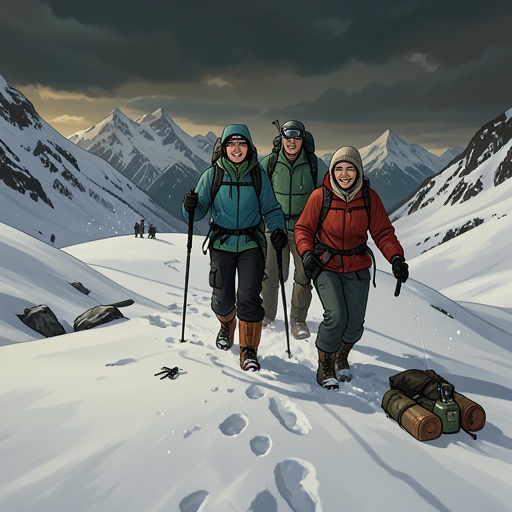
The narrator recalls a long journey up the valley to an inn where the party slept before climbing toward the Madlener-Haus. They began in the dark, carrying skis on their shoulders, while porters shouldered heavy loads. The Alpine Club hut stood on a shelf beside a snow-covered glacier. At the top, the porters set their loads against its stone wall, asked for more than the agreed price, and, after reaching a compromise, skied rapidly away on their short skis.
The episode makes the hut’s practical function tangible: it was a high-altitude stopping point reached through strenuous climbing and dependent on the transport of supplies. It also records the human arrangements that supported such travel. The hut was not simply an emblem of Alpine recreation; reaching it involved labor, negotiation, and a journey on foot before the skiing could begin.
Place in the Memoir
The Alpine Club is significant in this account as part of the infrastructure of a self-earned mountain life. The narrator describes winter as preparation for a spring glacier run: long climbs with heavy rucksacks built the strength needed for the descent, while huts and the routes between them enabled travel into increasingly remote country. The pleasure of the final run is inseparable from the work that made it possible.
The memoir offers no account of the Alpine Club’s formal organization or wider activities. Its portrait is grounded instead in specific shelters, their arrangements for wood and lodging, and the journeys that connected them. Through those details, the club’s huts stand for a form of access to the high Alps that required time, equipment, local assistance, and physical effort.