Arlberg
A Moveable FeastArlberg enters the narrative as a mountain region where skiing depends on climbing, judgment, and respect for unstable snow. The account links it to the ski country around Schruns and to Lech, where a Christmas avalanche turns the pleasures of winter travel into a lasting lesson about the limits of experience and control.
Setting and Access
The narrative places Schruns in Vorarlberg, Austria, at the end of a branch railway that follows a trout river through farms and forest from Bludenz. From the valley, logging and cattle trails lead into high mountain country. The terrain is not made accessible by lifts or funiculars: skiers climb on seal skins attached to their skis, and the routes depend on their own effort and the conditions they encounter.
High Alpine Club huts provide places to sleep and leave payment for firewood. Some require visitors to carry up their own wood; for longer journeys into the high mountains and glaciers, travelers may hire porters to carry supplies and establish a base. The named huts include the Lindauer-Hütte, the Madlener-Haus, and the Wiesbadener-Hütte. This infrastructure makes mountain travel possible, but does not remove its physical demands or exposure to danger.
Skiing and Instruction
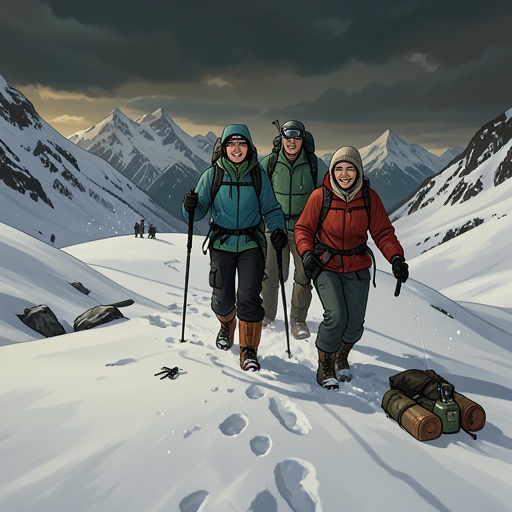
Walther Lent, a pioneer of high-mountain skiing who had once partnered with Hannes Schneider, began an Alpine skiing school in Schruns. He and Hadley and Ernest Hemingway enrolled. Lent moved pupils off practice slopes quickly and took them into the mountains, where learning meant climbing as well as skiing. With no ski patrols and broken legs beyond what people could afford, a descent began with the work of getting up; the climbs built the strength needed to ski down.
Lent treated the high mountains as the point of the sport: skiers could travel over untracked snow from one Alpine Club hut to another, crossing passes and glaciers. He emphasized bindings that would release in a fall rather than hold a ski fast enough to risk a leg injury. Unroped glacier skiing, one of his great ambitions, had to wait until spring, when crevasses were sufficiently covered. The account thus presents skiing not as effortless recreation but as a practice governed by equipment, bodily preparation, season, and judgment.
The Lech Avalanche
The danger became unmistakable during a winter of widespread avalanches. In the Arlberg, near Lech and over the mountains from the Schruns valley, a group of German vacationers arrived hoping to ski with Lent. Snow had fallen late, after the slopes had remained warm; the new powder was deep but had not settled or bonded to the ground. Lent had warned the group not to come, but they arrived anyway and, after he initially refused to take them out, said they would ski on their own.
Lent eventually led them to what he considered the safest slope. He crossed it first; as the others followed, the hillside gave way. Thirteen people were dug out, and nine had died. The disaster came not from an absence of warning but from the combination of unstable snow, the visitors’ inexperience, and the pressure to ski despite the conditions. It also marks a limit to the instructor’s ability to protect a party once the slope itself failed.
Aftermath and Significance
The avalanche had consequences for the small ski school: it had not prospered before the disaster, and afterward Hemingway and Hadley were almost its only members. They became serious students of avalanches, learning about different types, how to avoid them, and what to do if caught. Much of Hemingway’s writing that year took place during avalanche season, so the danger became part of the conditions under which he worked as well as the subject of practical study.
The memory of skiing in the high country also preserves a contrast between effort and exhilaration. Long climbs with heavy rucksacks made possible the spring glacier run: a sustained descent that could not simply be purchased or reached by taking a lift. In this recollection, the mountains offer intense pleasure, but only through accumulated work and attention to risk. Arlberg therefore signifies both the ideal of self-reliant Alpine travel and the abrupt consequences of misreading the landscape.