Enghien racecourse
A Moveable FeastEnghien racecourse is one of the Paris racing venues through which the narrator’s shared outings with Hadley gradually become a more consuming involvement with horse betting. First encountered as the home of the outsider, it promises the possibility of a long-shot win; later, its changing odds, stimulants, and demands on the narrator’s time expose the costs behind that promise.
Setting and Approach
The racecourse first enters the narrative through a morning racing paper bought on rue Descartes, near the Place de la Contrescarpe. The narrator has finished an early stretch of work and is hurrying back upstairs to write, but the paper says that the day’s meeting is at Enghien. The track is described as small and pretty, yet also larcenous: a place associated with outsiders rather than secure prospects. The appeal lies partly in that tension. A long shot could transform limited money, but the paper makes no such outcome certain.
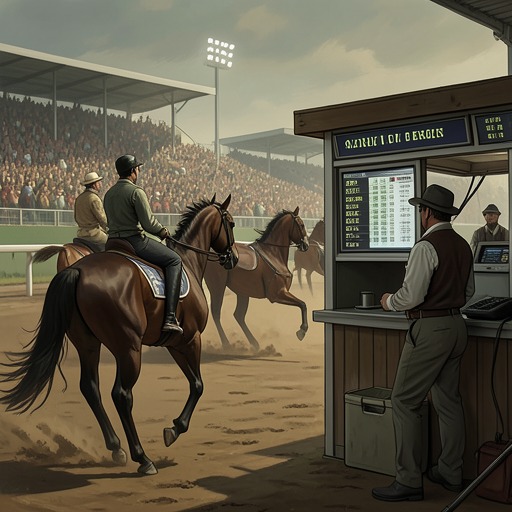
The outing begins by train from the Gare du Nord. The narrator and Hadley travel through what the account calls the dirtiest and saddest part of town, then walk from the railway siding to the racecourse, which appears as an oasis in contrast to the route. They arrive early and sit on the narrator’s raincoat on a freshly cropped grassy bank. Around them are the old grandstand, brown wooden betting booths, a green track, darker hurdles, water jumps, whitewashed walls and rails, and a paddock beneath newly leafed trees. The first horses are being walked to the paddock as the couple eat lunch and study the form.
A Shared Race Day
The racecourse is initially part of a day spent together, not simply a site for wagering. Hadley lies down on the raincoat and sleeps in the sun while the narrator goes to find an acquaintance from the old days at San Siro in Milano. The man gives the narrator two horses to consider, cautioning against treating them as investments while advising him not to reject them because of their prices. The couple’s attention moves between the landscape, the horses, and the calculations in the paper.
The first horse wins at twelve to one, taking command on the far side and finishing four lengths ahead. The narrator and Hadley set aside half the money and stake the other half on the second horse. That horse breaks ahead, leads over the hurdles and on the flat, and only just holds its advantage as the favorite closes in. After the finish, they go to the bar beneath the stand for champagne while waiting for the prices to be posted. The sequence makes the meeting vivid as both a social pleasure and a wager-by-wager test of hope: a win brings a brief celebration, but the next bet immediately puts part of the day’s money back at risk.
From Outing to Occupation
The narrator and Hadley go racing together many more times that year and in later years, often after the narrator has worked in the early morning. Hadley enjoys it, and sometimes loves it, but the narrator distinguishes the activity from other forms of recreation: it is not climbing in high mountain meadows, returning to a chalet, or crossing a pass with Chink. Nor, strictly speaking, is it racing alone. The couple call it racing, while the narrator recognizes that gambling on horses is at its center.
Over time, the narrator attends races alone more often and becomes increasingly involved. During the seasons, he works both Enghien and Hippodrome d’Auteuil, trying to handicap intelligently. The effort takes the time of a full-time job, yet the calculations show no way to make money that way. A newspaper can lay out the arithmetic, but knowledge does not remove the uncertainty. The narrator follows horses, odds, and the circumstances in which a stable might try with a horse, while recognizing that even a well-judged runner can be beaten. The close attention gives the racing world the character of demanding work rather than a dependable livelihood.
The narrator eventually stops because the activity takes too much time, has drawn him too deeply in, and has taught him too much about what goes on at Enghien and the flat-racing tracks. The decision marks a limit to an avocation that had seemed exciting and potentially profitable but could not be made profitable without consuming the hours needed for other work.
Betting’s Moral Cost
Enghien also becomes the setting for a sharper conflict between gambling and the narrator’s stated commitments. As a member of Bel Esprit, he campaigns to raise money to free the Major from his bank job. Yet money he had earmarked for the effort goes instead to Enghien, where he bets on jumping horses running under the influence of stimulants. At two meetings, the stimulated horses he backs outrun those that are unstimulated or insufficiently stimulated.
One race turns into an absurd spectacle: a horse is so overstimulated that it throws its jockey before the start, breaks away, and completes a full circuit of the steeplechase course, jumping beautifully by itself. Caught and remounted, it starts the race and finishes respectably, but outside the money. The comic display does not erase the narrator’s unease about the diverted funds. He regrets that the wager money did not go to Bel Esprit, then consoles himself that successful bets might have allowed him to contribute more than he originally intended. Enghien thus holds both the immediate pleasures of the shared race day and the later recognition that gambling could displace work, time, and even a cause the narrator had meant to support.