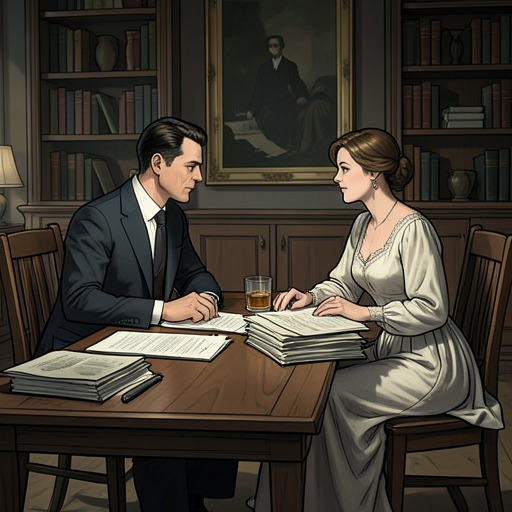
F. Scott Fitzgerald and Zelda Fitzgerald's Marriage
A Moveable FeastF. Scott Fitzgerald and Zelda Fitzgerald's Marriage appears as a powerful attachment caught in a recurring struggle over work, drinking, jealousy, and the possibility of a settled life. Scott is deeply in love with Zelda, yet fears losing her and becomes jealous; he repeatedly tries to protect time for writing, while their shared parties and conflicts disrupt those efforts. The narrator, Ernest Hemingway, presents the marriage through scenes and reports that do not always agree, leaving some of its most painful episodes unresolved rather than claiming certainty about what happened.
Early Attachment and a Story of Separation
Scott described having met Zelda during the war, losing her, and winning her back before their marriage. In one episode, while away from her overnight, he was eager to get dressed and call her. He explained that it was the first night he had slept away from her since they married and that he needed to let her know he was all right. His distress gave the separation an unusual weight. Hemingway, however, could not reconcile Scott’s account of their shared history with what he understood about the couple’s sleeping arrangements. He chose not to challenge him, and the uncertainty remains part of the scene: Scott’s urgency is clear, while the literal circumstances are not.
During that night Scott also recounted a tragedy at Saint-Raphaël from about a year earlier, involving Zelda and a French naval aviator who had fallen in love with her. Scott told the story in different forms on later occasions, apparently trying out versions as material for fiction. Hemingway considered the first telling the saddest and believed it might be true, but acknowledged that any of the versions could have been. The repeated retellings did not make the episode less painful; in Hemingway’s account, none affected a listener as strongly as the first.
Scott’s account of the aviator sharpened the emotional contradiction at the center of the marriage. Hemingway could picture the seaplane, diving raft, sea, and the contrasting appearances of Zelda, Scott, and the young man, yet could not ask how the reported affair fitted with Scott’s belief that he had slept beside Zelda each night. He wondered whether that discrepancy, or Scott’s failure to remember, made the story more tragic. The passage offers no resolution. Instead, it shows Scott’s attachment and the narrator’s uncertainty existing side by side.
Work, Parties, and Jealousy
At a lunch in the furnished flat the Fitzgeralds rented at 14 rue Tilsitt, Scott was hospitable and nervous, while Zelda was recovering from a night out on Montmartre. The previous evening, they had quarreled because Scott had resolved not to get drunk and to work hard; Zelda had treated his refusal to join in as joylessness. She was formally pleasant to Hemingway and Hadley Richardson, but seemed, to Hemingway, mentally still connected to the party. She was also jealous of the enjoyable journey Scott and Hemingway had taken together from Lyon and defended her own night out as a fair counterpart.
Hemingway came to see this tension as a recurring pattern. Scott would decide to avoid all-night drinking, exercise each day, and work regularly. Once he began to make progress, Zelda would complain of boredom and draw him toward another party. They would quarrel and then reconcile. Scott would take long walks with Hemingway to recover from drinking, resolve again to work, and start over. Hemingway understood Zelda as jealous of Scott’s writing, while also describing Scott as intensely jealous of her. The cycle did not simply pit a writer against a spouse: their shared social life, reconciliations, and renewed promises repeatedly brought them back into the same conflict.
Their drinking had once seemed to provide an escape from that conflict. Hemingway had seen them become unconscious after drinking, then wake refreshed and apparently unharmed; he describes this as a kind of defense they shared. By the spring in question, that pattern no longer protected them. Zelda could drink more than Scott, and he worried about her losing consciousness among the people and in the places they frequented. He disliked those company and settings, yet drank beyond what he could comfortably manage in order to endure them. At times he drank to remain awake past the point at which he would previously have fallen asleep. Hemingway connects this change with the shrinking intervals in which Scott was able to work.
Jealousy further entangled work and social life. Zelda, according to Hemingway, said she did not encourage people who pursued her and had nothing to do with them, but their attention amused her and made Scott jealous. He felt compelled to accompany her to the places they went, and Hemingway says the situation destroyed his work. In the same period, Scott was also becoming jealous of Zelda in relation to other women, although Hemingway distinguishes this from his earlier accounts of her attachment to the naval aviator. Their mutual jealousy did not lead to a stable confrontation or settlement; it helped keep them in company that Scott disliked and made his attempts to withdraw from drinking difficult to sustain.
Hopes of Renewal and Their Erosion
Scott repeatedly imagined that a change of place could restore their life together. He spoke of the French Riviera as it had been when he and Zelda first discovered it: stretches of blue sea and beach, pine woods, and the Esterel mountains reaching toward the water. He proposed that Hemingway and his wife join them the following summer. In his plan, the families would find an inexpensive place, work each day, swim, and keep drinking to a single apéritif before lunch and another before dinner. Zelda, he said, loved swimming and diving and would be happy with that disciplined arrangement. The Riviera was not merely a holiday destination in this account; it became the setting in which Scott hoped to reconcile marriage, health, and writing.
That hope returned when Scott and Zelda were away from Paris and Scott was trying to work again. Zelda had been ill after drinking champagne, and Scott told Hemingway that he was not drinking, that his novel was going well, and that they had no financial worries. He again invited Hemingway and his wife to Juan-les-Pins, promising an inexpensive villa and a return to the old routine. When Hemingway arrived after working in Madrid, he found a pleasant villa and Scott living nearby. A small welcoming party at the Casino included the MacLeishes, the Murphys, and the Fitzgeralds. The gathering seemed compatible with writing, except that it did not provide the solitude a writer needed.
At that moment Zelda appeared to Hemingway to be well and composed. She shared with him a startling private judgment comparing Al Jolson with Jesus. No one present treated it as significant, and Hemingway understood it then as a secret she had chosen to share. Only later, after Zelda’s first nervous breakdown, did he interpret the moment differently. In retrospect he connected it with the fact that Scott did not write anything else he considered good until he knew she was ill. The later interpretation changes the meaning of the earlier confidence without establishing that either spouse understood its significance at the time.
The promised Riviera renewal did not hold. Hemingway reports that, after the Fitzgeralds had spent the summer at Cap d’Antibes, Scott was changed by the time he saw him in Paris that fall. He had not stopped drinking; he was now drunk during the day as well as at night. Scott no longer seemed troubled by whether others were working and began visiting Hemingway at 113 rue Notre-Dame-des-Champs whenever he was drunk, at any hour. Hemingway also observed that he had become rude to people he regarded as socially beneath him. These changes stand against Scott’s earlier promises of restraint and discipline, and against his repeated belief that a different place could restore the life he wanted with Zelda.
Intimacy, Insecurity, and the Marriage’s Unresolved Terms
Much later, after Zelda had experienced what was then called her first nervous breakdown, Scott asked Hemingway to lunch at Michaud’s and insisted that he answer a personal question truthfully. He explained that Zelda had told him his physical build meant he could never satisfy a woman, and that the remark had changed how he felt about himself. He had never felt the same since and wanted an honest answer. Hemingway offered practical reassurance and urged him not to accept Zelda’s judgment as definitive. Scott objected that Hemingway did not know Zelda; Hemingway let the disagreement rest and pointed out that Scott had come for an honest response.
The episode shows how a judgment made within the marriage continued to affect Scott beyond the immediate quarrel. He approached Hemingway not simply for comfort but for a verdict he hoped would settle a doubt, while Hemingway recognized that candor could itself become a source of anger later. Scott had told him that he had never slept with anyone other than Zelda, and he described the marriage as the context in which the wound began. The account does not turn the exchange into a resolution: Scott rejects the narrator’s confidence about Zelda, and the two leave the question of what she meant, and how much authority her words should have, unsettled.
Narrative Significance
The marriage is assembled from different kinds of evidence: Scott’s declarations, stories that change with their retelling, Zelda’s reported remarks, and Hemingway’s own retrospective judgments. That structure matters. The story of the naval aviator remains uncertain; the Riviera plans are presented as sincere hopes but are contradicted by Scott’s later drinking; and Zelda’s private comparison acquires significance only in hindsight. Hemingway’s account therefore depicts the marriage not as a single, stable explanation of either spouse, but as an attachment repeatedly interpreted and reinterpreted by the people living around it.
Its central rhythm is the return of hope followed by interruption. Scott imagines disciplined work and a shared life in a more restorative setting, begins again, and is pulled back into drinking, parties, and jealousy. Zelda is represented both as the object of Scott’s fierce devotion and as a person whose conduct, as Hemingway reads it, intensifies his insecurity and disrupts his work. The narrator’s perspective is sympathetic to Scott but not wholly certain: he preserves contradictions, admits where he cannot know what happened, and shows how the marriage’s private history becomes inseparable from Scott’s ability to write.