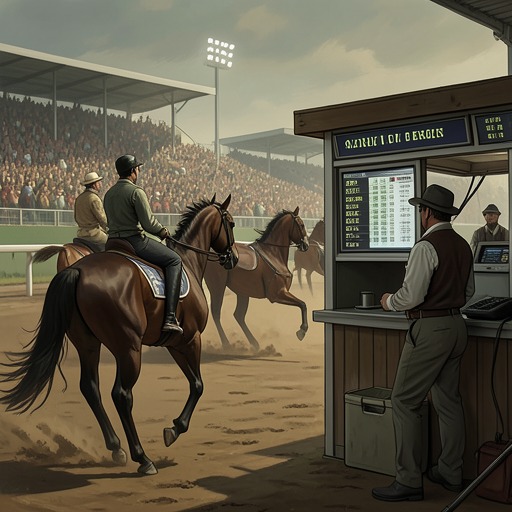
Hemingway gives up horse-race gambling
A Moveable FeastHemingway gives up horse-race gambling after a pursuit that had offered excitement, profit, and a feeling of expertise begins to consume too much of his time and draw him too deeply into the business of racing. The decision is not presented as a sudden rejection of the tracks: it follows years of betting with Hadley Richardson and a later period of going alone to study races. His withdrawal is practical and deliberate, but it leaves an emptiness—and a private remainder of the gambling life in the capital he continues to keep in his head.
From shared outing to gambling habit
The earlier attraction of the races is established through a day at Enghien. Newspaper work for a Toronto paper had brought in money, and Hemingway and Hadley Richardson hoped to find a long shot. Their hopes carried the memory of Chèvre d’Or, a horse they had backed at Auteuil at odds of 120 to one. It had led by twenty lengths before falling at the last jump, taking with it enough of their savings to have lasted six months. They tried not to think about that loss, but it shadows the prospect of betting again: the wager is both a possible gain and a household risk.
At Enghien, the couple set out intending to spend only the money they had brought. They travelled from the Gare du Nord, walked from the siding to the track, and made a quiet day of the meeting. Sitting on Hemingway’s raincoat on the fresh-cut grass, they ate lunch, drank wine, studied the racing form, and watched the paddock and course. Hadley lay in the sun while Hemingway sought out an acquaintance from the old days at San Siro, who gave him two horses to back. The first won at twelve to one; they saved half the money and put the other half on the second horse, which held on to win after leading over the hurdles and on the flat. The carefully divided stake shows the attraction in miniature: pleasure and company, but also the hope of turning a limited sum into more.
Hemingway later distinguishes this shared pleasure from what the activity became. He and Hadley went racing together many times, including after his early-morning work, and she sometimes loved it. Yet he insists that what bound him was not simply the racecourse or the companionship. It was gambling on horses, which they called racing. In his account, betting did not itself come between the couple; people could do that. The distinction makes the eventual decision less a marital rupture than a change in Hemingway’s own relation to the pastime.
The work of following horses
As his involvement deepened, Hemingway began going alone more often and worked the seasons at Auteuil and Enghien when he could. He describes handicapping as full-time labour: studying a horse’s performance, watching odds shift when it was due to start, and trying to judge when a stable would make a serious effort with it. At Auteuil, understanding a jumping race meant climbing to the top of the stands to follow what each horse did, including what a horse that might have won had failed to do. Even close observation could not guarantee success; a horse might be beaten when it finally tried, and working out its chances remained uncertain. As Hemingway notes, the calculations on paper showed that this kind of intelligent handicapping could not make money.
The work nevertheless gave him an intimate knowledge of the sport and its people. He learned the course at Auteuil as thoroughly as places he had known elsewhere and came to know jockeys, trainers, owners, and too many horses. He sometimes backed horses that almost nobody believed in except the men who trained and rode them, and these horses won repeatedly for him. That streak of informed success helps explain why he stayed involved: the appeal was not merely a random wager but the feeling that close attention could uncover what others missed. Yet he finally stopped because the pursuit demanded too much time, had drawn him in too far, and had taught him too much about what went on at Enghien and the flat-racing tracks.
The decision and its private residue
Hemingway describes the end as a specific act, not just a fading of interest. On the day he gave up racing, he crossed to the other side of the river and met his friend Mike Ward at the travel desk in the Guaranty Trust, then on the Boulevard des Italiens. He was depositing the racing capital back into the general funds, but told no one what he was doing. He did not enter it in the checkbook, either; he still kept the sum in his head. The money had been returned to ordinary use, while a mental account of it remained.
Mike recognized the significance of the change and called stopping a good thing. Hemingway answered that he had stopped. The plain exchange gives the decision weight without turning it into a triumphant declaration: Mike observes that quitting is hard, and Hemingway confirms the fact rather than explaining it away. He was glad to stop, but the cessation left an emptiness. His reflection distinguishes the emptiness left by good things from that left by bad ones. The latter fills by itself; the former, he thinks, can be filled only by finding something better. Putting the racing capital back into the general funds brought relaxation and a sense of wellbeing, but it did not erase the loss of an absorbing pursuit.
What followed the tracks
Mike proposed that they go to bicycle races sometime. Hemingway knew little about them at first, and they did not begin immediately; later, cycling became a large part of their lives after the first part of Paris had broken up. He imagined writing about the sport, from the smoky afternoon light and steep wooden track at the Vélodrome d’Hiver to the dangerous speed of races at Stade Buffalo. He also describes the tactics and exertion of the riders, including the motor-paced contests in which cyclists followed trainers on motorcycles. The specificity of these scenes marks a new fascination, but Hemingway says he started many stories about bicycle racing without writing one as good as the races themselves. The replacement for horse racing was therefore not a clean transfer of expertise into finished work: it offered another subject and another life around sport, while leaving a gap in his writing.
His account also complicates any simple story of reform. In a separate episode, he recalls that money earmarked for Bel Esprit, the campaign to free T. S. Eliot from his bank job, went instead to Enghien, where he backed steeplechase horses racing under the influence of stimulants. At two meetings the stimulated horses he backed outran horses that were unstimulated or insufficiently stimulated. In one race, a horse was so overstimulated that it threw its jockey before the start and completed a circuit of the course alone, jumping beautifully; after it was caught and remounted, it finished outside the money. Hemingway says he would have been happier had the wagers gone to Bel Esprit, though he comforted himself that successful bets could have yielded a larger contribution. The episode exposes the moral unease and rationalization that accompanied his gambling, even as the later decision to stop restores the capital to ordinary funds and redirects his attention toward work and life away from the track.