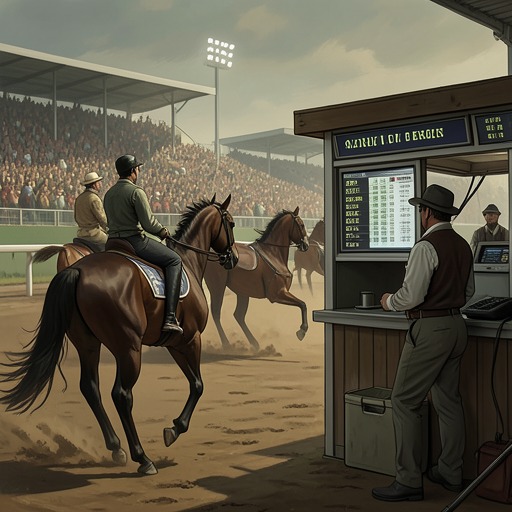
Hippodrome d’Auteuil
A Moveable FeastHippodrome d’Auteuil was a central course in Ernest Hemingway’s life as a racing enthusiast, a place where steeplechases offered both a beautiful spectacle and a subject for intense study. He learned to read horses, odds, and stable intentions from the stands, but the work of following races became so consuming that he eventually withdrew from it.
The Course and Its Races
At Hippodrome d’Auteuil, Hemingway watched jumping races from high in the stands. To see how each horse handled the course, he had to climb quickly and follow the field over the obstacles. The vantage point let him observe not only the horse that won, but also one that might have won and did not: where it faltered, and how it failed to do what it seemed capable of doing.
He tracked prices and shifts in the odds whenever a horse he followed started, watched how it was working, and tried to learn when its stable intended to make a serious effort. Even then, a horse could be beaten when it was finally tried. The work demanded close, repeated observation; it also taught him the course so well that he came to know it as thoroughly as almost any place he had known.
A Long Shot and a Costly Fall
Hippodrome d’Auteuil was also associated with a painful reversal in the couple’s finances. Hadley once backed a horse there named Chèvre d’Or at odds of 120 to one. It led by twenty lengths, then fell at the last jump. The savings riding on the horse would have kept the couple for six months, and they had been ahead that year until the loss. They tried not to think about it, but the fall marks the precarious line between a racing success and a ruinous wager.
That episode belongs to the couple’s wider habit of treating betting as racing. They continued going together after Hemingway’s early-morning work, and Hadley enjoyed it, sometimes passionately. Yet the sport’s attraction could not erase its financial risk: even a dramatic lead and a seemingly decisive chance offered no protection from a fall at the final obstacle.
Observation, Labor, and Withdrawal
Hemingway worked both Hippodrome d’Auteuil and Enghien racecourse when their seasons allowed. He sometimes found horses that few people believed in apart from their trainers and jockeys, and he backed some that went on to win repeatedly. But intelligent handicapping demanded full-time labor, and, as he concluded, that effort did not yield money on paper. Following the races meant learning the people and the animals as well as the course; at Hippodrome d’Auteuil he came to know jockeys, trainers, owners, and more horses and racing details than he wanted to carry.
The attraction also competed with his responsibilities as a young writer supporting a wife and child. At a time when he could not afford to go racing, he recognized how dangerous it was to stake money he could not afford to lose on horses whose performance might be artificially encouraged. The larger racing culture could look like an opportunity to make money, but the risk and attention it required worked against the full-time job of learning to write prose.
The End of the Avocation
Hemingway’s relationship with racing changed from shared recreation to an increasingly solitary and absorbing pursuit. He went alone more often, worked the tracks, and became too involved. Although he valued Hippodrome d’Auteuil’s beautiful races and great horses, he ultimately stopped working on the races because they took too much time and he knew too much about what went on at both Auteuil and the flat-racing tracks.
Stopping brought relief, but also a sense of emptiness. He returned the racing capital to the couple’s general funds and felt relaxed and good. The course thus stands in his recollection for both the discipline of close attention and the limits of that attention: the more completely racing occupied his time, the clearer it became that he needed to leave it behind.