Horses
A Moveable FeastHorses in Ernest Hemingway’s Paris memoir are at once part of the city’s working life and the center of a beautiful, risky sporting world. At the racecourse, they invite patient observation of movement, form, and odds; in the betting ring, they draw Hemingway into an increasingly demanding pursuit that he eventually leaves behind. The contrast between their physical grace and the human cost of gambling gives the animals a recurring role in the memoir’s account of poverty, work, and self-discipline.
Working Animals and Urban Images
Horses appear first as part of Paris’s ordinary infrastructure. At night, horse-drawn tank wagons pump out the cesspools beneath apartment houses. Their brown and saffron-colored cylinders move along Rue Cardinal Lemoine, and, seen in moonlight, they strike Hemingway as resembling paintings by Braque. The image joins an unpleasant municipal task to an unexpected visual beauty: the horses carry the city’s waste, while the wagons’ shape and color turn their passage into something he can look at as an artist.
The Racecourse and the Family’s Stakes
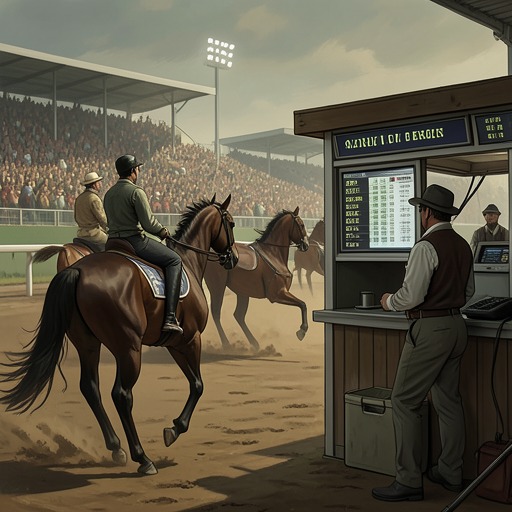
At Enghien racecourse, racing brings Hadley and Hemingway together in an outing shaped by their limited means. They travel out of Paris, eat lunch on a raincoat laid over fresh grass, drink wine, study the racing paper, and watch horses being led toward the paddock. An acquaintance from Hemingway’s earlier days at San Siro gives him two horses to consider, warning that they are no investment. The first wins at twelve to one, jumping cleanly and finishing four lengths ahead. They set aside half the money they had to spend and bet the other half on the second horse, which leads over the hurdles and on the flat, then barely holds off the favorite at the line. The close finish makes the excitement vivid, but the small, carefully divided stake keeps the household budget in view.
That calculation had a painful precedent. At Auteuil, Hadley once backed Chèvre d’Or, a 120-to-one outsider who led by twenty lengths before falling at the last jump. The savings invested in the horse would have supported them for six months. They had been ahead that year until the fall, a reversal so costly that the memoir says they tried not to think about it. The horse’s apparent triumph, undone at the final obstacle, becomes a sharp image of the uncertainty built into wagering: even a large lead cannot secure the money on which a poor family is relying.
Study, Skill, and the Cost of Gambling
Hemingway’s interest in horses grows beyond occasional outings into sustained work. He follows the seasonal racing at Auteuil and Enghien, studying jumping races from high in the stands so he can see what each horse does and how a horse that might have won fails to do so. He watches changes in the odds, tracks horses as they start, and tries to learn how they are working and when a stable intends to make a serious effort. Knowledge accumulates through close attention to horses, jockeys, trainers, owners, and the course itself. At Auteuil, he values the beauty of watching the great horses in honest races, even as the necessary analysis makes racing feel like a full-time job.
The memoir distinguishes that study from the hope of making a living by betting. Hemingway says that handicapping intelligently did not make money on paper, and his own practical experience confirms the difficulty. Some horses win repeatedly despite being trusted by almost no one beyond the men who train and ride them. But the effort to identify them demands more time and involvement than he can afford. At the same time, the races operate in a world where doping is extensively practiced. Before saliva tests and other detection methods, a bettor might try to recognize the signs of stimulants in the paddock and back a horse with money he could not afford to lose. Such judgment could seem almost extrasensory, but it was a dangerous way for a young writer supporting a wife and child to spend the hours needed to learn his craft.
One race at Enghien exposes the uneasy overlap between racing expertise and moral compromise. Hemingway had earmarked money for Bel Esprit, the campaign to help T. S. Eliot leave his bank job, but instead took the funds to bet on stimulated jumping horses. In one race, a horse had been stimulated so excessively that it threw its jockey before the start and completed a full circuit of the steeplechase course alone, jumping beautifully. Caught and remounted, it started the race and finished respectably, but outside the money. The incident is memorable for the horse’s conspicuous ability, yet its freedom is momentary and accidental: it is caught, remounted, and returned to competition. Hemingway’s successful wagers later offered him a rationalization that he could have contributed more to Bel Esprit with his winnings, but he still regarded the choice as a moral failure.
Leaving the Races
Racing never, in Hemingway’s account, came between him and Hadley; people could do that. It nonetheless remained close to them like a demanding companion, made alluring by its beauty and excitement as well as by the possibility of profit. Hemingway recognizes that writing about racing had helped him justify the time he devoted to it. That defense weakens when the manuscript he had written is lost: only one racing story survives because it had already been sent through the mail. The horses and the writing about them are thus caught in the same vulnerability to loss, but the lost work also makes clear how little the gambling has protected his creative labor.
As he becomes more deeply involved, Hemingway finally stops. He says that he knew too much about what went on at Enghien and at flat-racing tracks, and that racing had taken too much time. When he gives it up, he deposits the racing capital into the general funds and feels relaxed and well, though the activity’s end leaves an emptiness. He treats that emptiness as part of ending any absorbing pursuit: when the pursuit was bad, it filled by itself; when it was good, it could only be replaced by something better. Horses have not become less beautiful or less interesting. What changes is Hemingway’s willingness to let their races organize his time and risk the money and attention his writing requires.