Madlener-Haus
A Moveable FeastMadlener-Haus is a high-mountain Alpine Club hut on a shelf beside a snow-covered glacier, reached from the Schruns valley by a climb that the narrator remembers as both physically punishing and central to the winter’s pleasures. It is less a destination made easy by transport than a refuge earned through repeated effort: the ascent, the carried loads, and the skiing beyond it make the hut part of a larger discipline of moving through the mountains.
Setting and Approach
Schruns had no ski lifts or funiculars. Logging and cattle trails led up the mountain valleys toward the high country, and climbers used seal skins attached to their skis to ascend. The Madlener-Haus was one of the principal Alpine Club huts named in the account, alongside the Lindauer-Hütte and Wiesbadener-Hütte. Such huts offered shelter for summer climbers and stopping places on longer tours; on extended journeys, provisions and wood might have to be carried up or brought by hired porters.
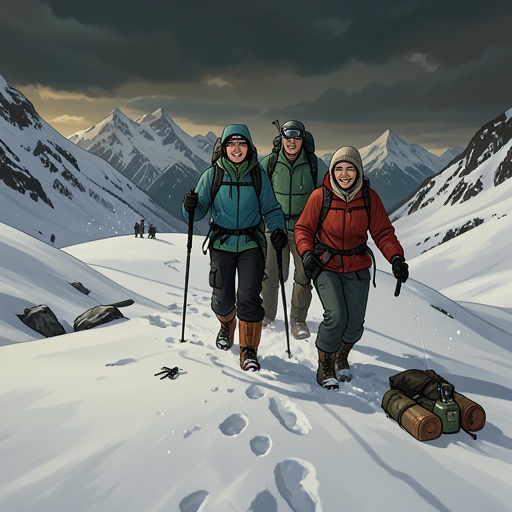
The journey to Madlener-Haus began with a long trip up the valley and an overnight stay at an old inn. Before daylight, the party ate breakfast, shouldered its skis, and started climbing under bright stars. This approach makes the hut part of a sequence rather than an isolated landmark: travel through the valley, a night’s rest, then the dark ascent toward the glacier.
The Climb and Its Labor
The climb included a steep, particularly difficult section. The narrator recalls that it became easier on the second attempt and eventually could be made easily while carrying twice the original load. That change gives the route a measure of acquired strength: the mountain remains demanding, but repeated passage alters what the body can manage.
Porters carried heavy loads on short skis. At the hut, they set their loads against its stone wall, asked for more money than had been agreed, and left after reaching a compromise, skiing rapidly down the mountain. Their work reveals the practical costs behind the party’s access to the high country, while the narrator’s recollection of competing over pack weights contrasts the climbers’ chosen test with the porters’ paid labor.
Part of a Winter Practice
The hut belonged to a broader pattern of winter life in Schruns, where the family stayed from around Thanksgiving until nearly Easter. Under Walther Lent’s Alpine skiing instruction, pupils were taken off practice slopes and into high-mountain trips. Lent’s ideal was to travel across high passes and glaciers from one hut to another, seeking untracked snow and avoiding bindings that could keep a ski attached in a fall and break a leg.
Climbing was not merely the price of reaching a descent. The party set a pace below its maximum, carried heavy rucksacks, and built the strength needed for the skiing it hoped to do. By spring, the season’s accumulated effort made possible a long, straight run over glacier snow. The account presents that exhilaration as something that could not be bought with a lift ticket: it was the end point of the work done throughout the winter.
Place in the Recollection
Madlener-Haus helps give the mountain winter its physical geography. Its stone wall, glacier-side shelf, difficult approach, and porters’ departure make the high Alps a place of shelter and human effort, not simply scenery. The hut also belongs to a period remembered as happy and comparatively innocent, before new arrivals changed the family’s life. The narrator later says that the family never returned to Vorarlberg; the remembered climbs to Madlener-Haus therefore remain part of a closed chapter, preserved through the effort and pleasure of getting there.