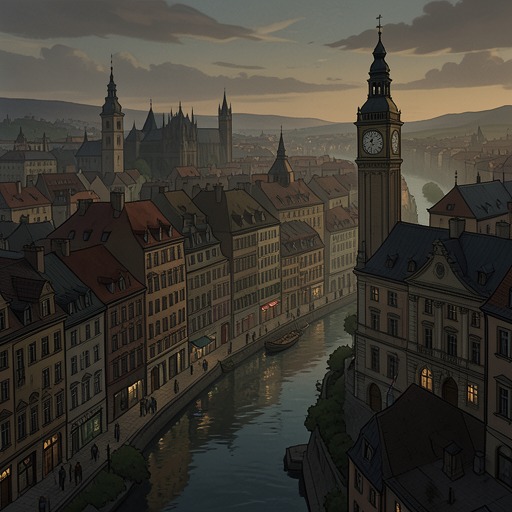
Paris is a moveable feast
A Moveable FeastParis is a moveable feast is Ernest Hemingway’s expression for the way a city lived in youth can remain present long after a person leaves it. Dedicated to a friend in 1950, it makes Paris both a particular place and a durable inward experience: not an unchanging idyll, but a city remembered through its streets, weather, work, appetite, and intimate routines.
Meaning and Dedication
The dedication states the expression’s central claim: a young person fortunate enough to have lived in Paris carries it through the rest of life, wherever later journeys lead. The feast is therefore not limited to food or to a single celebration. It suggests an abundance of experience that can be revisited in memory, though the book makes clear that this abundance included cold rooms, financial constraint, and days when hunger sharpened perception as much as it caused discomfort.
The phrase’s mobility is emotional and imaginative as well as geographical. Paris can be left, recalled, and entered again through the act of telling. The city is not preserved as a static picture; its meaning changes with the narrator’s circumstances, from winter rain and scarce money to the concentration of writing or the pleasure of a shared meal. Its persistence comes from that accumulation of particular experiences.
A City Encountered on Foot
Walking provides one of the narrator’s ordinary ways of knowing Paris. After work, or when trying to think something through, he walks along the quays. At the head of the Île de la Cité, below the Pont Neuf, he watches fishermen in a small park beneath large chestnut trees. The useful fishing spots shift with the height of the Seine; the fishermen use jointed cane poles, fine leaders, light tackle, quill floats, and carefully baited water. Their catches of Goujon are not a picturesque invention for visitors but food that can be fried whole and eaten bones and all.
The narrator sometimes buys wine, bread, and sausage, sits in the sun with a book, and watches the fishing between the Île Saint-Louis and the Place du Vert-Galant. He objects to travel writers who portray the fishermen as foolish men who never catch anything: many are pensioners or workers fishing on a day or half-day off, and their fishing is serious and productive. He does not take it up himself. He lacks the tackle, wants to save money to fish in Spain, and cannot know when work or travel will take him away. His attention to the fishermen lets the city’s everyday labor and recreation become part of his experience without pretending that he is free of time and money constraints.
The city is also registered through movement between streets and places of shelter. In winter, the first cold rains erase the visible tops of the white houses, darken the streets, and close the small shops. The narrator rents a room on the top floor of the hotel where Verlaine died; heating it would require several kinds of fuel, and he fears that a cold chimney might fill the room with smoke and waste the money. Rather than risk the fire, he walks through the rain past the Lycée Henri Quatre, the church of St.-Étienne-du-Mont, and the Place du Panthéon, eventually reaching a familiar café on the Place Saint-Michel. The remembered city includes not only destinations but the calculations that shape a route.
Poverty, Appetite, and Perception
Hunger changes what the narrator sees. When he has given up journalism and is writing work that no one in America will buy, he sometimes goes to the Jardin du Luxembourg because its walk offers no food to look at or smell. In the Musée du Luxembourg, the paintings seem clearer and more beautiful when he is hollow with hunger; he feels he understands Cézanne’s landscapes better. The thought that Cézanne may have painted hungry comes to him as an illuminating but possibly unsound speculation, and he later imagines that the painter’s hunger may have been of another kind. The episode makes deprivation part of the narrator’s way of looking, without turning it into a simple virtue.
His own self-reproach makes the material limits explicit. After complaining, he thinks he should have bought bread rather than skipped a meal, remembers that he could have borrowed money from Sylvia, and recognizes that he chose his work freely. He calls hunger healthy and the pictures better in its presence, but eating remains a pleasure, not an enemy of art. At Lipp's, he orders a liter of cold beer and potato salad, then another serving with cervelas. He eats slowly, mopping up olive oil and mustard sauce with bread, and finishes with a smaller beer. The detailed meal reverses the earlier deprivation: bodily appetite restores pleasure to a day otherwise shaped by self-criticism and restraint.
Poverty also shapes domestic life without defining the couple as they understand themselves. The narrator recalls that his wife did not complain about lacking a bathtub, shower, or flushing toilet, and did not cry over money when a horse fell. He regrets having been slow to appreciate the grey lamb jacket she wanted, and remembers how the couple fought poverty by not spending, sometimes buying pictures instead of clothes. They wore sweatshirts as underwear to keep warm, yet ate and drank well for little, slept warmly together, and did not think of themselves as poor. In one evening’s plan, they will eat at home, drink inexpensive Beaune, read, and go to bed together; the modest meal is inseparable from their confidence in their shared life.
Work and the Return to the City
Paris is also a working environment whose streets connect thought to practice. After deciding that he must eventually write a novel, the narrator refuses to begin one merely because regular meals depend on it. Instead, he will write a long story about what he knows best. He walks home by a route chosen for speed, passing from the rue Bonaparte to the rue Guynemer and the rue Notre-Dame-des-Champs, then goes to the Closerie des Lilas. The city’s geography serves a practical discipline: there is no need to solve every question about subject matter before returning to the place where work can begin.
At the café, he sits in a corner with afternoon light over his shoulder, drinks half a café crème, and writes in his notebook. The story concerns a man coming back from the war, but the war itself is not mentioned. The narrator wants to remain with the river in the story, where trout move in a pool beside the piles of a bridge. He leaves the work unfinished for the night because the river and country still have to be made; in the morning he will return to them. The remembered city thus includes the repeated movement between streets, café, notebook, and the next day’s labor.
Completion brings its own brief emptiness. After finishing a story in a café, the narrator closes the notebook, puts it in his inside pocket, and orders a dozen portugaises and half a carafe of dry white wine. He feels both sad and happy, as after making love, and believes the story is good, though he will not know its quality until rereading it the next day. The oysters and wine restore him from the emptied feeling and allow him to make plans. Paris becomes memorable through this sequence of work, exhaustion, eating, and renewed intention—not through a separation of artistic life from bodily need.
Intimacy, Movement, and Lasting Memory
The city’s pleasures are often shared. In the narrator’s imagined winter escape, the rain of Paris would become snow falling through pines near Les Avants; a modest pension, books, warmth, and an open window under the stars promise time together. Third-class train travel is affordable, and the pension costs little more than staying in Paris. The plan turns departure into a continuation of the couple’s life rather than an escape from it: the desired change of landscape is valued for the companionship and routine it makes possible.
Actual travel is less orderly. In late spring, the narrator agrees to go with Scott to Lyon to recover the small Renault that Scott and Zelda had abandoned because of bad weather. They plan to take the morning express, collect the car, and drive back toward Paris. At the Gare de Lyon, Scott does not arrive with the tickets; the narrator boards alone, pays for a second-class ticket, and wires the hotel address from Dijon. The episode shows movement subject to missed meetings, expense, and uncertainty. It does not diminish the expression’s claim that Paris travels in memory; instead, it gives that claim a practical counterpoint, distinguishing the city carried inwardly from the journeys that may or may not go as planned.
Across these scenes, Paris is neither merely a backdrop nor a permanently happy place. Rain can darken it, poverty can govern a meal, and work can demand that its streets be crossed on the quickest route. Yet a fishing spot, a café table, a shared inexpensive dinner, or the return to a notebook gives the city forms that can be carried forward. The expression names the lasting presence of those lived particulars: Paris remains available to memory because it was made from days and actions, not from an ideal image alone.