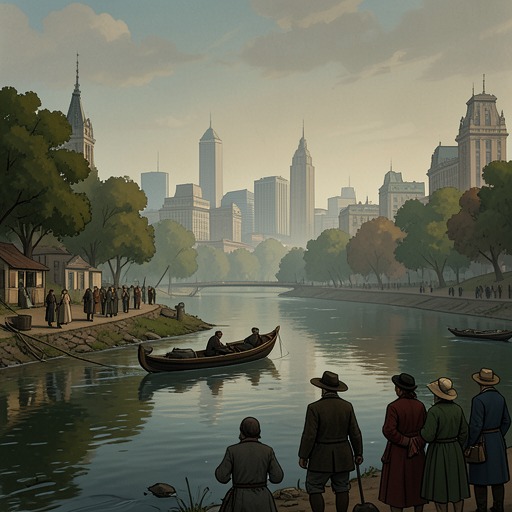
Pont Neuf
A Moveable FeastPont Neuf is remembered as more than a landmark: at the point of Île de la Cité, it opens onto a small riverside park where the Seine’s currents support a quiet, productive world of fishing. In the narrator’s Paris, the bridge is part of a daily landscape read on foot, where watching other people at work can be as absorbing as working at a desk.
Setting and Riverbank
Below Pont Neuf, Île de la Cité narrows to a sharp point, likened to the bow of a ship. A small park at the water’s edge, shaded by large, spreading chestnut trees, lies below a stairway. The Seine’s currents and backwaters make good fishing places there, though the best spots shift with the river’s height. The description makes the riverbank a changing, practical environment rather than a fixed scenic view.
Fishing and Everyday Life
The fishermen use long, jointed cane poles, fine leaders, light tackle, and quill floats, baiting carefully for the stretch of water they have chosen. They catch fish regularly, sometimes making substantial catches of Goujon, which are fried whole and eaten bones and all. The narrator follows this fishing between Île Saint-Louis and Place du Vert-Galant, and on bright days buys wine, bread, and sausage, sits in the sun with a book, and watches.
This attention also corrects the impression left by travel writers, who portray the Seine’s fishermen as foolish men who catch nothing. The fishing is serious and productive. Some fishermen are living on small pensions that inflation will later make worthless; others are keen anglers fitting it around a day or half-day off work. The narrator does not join them: he lacks the tackle, prefers to save his money for fishing in Spain, and cannot know when work or travel will take him away. Still, their presence in the city pleases him, as does the fact that they can carry a few fritures home to their families.
Walking, Attention, and Writing
The river belongs to the narrator’s habit of walking after work or when trying to think something through. He finds it easier to think while moving or watching people absorbed in an activity they understand. The fishermen, with their changing positions and practiced equipment, offer not merely a view but a form of concentrated work to observe. On the Île Saint-Louis, a good friture is available without traveling farther; when the household has money for an excursion, an open-air restaurant over the river at Bas Meudon offers another way to eat Goujon.
Elsewhere, the memoir carries the conjunction of river, bridge, and composition into a writing episode at the Closerie des Lilas: the narrator is working on a story about returning from war, yet his attention remains with trout in a pool and the resistance of the bridge’s piles. The bridge imagery links the observed city to the work of making a story, while Pont Neuf itself remains grounded in the book’s particular scene of walking, watching, and the river’s everyday livelihood.